Spring Sale Special Limited Time 70% Discount Offer - Ends in 0d 00h 00m 00s - Coupon code: buysanta

Exact2Pass Menu

Security, Professional (JNCIP-SEC)

Last Update 12 hours ago Total Questions : 115

The Security, Professional (JNCIP-SEC) content is now fully updated, with all current exam questions added 12 hours ago. Deciding to include JN0-637 practice exam questions in your study plan goes far beyond basic test preparation.

You'll find that our JN0-637 exam questions frequently feature detailed scenarios and practical problem-solving exercises that directly mirror industry challenges. Engaging with these JN0-637 sample sets allows you to effectively manage your time and pace yourself, giving you the ability to finish any Security, Professional (JNCIP-SEC) practice test comfortably within the allotted time.

Question # 21

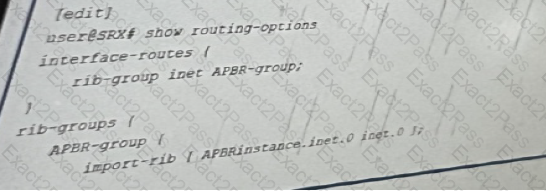
You are configuring advanced policy-based routing. You have created a static route with next

hop of an interface in your inet.0 routing table
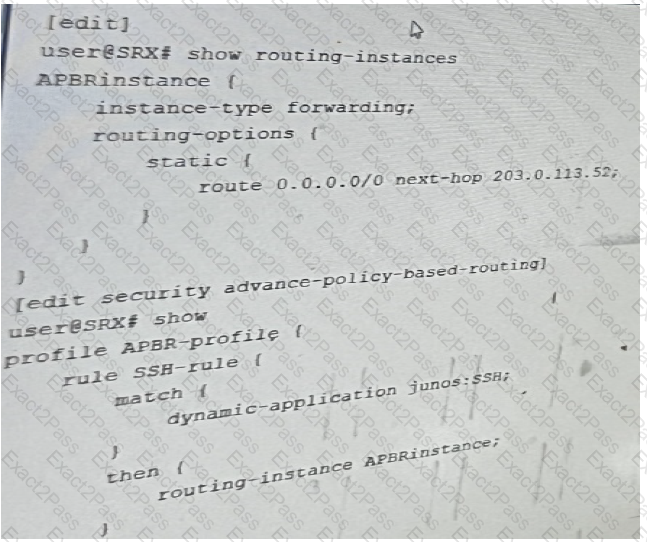
Referring to the exhibit, what should be changed to solve this issue?

A.

You should change the routing instance type to virtual-router.

B.

You should move the static route configuration to the main routing instance.

C.

You should move the inet. o table before the routing instance table in your rib-groups configuration.

D.

You should delete the interface-routes configuration under the routing-options hierarchy.

Question # 22

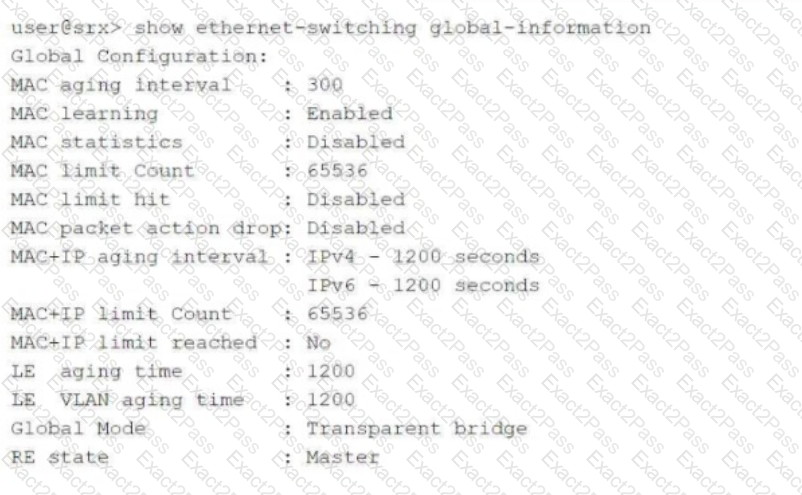
Click the Exhibit button.

Referring to the exhibit, which two statements are correct? (Choose two.)

A.

You cannot secure intra-VLAN traffic with a security policy on this device.

B.

You can secure inter-VLAN traffic with a security policy on this device.

C.

The device can pass Layer 2 and Layer 3 traffic at the same time.

D.

The device cannot pass Layer 2 and Layer 3 traffic at the same time.

Question # 23

Which two statements about policy enforcer and the forescout integration are true? (Choose two)

A.

802.1X authenticated devices are supported.

B.

802.1X authenticated devices are not supported.

C.

A Forescout CounterACT agent must be installed on third-party devices

D.

A Forescout CounterACT agent is agentless and does not need to be installed on third-party device

Question # 24

Which role does an SRX Series device play in a DS-Lite deployment?

A.

Softwire concentrator

B.

STUN server

C.

STUN client

D.

Softwire initiator

Question # 25

You have deployed automated threat mitigation using Security Director with Policy Enforcer, Juniper ATP Cloud, SRX Series devices, and EX Series switches.

In this scenario, which device is responsible for blocking the infected hosts?

A.

Policy Enforcer

B.

Security Director

C.

Juniper ATP Cloud

D.

EX Series switch

Question # 26

Which two statements are true when setting up an SRX Series device to operate in mixed mode? (Choose two.)

A.

A physical interface can be configured to be both a Layer 2 and a Layer 3 interface at the same time.

B.

User logical systems support Layer 2 traffic processing.

C.

The SRX must be rebooted after configuring at least one Layer 3 and one Layer 2 interface.

D.

Packets from Layer 2 interfaces are switched within the same bridge domain.

Question # 27

The SRX series device is performing static NAT. you want to ensure that host A can reach the

internal webserver www.juniper.net using domain name.
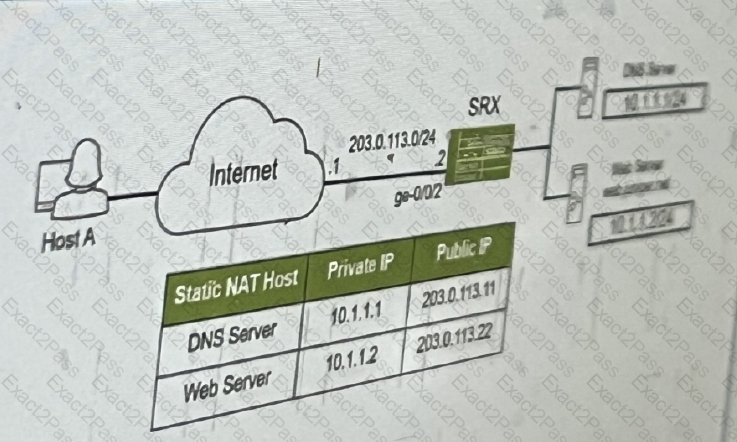
Referring to the exhibit, which two Junos features are required to accomplish this task? (Choose two.)

A.

DNS doctoring

B.

proxy ARP

C.

persistent NAT

D.

STUN

Question # 28

A company has acquired a new branch office that has the same address space of one of its local networks, 192.168.100/24. The offices need to communicate with each other.

Which two NAT configurations will satisfy this requirement? (Choose two.)

A.

[edit security nat source]

user@OfficeA# show rule-set OfficeBtoA {

from zone OfficeB;

to zone OfficeA;

rule 1 {

match {

source-address 192.168.210.0/24;

destination-address 192.168.200.0/24;

}

then {

source-nat {

interface;

}

}

}

}

B.

[edit security nat static]

user@OfficeA# show rule-set From-Office-B {

from interface ge-0/0/0.0;

rule 1 {

match {

destination-address 192.168.200.0/24;

}

then {

static-nat {

prefix 192.168.100.0/24;

}

}

}

}

C.

[edit security nat static]

user@OfficeB# show rule-set From-Office-A {

from interface ge-0/0/0.0;

rule 1 {

match {

destination-address 192.168.210.0/24;

}

then {

static-nat {

prefix 192.168.100.0/24;

}

}

}

}

D.

[edit security nat source]

user@OfficeB# show rule-set OfficeAtoB {

from zone OfficeA;

to zone OfficeB;

rule 1 {

match {

source-address 192.168.200.0/24;

destination-address 192.168.210.0/24;

}

then {

source-nat {

interface;

}

}

}

}

Question # 29

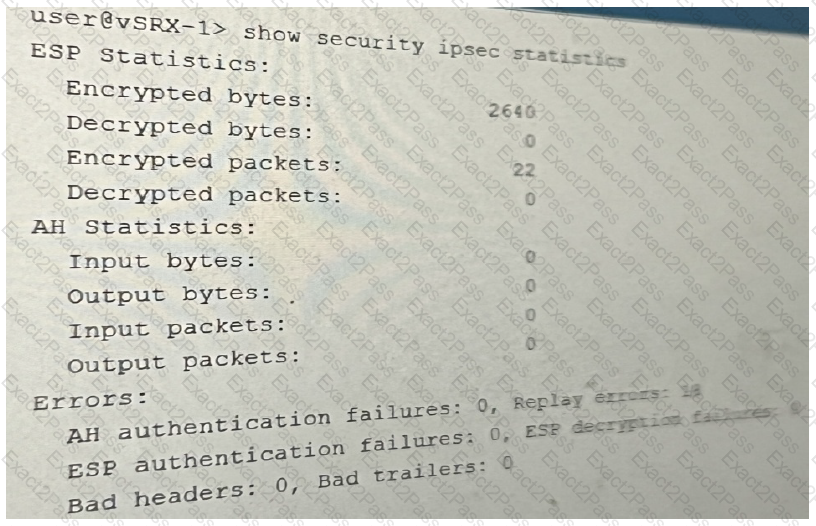
Referring to the exhibit, which two statements are true ?
A.

Every VPN packet that the SRX receives from the VPN peer is outside the ESP sequence window

B.

The SRX is sending traffic into the tunnel and out toward the VPN peer.

C.

The SRX is not sending any packets to the VPN peer.

D.

The SRX is not receiving any packets from the VPN peer.

Question # 30

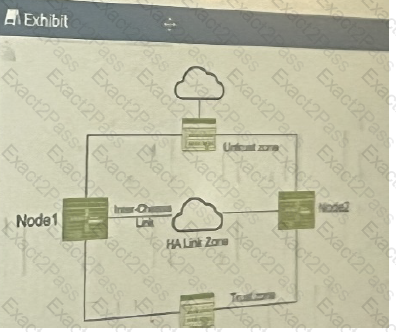
Exhibit:

You have deployed a pair of SRX series devices in a multimode HA environment. You need to enable IPsec encryption on the interchassis link.

Referring to the exhibit, which three steps are required to enable ICL encryption? (Choose three.)


A.

Install the Junos IKE package on both nodes.

B.

Enable OSPF for both interchassis link interfaces and tum on the dynamic-neighbors parameter.

C.

Configure a VPN profile for the HA traffic and apply to both nodes.

D.

Enable HA link encryption in the IPsec profile on both nodes.

E.

Enable HA link encryption in the IKE profile on both nodes,

Go to page: