Exact2Pass

Last Update 20 hours ago Total Questions : 273
The MuleSoft Certified Integration Architect - Level 1 content is now fully updated, with all current exam questions added 20 hours ago. Deciding to include MCIA-Level-1 practice exam questions in your study plan goes far beyond basic test preparation.
You'll find that our MCIA-Level-1 exam questions frequently feature detailed scenarios and practical problem-solving exercises that directly mirror industry challenges. Engaging with these MCIA-Level-1 sample sets allows you to effectively manage your time and pace yourself, giving you the ability to finish any MuleSoft Certified Integration Architect - Level 1 practice test comfortably within the allotted time.
An organization is designing an integration solution to replicate financial transaction data from a legacy system into a data warehouse (DWH).
The DWH must contain a daily snapshot of financial transactions, to be delivered as a CSV file. Daily transaction volume exceeds tens of millions of records, with significant spikes in volume during popular shopping periods.
What is the most appropriate integration style for an integration solution that meets the organization ' s current requirements?
As a part of project , existing java implementation is being migrated to Mulesoft. Business is very tight on the budget and wish to complete the project in most economical way possible.
Canonical object model using java is already a part of existing implementation. Same object model is required by mule application for a business use case. What is the best way to achieve this?
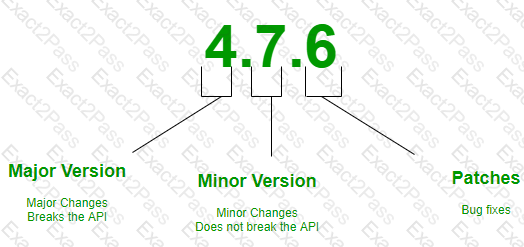
An API has been updated in Anypoint Exchange by its API producer from version 3.1.1 to 3.2.0 following accepted semantic versioning practices and the changes have been communicated via the API ' s public portal. The API endpoint does NOT change in the new version. How should the developer of an API client respond to this change?
A finance giant is planning to migrate all its Mule applications to Runtime fabric (RTF). Currently all Mule applications are deployed cloud hub using automated CI/CD scripts.
As an integration architect, which of the below step would you suggest to ensure that the applications from cloudhub are migrated properly to Runtime Fabric (RTF) with an assumption that organization is keen on keeping the same deployment strategy.
An integration architect is designing an API that must accept requests from API clients for both XML and JSON content over HTTP/1.1 by default.
Which API architectural style, when used for its intended and typical purposes, should the architect choose to meet these requirements?
A large life sciences customer plans to use the Mule Tracing module with the Mapped Diagnostic Context (MDC) logging operations to enrich logging in its Mule application and to improve tracking by providing more context in the Mule application logs. The customer also wants to improve throughput and lower the message processing latency in its Mule application flows.
After installing the Mule Tracing module in the Mule application, how should logging be performed in flows in Mule applications, and what should be changed In the log4j2.xml files?
Refer to the exhibit.
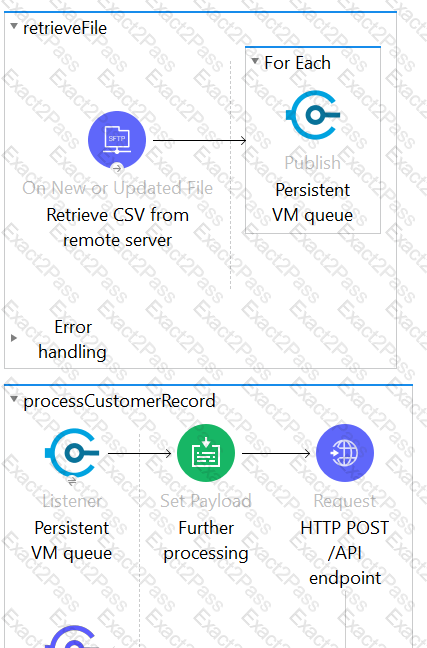
This Mule application is deployed to multiple Cloudhub workers with persistent queue enabled. The retrievefile flow event source reads a CSV file from a remote SFTP server and then publishes each record in the CSV file to a VM queue. The processCustomerRecords flow’s VM Listner receives messages from the same VM queue and then processes each message separately.
How are messages routed to the cloudhub workers as messages are received by the VM Listener?
An organization is designing the following two Mule applications that must share data via a common persistent object store instance:
- Mule application P will be deployed within their on-premises datacenter.
- Mule application C will run on CloudHub in an Anypoint VPC.
The object store implementation used by CloudHub is the Anypoint Object Store v2 (OSv2).
what type of object store(s) should be used, and what design gives both Mule applications access to the same object store instance?
A system API EmployeeSAPI is used to fetch employee ' s data from an underlying SQL database.
The architect must design a caching strategy to query the database only when there is an update to the employees stable or else return a cached response in order to minimize the number of redundant transactions being handled by the database.
What must the architect do to achieve the caching objective?
In Anypoint Platform, a company wants to configure multiple identity providers(Idps) for various lines of business (LOBs) Multiple business groups and environments have been defined for the these LOBs. What Anypoint Platform feature can use multiple Idps access the company’s business groups and environment?


 Diagram
Description automatically generated
Diagram
Description automatically generated