Exact2Pass

Last Update 20 hours ago Total Questions : 273
The MuleSoft Certified Integration Architect - Level 1 content is now fully updated, with all current exam questions added 20 hours ago. Deciding to include MCIA-Level-1 practice exam questions in your study plan goes far beyond basic test preparation.
You'll find that our MCIA-Level-1 exam questions frequently feature detailed scenarios and practical problem-solving exercises that directly mirror industry challenges. Engaging with these MCIA-Level-1 sample sets allows you to effectively manage your time and pace yourself, giving you the ability to finish any MuleSoft Certified Integration Architect - Level 1 practice test comfortably within the allotted time.
A mule application is being designed to perform product orchestration. The Mule application needs to join together the responses from an inventory API and a Product Sales History API with the least latency.
To minimize the overall latency. What is the most idiomatic (used for its intended purpose) design to call each API request in the Mule application?
According to MuleSoft, a synchronous invocation of a RESTful API using HTTP to get an individual customer record from a single system is an example of which system integration interaction pattern?
A company is planning to migrate its deployment environment from on-premises cluster to a Runtime Fabric (RTF) cluster. It also has a requirement to enable Mule applications deployed to a Mule runtime instance to store and share data across application replicas and restarts.
How can these requirements be met?
A stock trading company handles millions of trades a day and requires excellent performance and reliability within its stock trading system. The company operates a number of event-driven APIs Implemented as Mule applications that are hosted on various customer-hosted Mule clusters and needs to enable message exchanges between the APIs within their internal network using shared message queues.
What is an effective way to meet the cross-cluster messaging requirements of its event-driven APIs?
Which key DevOps practice and associated Anypoint Platform component should a MuteSoft integration team adopt to improve delivery quality?
A manufacturing company is planning to deploy Mule applications to its own Azure Kubernetes Service infrastructure.
The organization wants to make the Mule applications more available and robust by deploying each Mule application to an isolated Mule runtime in a Docker container while managing all the Mule applications from the MuleSoft-hosted control plane.
What is the most idiomatic (used for its intended purpose) choice of runtime plane to meet these organizational requirements?
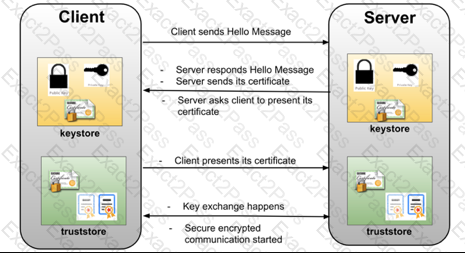
What requires configuration of both a key store and a trust store for an HTTP Listener?
A manufacturing company plans to deploy Mule applications to its own
Azure Kubernetes service infrastructure.The organization wants to make
the Mule applications more available and robust by deploying each Mule
application to an isolated Mule runtime in a Docker container while
managing all the Mule applications from the MuleSoft-hosted control plane.
What choice of runtime plane meets these organizational requirements?
Which role is primarily responsible for building API implementation as part of a typical MuleSoft integration project?
As a part of project requirement, Java Invoke static connector in a mule 4 application needs to invoke a static method in a dependency jar file. What are two ways to add the dependency to be visible by the connectors class loader?
(Choose two answers)