Spring Sale Special Limited Time 70% Discount Offer - Ends in 0d 00h 00m 00s - Coupon code: buysanta

Exact2Pass Menu

MuleSoft Certified Integration Architect - Level 1

Last Update 4 hours ago Total Questions : 273

The MuleSoft Certified Integration Architect - Level 1 content is now fully updated, with all current exam questions added 4 hours ago. Deciding to include MCIA-Level-1 practice exam questions in your study plan goes far beyond basic test preparation.

You'll find that our MCIA-Level-1 exam questions frequently feature detailed scenarios and practical problem-solving exercises that directly mirror industry challenges. Engaging with these MCIA-Level-1 sample sets allows you to effectively manage your time and pace yourself, giving you the ability to finish any MuleSoft Certified Integration Architect - Level 1 practice test comfortably within the allotted time.

Question # 51

An organization is not meeting its growth and innovation objectives because IT cannot deliver projects last enough to keep up with the pace of change required by the business.

According to MuleSoft’s IT delivery and operating model, which step should the organization lake to solve this problem?

A.

Modify IT governance and security controls so that line of business developers can have direct access to the organization ' s systems of record

B.

Switch from a design-first to a code-first approach for IT development

C.

Adopt a new approach that decouples core IT projects from the innovation that happens within each line of business

D.

Hire more |T developers, architects, and project managers to increase IT delivery

Question # 52

A retail company is implementing a MuleSoft API to get inventory details from two vendors by Invoking each vendor ' s online applications. Due to network issues, the invocations to the vendor applications are timing out intermittently, but the requests are successful after re-invoking each

vendor application.

What is the most performant way of implementing the API to invoke each vendor application and to retry invocations that generate timeout errors?

A.

Use a For-Each scope to invoke the two vendor applications in series, one after the other.

Place the For-Each scope inside an Until-Successful scope to retry requests that raise timeout errors.

B.

Use a Choice scope to Invoke each vendor application on a separate route.

Place the Choice scope inside an Until-Successful scope to retry requests that raise

timeout errors.

C.

Use a Scatter-Gather scope to invoke each vendor application on a separate route.

Use an Until-Successful scope in each route to retry requests that raise timeout errors.

D.

Use a Round-Robin scope to invoke each vendor application on a separate route.

Use a Try-Catch scope in each route to retry requests that raise timeout errors.

Question # 53

An organization uses one specific CloudHub (AWS) region for all CloudHub deployments. How are CloudHub workers assigned to availability zones (AZs) when the organization ' s Mule applications are deployed to CloudHub in that region?

A.

Workers belonging to a given environment are assigned to the same AZ within that region.

B.

AZs are selected as part of the Mule application ' s deployment configuration.

C.

Workers are randomly distributed across available AZs within that region.

D.

An AZ is randomly selected for a Mule application, and all the Mule application ' s CloudHub workers are assigned to that one AZ

Question # 54

An organization is creating a set of new services that are critical for their business. The project team prefers using REST for all services but is willing to use SOAP with common WS- " standards if a particular service requires it.

What requirement would drive the team to use SOAP/WS-* for a particular service?

A.

Must use XML payloads for the service and ensure that it adheres to a specific schema

B.

Must publish and share the service specification (including data formats) with the consumers of the service

C.

Must support message acknowledgement and retry as part of the protocol

D.

Must secure the service, requiring all consumers to submit a valid SAML token

Question # 55

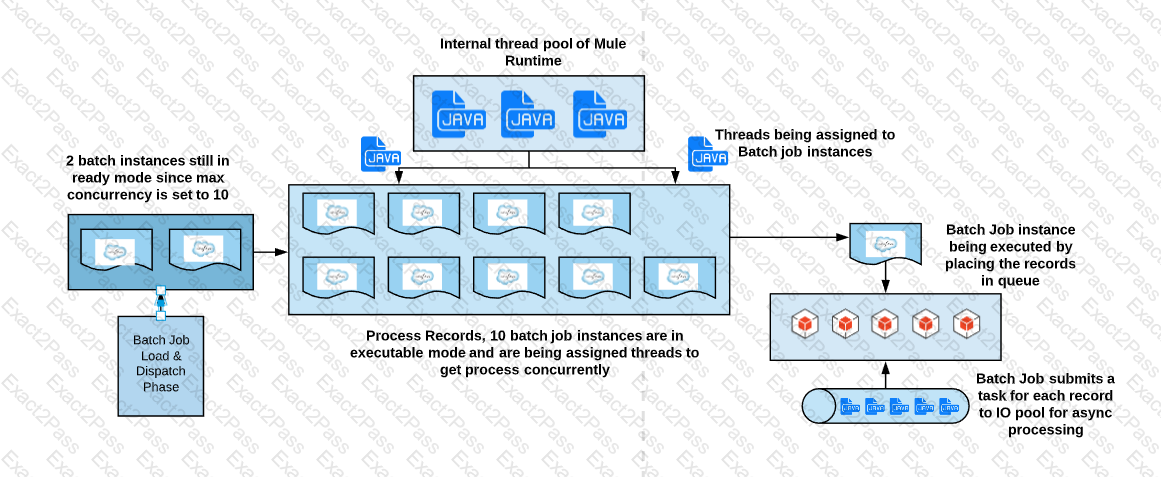
A Mule application contains a Batch Job with two Batch Steps (Batch_Step_l and Batch_Step_2). A payload with 1000 records is received by the Batch Job.

How many threads are used by the Batch Job to process records, and how does each Batch Step process records within the Batch Job?

A.

Each Batch Job uses SEVERAL THREADS for the Batch Steps Each Batch Step instance receives ONE record at a time as the payload, and RECORDS are processed IN PARALLEL within and between the two Batch Steps

B.

Each Batch Job uses a SINGLE THREAD for all Batch steps Each Batch step instance receives ONE record at a time as the payload, and RECORDS are processed IN ORDER, first through Batch_Step_l and then through Batch_Step_2

C.

Each Batch Job uses a SINGLE THREAD to process a configured block size of record Each Batch Step instance receives A BLOCK OF records as the payload, and BLOCKS of records are processed IN ORDER

D.

Each Batch Job uses SEVERAL THREADS for the Batch Steps Each Batch Step instance receives ONE record at a time as the payload, and BATCH STEP INSTANCES execute IN PARALLEL to process records and Batch Steps in ANY order as fast as possible

Question # 56

What aspects of a CI/CD pipeline for Mute applications can be automated using MuleSoft-provided Maven plugins?

A.

Compile, package, unit test, deploy, create associated API instances in API Manager

B Import from API designer, compile, package, unit test, deploy, publish to Am/point Exchange

B.

Compile, package, unit test, validate unit test coverage, deploy

C.

Compile, package, unit test, deploy, integration test

Question # 57

According to MuleSoft, what is a major distinguishing characteristic of an application network in relation to the integration of systems, data, and devices?

A.

It uses a well-organized monolithic approach with standards

B.

It is built for change and self-service

C.

It leverages well-accepted internet standards like HTTP and JSON

D.

It uses CI/CD automation for real-time project delivery

Question # 58

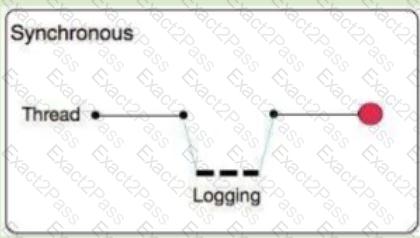
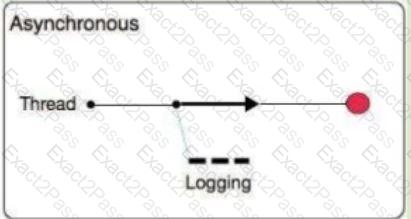
What is a key difference between synchronous and asynchronous logging from Mule applications?

A.

Synchronous logging writes log messages in a single logging thread but does not block the Mule event being processed by the next event processor

B.

Asynchronous logging can improve Mule event processing throughput while also reducing the processing time for each Mule event

C.

Asynchronous logging produces more reliable audit trails with more accurate timestamps

D.

Synchronous logging within an ongoing transaction writes log messages in the same thread that processes the current Mule event

Question # 59

An organization ' s IT team follows an API-led connectivity approach and must use Anypoint Platform to implement a System AP\ that securely accesses customer data. The organization uses Salesforce as the system of record for all customer data, and its most important objective is to reduce the overall development time to release the System API.

The team ' s integration architect has identified four different approaches to access the customer data from within the implementation of the System API by using different Anypoint Connectors that all meet the technical requirements of the project.

A.

Use the Anypoint Connector for Database to connect to a MySQL database to access a copy of the customer data

B.

Use the Anypoint Connector for HTTP to connect to the Salesforce APIs to directly access the customer data

C.

Use the Anypoint Connector for Salesforce to connect to the Salesforce APIs to directly access the customer data

D.

Use the Anypoint Connector tor FTP to download a file containing a recent near-real time extract of the customer data

Question # 60

What best describes the Fully Qualified Domain Names (FQDNs), also known as DNS entries, created when a Mule application is deployed to the CloudHub Shared Worker Cloud?


A.

A fixed number of FQDNs are created, IRRESPECTIVE of the environment and VPC design

B.

The FQDNs are determined by the application name chosen, IRRESPECTIVE of the region

C.

The FQDNs are determined by the application name, but can be modified by an administrator after deployment

D.

The FQDNs are determined by both the application name and the region

Go to page: