Exact2Pass

Last Update 20 hours ago Total Questions : 273
The MuleSoft Certified Integration Architect - Level 1 content is now fully updated, with all current exam questions added 20 hours ago. Deciding to include MCIA-Level-1 practice exam questions in your study plan goes far beyond basic test preparation.
You'll find that our MCIA-Level-1 exam questions frequently feature detailed scenarios and practical problem-solving exercises that directly mirror industry challenges. Engaging with these MCIA-Level-1 sample sets allows you to effectively manage your time and pace yourself, giving you the ability to finish any MuleSoft Certified Integration Architect - Level 1 practice test comfortably within the allotted time.
Refer to the exhibit.
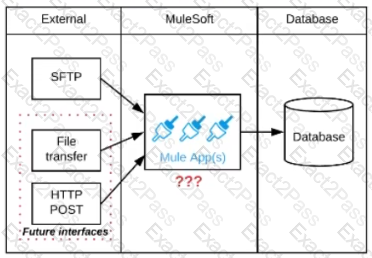
A business process involves the receipt of a file from an external vendor over SFTP. The file needs to be parsed and its content processed, validated, and ultimately persisted to a database. The delivery mechanism is expected to change in the future as more vendors send similar files using other mechanisms such as file transfer or HTTP POST.
What is the most effective way to design for these requirements in order to minimize the impact of future change?
When designing an upstream API and its implementation, the development team has been advised to not set timeouts when invoking downstream API. Because the downstream API has no SLA that can be relied upon. This is the only donwstream API dependency of that upstream API. Assume the downstream API runs uninterrupted without crashing. What is the impact of this advice?
An organization is sizing an Anypoint VPC to extend their internal network to Cloudhub.
For this sizing calculation, the organization assumes 150 Mule applications will be deployed among three(3) production environments and will use Cloudhub’s default zero-downtime feature. Each Mule application is expected to be configured with two(2) Cloudhub workers.This is expected to result in several Mule application deployments per hour.
Refer to the exhibit.
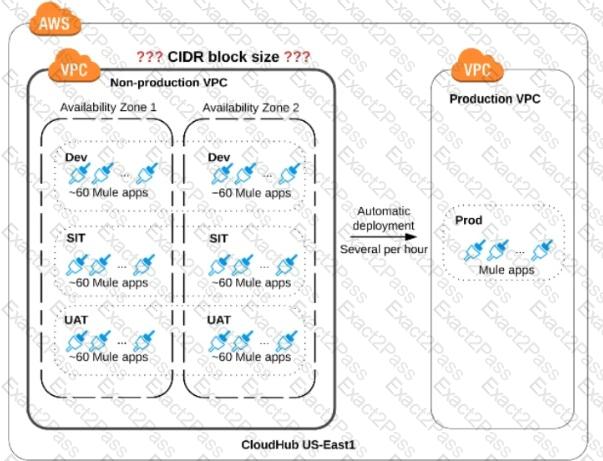
An organization is sizing an Anypoint VPC for the non-production deployments of those Mule applications that connect to the organization ' s on-premises systems. This applies to approx. 60 Mule applications. Each application is deployed to two CloudHub i workers. The organization currently has three non-production environments (DEV, SIT and UAT) that share this VPC. The AWS region of the VPC has two AZs.
The organization has a very mature DevOps approach which automatically progresses each application through all non-production environments before automatically deploying to production. This process results in several Mule application deployments per hour, using CloudHub ' s normal zero-downtime deployment feature.
What is a CIDR block for this VPC that results in the smallest usable private IP address range?
What is a defining characteristic of an integration-Platform-as-a-Service (iPaaS)?
A team has completed the build and test activities for a Mule application that implements a System API for its application network.
Which Anypoint Platform component should the team now use to both deploy and monitor the System AP\ implementation?
According to MuleSoft, which major benefit does a Center for Enablement (C4E) provide for an enterprise and its lines of business?
What is an advantage of using OAuth 2.0 client credentials and access tokens over only API keys for API authentication?
Refer to the exhibit.
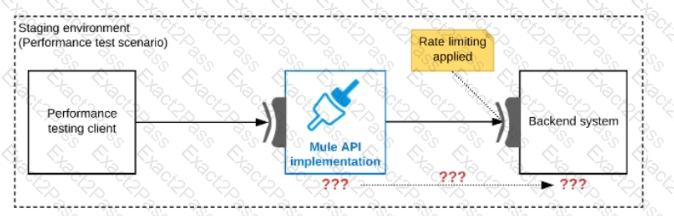
One of the backend systems invoked by an API implementation enforces rate limits on the number of requests a particular client can make. Both the backend system and the API implementation are deployed to several non-production environments in addition to production.
Rate limiting of the backend system applies to all non-production environments. The production environment, however, does NOT have any rate limiting.
What is the most effective approach to conduct performance tests of the API implementation in a staging (non-production) environment?
A Mule application name Pub uses a persistence object store. The Pub Mule application is deployed to Cloudhub and it configured to use Object Store v2.
Another Mule application name sub is being developed to retrieve values from the Pub Mule application persistence object Store and will also be deployed to cloudhub.
What is the most direct way for the Sub Mule application to retrieve values from the Pub Mule application persistence object store with the least latency?


 Diagram
Description automatically generated
Diagram
Description automatically generated