Exact2Pass

Last Update 20 hours ago Total Questions : 330
The AWS Certified Machine Learning - Specialty content is now fully updated, with all current exam questions added 20 hours ago. Deciding to include MLS-C01 practice exam questions in your study plan goes far beyond basic test preparation.
You'll find that our MLS-C01 exam questions frequently feature detailed scenarios and practical problem-solving exercises that directly mirror industry challenges. Engaging with these MLS-C01 sample sets allows you to effectively manage your time and pace yourself, giving you the ability to finish any AWS Certified Machine Learning - Specialty practice test comfortably within the allotted time.
A company ' s machine learning (ML) specialist is designing a scalable data storage solution for Amazon SageMaker. The company has an existing TensorFlow-based model that uses a train.py script. The model relies on static training data that is currently stored in TFRecord format.
What should the ML specialist do to provide the training data to SageMaker with the LEAST development overhead?
A Machine Learning Specialist observes several performance problems with the training portion of a machine learning solution on Amazon SageMaker The solution uses a large training dataset 2 TB in size and is using the SageMaker k-means algorithm The observed issues include the unacceptable length of time it takes before the training job launches and poor I/O throughput while training the model
What should the Specialist do to address the performance issues with the current solution?
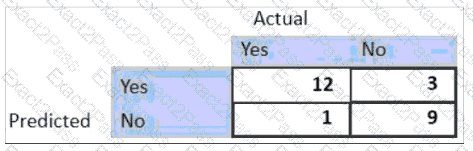
For the given confusion matrix, what is the recall and precision of the model?
A company wants to classify user behavior as either fraudulent or normal. Based on internal research, a Machine Learning Specialist would like to build a binary classifier based on two features: age of account and transaction month. The class distribution for these features is illustrated in the figure provided.
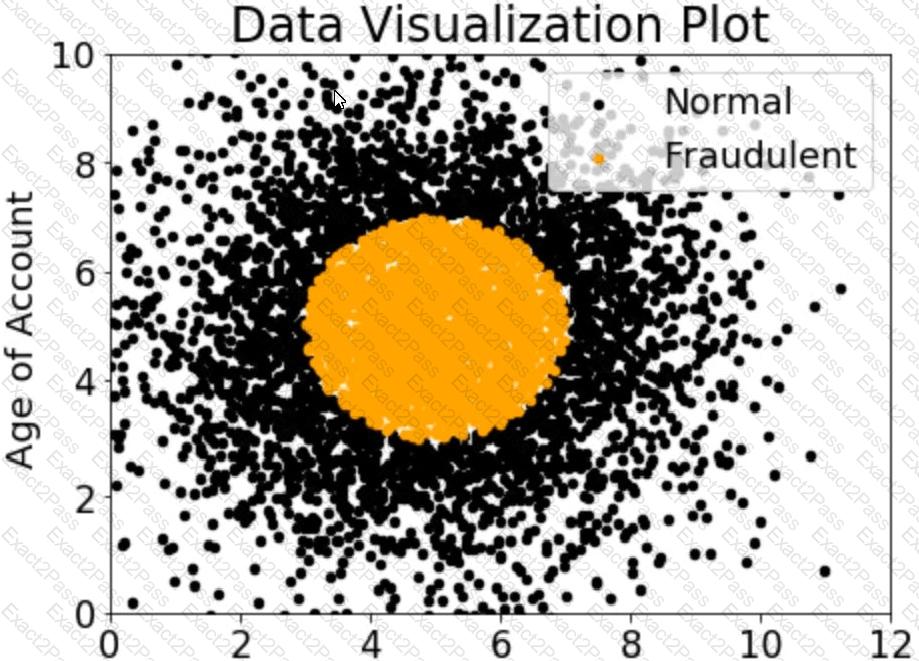
Based on this information which model would have the HIGHEST accuracy?
A Machine Learning Specialist is building a convolutional neural network (CNN) that will classify 10 types of animals. The Specialist has built a series of layers in a neural network that will take an input image of an animal, pass it through a series of convolutional and pooling layers, and then finally pass it through a dense and fully connected layer with 10 nodes The Specialist would like to get an output from the neural network that is a probability distribution of how likely it is that the input image belongs to each of the 10 classes
Which function will produce the desired output?
A manufacturing company wants to create a machine learning (ML) model to predict when equipment is likely to fail. A data science team already constructed a deep learning model by using TensorFlow and a custom Python script in a local environment. The company wants to use Amazon SageMaker to train the model.
Which TensorFlow estimator configuration will train the model MOST cost-effectively?
A data scientist uses an Amazon SageMaker notebook instance to conduct data exploration and analysis. This requires certain Python packages that are not natively available on Amazon SageMaker to be installed on the notebook instance.
How can a machine learning specialist ensure that required packages are automatically available on the notebook instance for the data scientist to use?
A data scientist is designing a repository that will contain many images of vehicles. The repository must scale automatically in size to store new images every day. The repository must support versioning of the images. The data scientist must implement a solution that maintains multiple immediately accessible copies of the data in different AWS Regions.
Which solution will meet these requirements?
A data scientist needs to identify fraudulent user accounts for a company ' s ecommerce platform. The company wants the ability to determine if a newly created account is associated with a previously known fraudulent user. The data scientist is using AWS Glue to cleanse the company ' s application logs during ingestion.
Which strategy will allow the data scientist to identify fraudulent accounts?
A manufacturer is operating a large number of factories with a complex supply chain relationship where unexpected downtime of a machine can cause production to stop at several factories. A data scientist wants to analyze sensor data from the factories to identify equipment in need of preemptive maintenance and then dispatch a service team to prevent unplanned downtime. The sensor readings from a single machine can include up to 200 data points including temperatures, voltages, vibrations, RPMs, and pressure readings.
To collect this sensor data, the manufacturer deployed Wi-Fi and LANs across the factories. Even though many factory locations do not have reliable or high-speed internet connectivity, the manufacturer would like to maintain near-real-time inference capabilities.
Which deployment architecture for the model will address these business requirements?

