
Spring Sale Special Limited Time 70% Discount Offer - Ends in 0d 00h 00m 00s - Coupon code: buysanta

Exact2Pass Menu

AWS Certified Machine Learning - Specialty

Last Update 12 hours ago Total Questions : 330

The AWS Certified Machine Learning - Specialty content is now fully updated, with all current exam questions added 12 hours ago. Deciding to include MLS-C01 practice exam questions in your study plan goes far beyond basic test preparation.

You'll find that our MLS-C01 exam questions frequently feature detailed scenarios and practical problem-solving exercises that directly mirror industry challenges. Engaging with these MLS-C01 sample sets allows you to effectively manage your time and pace yourself, giving you the ability to finish any AWS Certified Machine Learning - Specialty practice test comfortably within the allotted time.

Question # 31

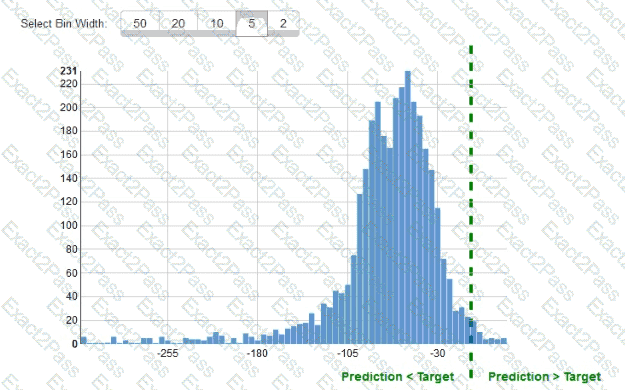
While reviewing the histogram for residuals on regression evaluation data a Machine Learning Specialist notices that the residuals do not form a zero-centered bell shape as shown What does this mean?
A.

The model might have prediction errors over a range of target values.

B.

The dataset cannot be accurately represented using the regression model

C.

There are too many variables in the model

D.

The model is predicting its target values perfectly.

Question # 32

A Machine Learning Specialist is implementing a full Bayesian network on a dataset that describes public transit in New York City. One of the random variables is discrete, and represents the number of minutes New Yorkers wait for a bus given that the buses cycle every 10 minutes, with a mean of 3 minutes.

Which prior probability distribution should the ML Specialist use for this variable?

A.

Poisson distribution ,

B.

Uniform distribution

C.

Normal distribution

D.

Binomial distribution

Question # 33

A Data Scientist is developing a binary classifier to predict whether a patient has a particular disease on a series of test results. The Data Scientist has data on 400 patients randomly selected from the population. The disease is seen in 3% of the population.

Which cross-validation strategy should the Data Scientist adopt?

A.

A k-fold cross-validation strategy with k=5

B.

A stratified k-fold cross-validation strategy with k=5

C.

A k-fold cross-validation strategy with k=5 and 3 repeats

D.

An 80/20 stratified split between training and validation

Question # 34

A trucking company is collecting live image data from its fleet of trucks across the globe. The data is growing rapidly and approximately 100 GB of new data is generated every day. The company wants to explore machine learning uses cases while ensuring the data is only accessible to specific IAM users.

Which storage option provides the most processing flexibility and will allow access control with IAM?

A.

Use a database, such as Amazon DynamoDB, to store the images, and set the IAM policies to restrict access to only the desired IAM users.

B.

Use an Amazon S3-backed data lake to store the raw images, and set up the permissions using bucket policies.

C.

Setup up Amazon EMR with Hadoop Distributed File System (HDFS) to store the files, and restrict access to the EMR instances using IAM policies.

D.

Configure Amazon EFS with IAM policies to make the data available to Amazon EC2 instances owned by the IAM users.

Question # 35

A sports analytics company is providing services at a marathon. Each runner in the marathon will have their race ID printed as text on the front of their shirt. The company needs to extract race IDs from images of the runners.

Which solution will meet these requirements with the LEAST operational overhead?

A.

Use Amazon Rekognition.

B.

Use a custom convolutional neural network (CNN).

C.

Use the Amazon SageMaker Object Detection algorithm.

D.

Use Amazon Lookout for Vision.

Question # 36

A machine learning (ML) specialist is developing a model for a company. The model will classify and predict sequences of objects that are displayed in a video. The ML specialist decides to use a hybrid architecture that consists of a convolutional neural network (CNN) followed by a classifier three-layer recurrent neural network (RNN).

The company developed a similar model previously but trained the model to classify a different set of objects. The ML specialist wants to save time by using the previously trained model and adapting the model for the current use case and set of objects.

Which combination of steps will accomplish this goal with the LEAST amount of effort? (Select TWO.)

A.

Reinitialize the weights of the entire CNN. Retrain the CNN on the classification task by using the new set of objects.

B.

Reinitialize the weights of the entire network. Retrain the entire network on the prediction task by using the new set of objects.

C.

Reinitialize the weights of the entire RNN. Retrain the entire model on the prediction task by using the new set of objects.

D.

Reinitialize the weights of the last fully connected layer of the CNN. Retrain the CNN on the classification task by using the new set of objects.

E.

Reinitialize the weights of the last layer of the RNN. Retrain the entire model on the prediction task by using the new set of objects.

Question # 37

A data scientist wants to use Amazon Forecast to build a forecasting model for inventory demand for a retail company. The company has provided a dataset of historic inventory demand for its products as a .csv file stored in an Amazon S3 bucket. The table below shows a sample of the dataset.

How should the data scientist transform the data?

A.

Use ETL jobs in AWS Glue to separate the dataset into a target time series dataset and an item metadata dataset. Upload both datasets as .csv files to Amazon S3.

B.

Use a Jupyter notebook in Amazon SageMaker to separate the dataset into a related time series dataset and an item metadata dataset. Upload both datasets as tables in Amazon Aurora.

C.

Use AWS Batch jobs to separate the dataset into a target time series dataset, a related time series dataset, and an item metadata dataset. Upload them directly to Forecast from a local machine.

D.

Use a Jupyter notebook in Amazon SageMaker to transform the data into the optimized protobuf recordIO format. Upload the dataset in this format to Amazon S3.

Question # 38

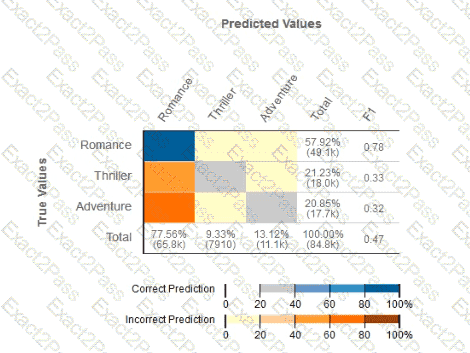
Given the following confusion matrix for a movie classification model, what is the true class frequency for Romance and the predicted class frequency for Adventure?
A.

The true class frequency for Romance is 77.56% and the predicted class frequency for Adventure is 20 85%

B.

The true class frequency for Romance is 57.92% and the predicted class frequency for Adventure is 1312%

C.

The true class frequency for Romance is 0 78 and the predicted class frequency for Adventure is (0 47 - 0.32).

D.

The true class frequency for Romance is 77.56% * 0.78 and the predicted class frequency for Adventure is 20 85% ' 0.32

Question # 39

A Machine Learning Specialist prepared the following graph displaying the results of k-means for k = [1:10]
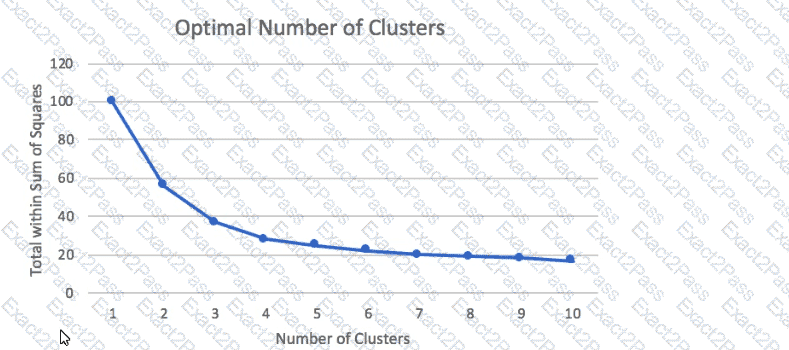
Considering the graph, what is a reasonable selection for the optimal choice of k?

A.

1

B.

4

C.

7

D.

10

Question # 40

A Machine Learning Specialist is developing a custom video recommendation model for an application The dataset used to train this model is very large with millions of data points and is hosted in an Amazon S3 bucket The Specialist wants to avoid loading all of this data onto an Amazon SageMaker notebook instance because it would take hours to move and will exceed the attached 5 GB Amazon EBS volume on the notebook instance.

Which approach allows the Specialist to use all the data to train the model?

A.

Load a smaller subset of the data into the SageMaker notebook and train locally. Confirm that the trainingcode is executing and the model parameters seem reasonable. Initiate a SageMaker training job using thefull dataset from the S3 bucket using Pipe input mode.

B.

Launch an Amazon EC2 instance with an AWS Deep Learning AMI and attach the S3 bucket to theinstance. Train on a small amount of the data to verify the training code and hyperparameters. Go back toAmazon SageMaker and train using the full dataset

C.

Use AWS Glue to train a model using a small subset of the data to confirm that the data will be compatiblewith Amazon SageMaker. Initiate a SageMaker training job using the full dataset from the S3 bucket usingPipe input mode.

D.

Load a smaller subset of the data into the SageMaker notebook and train locally. Confirm that the trainingcode is executing and the model parameters seem reasonable. Launch an Amazon EC2 instance with anAWS Deep Learning AMI and attach the S3 bucket to train the full dataset.

Go to page:
