Summer Sale Special Limited Time 70% Discount Offer - Ends in 0d 00h 00m 00s - Coupon code: buysanta

Exact2Pass Menu

Fortinet NSE 7 - Enterprise Firewall 7.2

Last Update 1 day ago Total Questions : 80

The Fortinet NSE 7 - Enterprise Firewall 7.2 content is now fully updated, with all current exam questions added 1 day ago. Deciding to include NSE7_EFW-7.2 practice exam questions in your study plan goes far beyond basic test preparation.

You'll find that our NSE7_EFW-7.2 exam questions frequently feature detailed scenarios and practical problem-solving exercises that directly mirror industry challenges. Engaging with these NSE7_EFW-7.2 sample sets allows you to effectively manage your time and pace yourself, giving you the ability to finish any Fortinet NSE 7 - Enterprise Firewall 7.2 practice test comfortably within the allotted time.

Question # 1

Refer to the exhibit, which shows an ADVPN network.
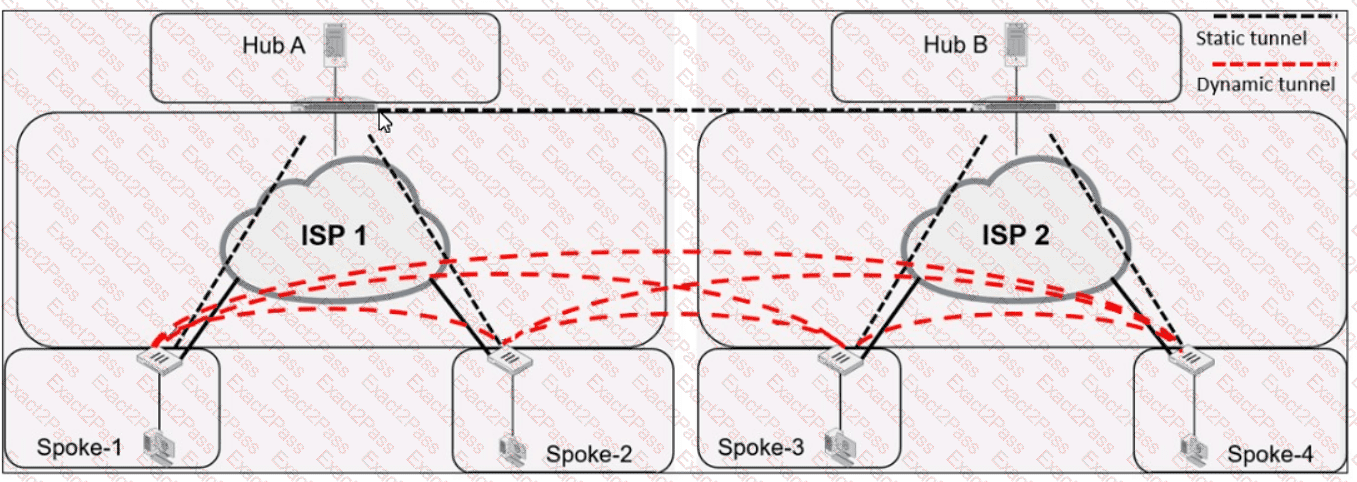
Which VPN phase 1 parameters must you configure on the hub for the ADVPN feature to function? (Choose two.)

A.

set auto-discovery-forwarder enable

B.

set add-route enable

C.

set auto-discovery-receiver enable

D.

set auto-discovery-sender enable

Question # 2

Which two statements about ADVPN are true? (Choose two.)

A.

You must disable add-route in the hub.

B.

AllFortiGate devices must be in the same autonomous system (AS).

C.

The hub adds routes based on IKE negotiations.

D.

You must configure phase 2 quick mode selectors to 0.0.0.0 0.0.0.0.

Question # 3

You contoured an address object on the tool fortiGate in a Security Fabric. This object is not synchronized with a downstream device. Which two reasons could be the cause? (Choose two)

A.

The address object on the tool FortiGate has fabric-object set to disable

B.

The root FortiGate has configuration-sync set to enable

C.

The downstream TortiGate has fabric-object-unification set to local

D.

The downstream FortiGate has configuration-sync set to local

Question # 4

Which FortiGate in a Security I auric sends togs to FortiAnalyzer?

A.

Only the root FortiGate.

B.

Each FortiGate in the Security fabric.

C.

The FortiGate devices performing network address translation (NAT) or unified threat management (UTM). if configured.

D.

Only the last FortiGate that handled a session in the Security Fabric

Question # 5

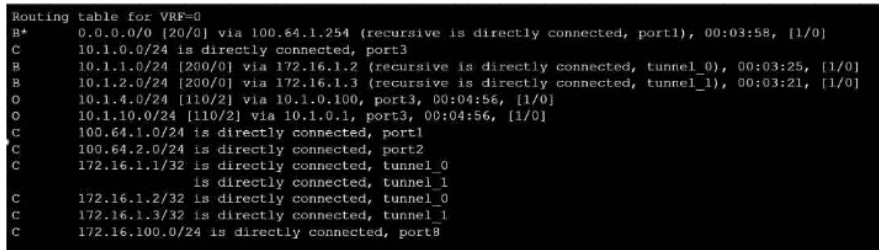
Exhibit.

Refer to the exhibit, which shows a partial touting table

What two concisions can you draw from the corresponding FortiGate configuration? (Choose two.)

A.

IPSec Tunnel aggregation is configured

B.

net-device is enabled in the tunnel IPSec phase 1 configuration

C.

OSPI is configured to run over IPSec.

D.

add-route is disabled in the tunnel IPSec phase 1 configuration.

Question # 6

Which, three conditions are required for two FortiGate devices to form an OSPF adjacency? (Choose three.)

A.

OSPF interface network types match

B.

OSPF router IDs are unique

C.

OSPF interface priority settings are unique

D.

OSPF link costs match

E.

Authentication settings match

Question # 7

You want to configure faster failure detection for BGP

Which parameter should you enable on both connected FortiGate devices?

A.

Ebgp-enforce-multihop

B.

bfd

C.

Distribute-list-in

D.

Graceful-restart

Question # 8

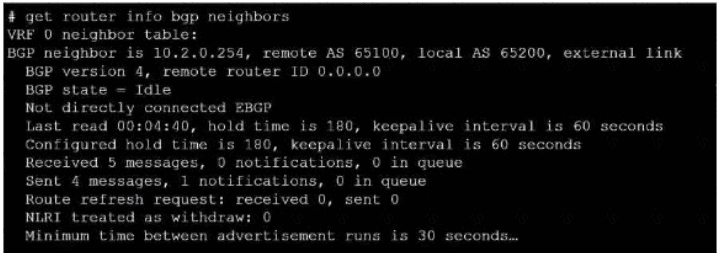
Exhibit.

Refer to the exhibit, which provides information on BGP neighbors.

Which can you conclude from this command output?

A.

The router are in the number to match the remote peer.

B.

You must change the AS number to match the remote peer.

C.

BGP is attempting to establish a TCP connection with the BGP peer.

D.

The bfd configuration to set to enable.

Question # 9

Refer to the exhibit, which contains a partial BGP combination.
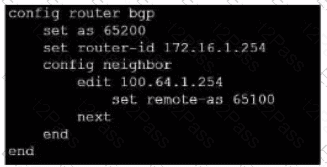
You want to configure a loopback as the OGP source.

Which two parameters must you set in the BGP configuration? (Choose two)

A.

ebgp-enforce-multihop

B.

recursive-next-hop

C.

ibgp-enfoce-multihop

D.

update-source

Question # 10

Which two statements about the BFD parameter in BGP are true? (Choose two.)

A.

It allows failure detection in less than one second.

B.

The two routers must be connected to the same subnet.

C.

It is supported for neighbors over multiple hops.

D.

It detects only two-way failures.

Go to page: