Winter Sale Special Limited Time 70% Discount Offer - Ends in 0d 00h 00m 00s - Coupon code: buysanta

Exact2Pass Menu

Fortinet NSE 7 - Secure Networking 7.6 Architect

Last Update 13 hours ago Total Questions : 177

The Fortinet NSE 7 - Secure Networking 7.6 Architect content is now fully updated, with all current exam questions added 13 hours ago. Deciding to include NSE7_FSN_AR-7.6 practice exam questions in your study plan goes far beyond basic test preparation.

You'll find that our NSE7_FSN_AR-7.6 exam questions frequently feature detailed scenarios and practical problem-solving exercises that directly mirror industry challenges. Engaging with these NSE7_FSN_AR-7.6 sample sets allows you to effectively manage your time and pace yourself, giving you the ability to finish any Fortinet NSE 7 - Secure Networking 7.6 Architect practice test comfortably within the allotted time.

Question # 41

During the SAML negotiation process, in which section does the Identity Provider (IdP) provide the SAML attributes used in the authentication process to the Service Provider (SP)?

A.

Bindings HTTP post

B.

Assertion dump

C.

Authentication request

D.

Authentication response

Question # 42

Exhibit.

Refer to the exhibit, which shows two entries that were generated in the FSSO collector agent logs.eeeeeeeeeeeeeeeeeeeeeeeeeeeeeeeeeeeeeeeeeeeeeeeeeeeeeeeeeeeeeeeeeeeeeee

What three conclusions can you draw from these log entries? {Choose three.)

A.

Remote registry is not running on the workstation.

B.

The user ' s status shows as " not verified " in the collector agent.

C.

DNS resolution is unable to resolve the workstation name.

D.

The FortiGate firmware version is not compatible with that of the collector agent.

E.

A firewall is blocking traffic to port 139 and 445.

Question # 43

When you deploy SD-WAN, you can choose from several common designs. Each design best applies to specific contexts.

Which two statements correctly associate a common SD-WAN design with its main indication or constraint? (Choose two.)

A.

Use remote breakout to centralize traffic inspection and limit local management requirements.

B.

Use a direct internet access (DIA) design to increase traffic security and allow local devices with limited capabilities.

C.

Use a standalone design for sites with only one WAN link to the cloud.

D.

Use a cloud on-ramp topology to improve the performance of cloud applications.

Question # 44

Refer to the exhibit, which shows the partial output of command diagnose debug rating.
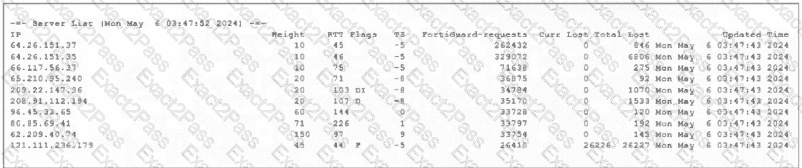
In this exhibit, which FDS server will the FortiGate algorithm choose?

A.

66.117.56.37

B.

208.91.112.194

C.

209.22.147.36

D.

64.26.151.37

Question # 45

While troubleshooting a FortiGate web filter issue, users report that they cannot access any websites, even though those sites are not explicitly blocked by any web filter profiles that are applied to firewall policies.
What are the three most likely reasons for this behavior? (Choose three answers)

A.

The web filter cache has been cleared causing all websites to take longer to be rated.

B.

The SSL/TLS deep inspection was configured but the browsers do not have the FortiGate certificate installed.

C.

The webfilter-force-off setting has been enabled under config system fortiguard.

D.

The DNS server is unreachable, preventing URL resolution.

E.

The FortiGuard Web Filtering license has expired, causing FortiGate to apply the default block action.

Question # 46

Refer to the exhibit.

The output of a BGO debug command is shown.
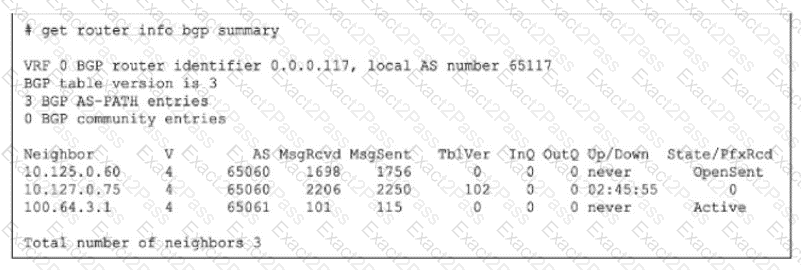
What is the most likely reason that the local FortiGate is not receiving any prefixes from its neighbors?

A.

The local router is waiting for the keepalive message from the router 10.125.0.60.

B.

None of the three neighbors has successfully established the TCP three-way handshake with the local router.

C.

The router 100.64.3.1 is waiting for the OPEN message from the local router.

D.

The RIB-OUT configuration for router 10.127.0.75 prevents any route advertisement to the local router.

Question # 47

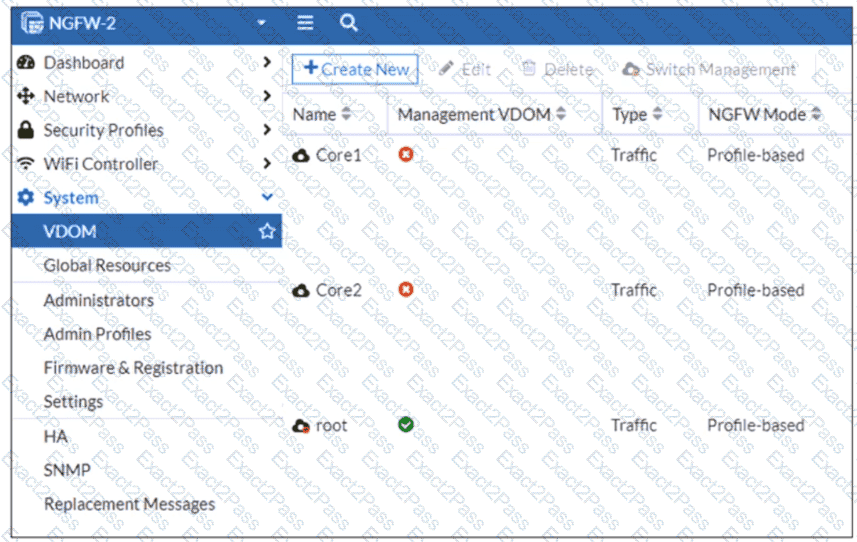
Refer to the exhibit.

The VDOM configuration on a FortiGate device is shown. You discover that web filtering stopped working in Core1 and Core2 after a maintenance window.

What are two reasons why web filtering stopped working? (Choose two answers.)

A.

The root VDOM does not have access to FortiManager in a closed network.

B.

The root VDOM does not have access to any valid public Fortinet Distribution Network (FDN) server.

C.

The Core1 and Core2 VDOMs must also be enabled as management VDOMs to receive FortiGuard updates.

D.

The root VDOM does not use a VDOM link to connect with the Core1 and Core2 VDOMs.

Question # 48

Refer to the exhibit, which shows the output of get router info ospf neighbor.
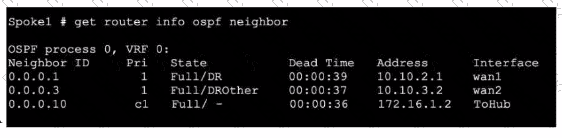
What can you conclude from the command output?

A.

The network type connecting the local Fortigate and OSPF neighbor 0.0.0.10 is point-to-point.

B.

All neighbors are in area 0.0.0.0.

C.

The local FortiGate is the BDR.

D.

The local FortiGate is not a DROther.

Question # 49

Which three conditions are required for two FortiGate devices to form an OSPF adjacency? (Choose three answers)

A.

OSPF link costs match.

B.

OSPF interface priority settings are unique.

C.

OSPF interface network types match.

D.

Authentication settings match.

E.

OSPF router IDs are unique.

Question # 50

Refer to the exhibit.

Partial output of a real-time OSPF debug is shown.
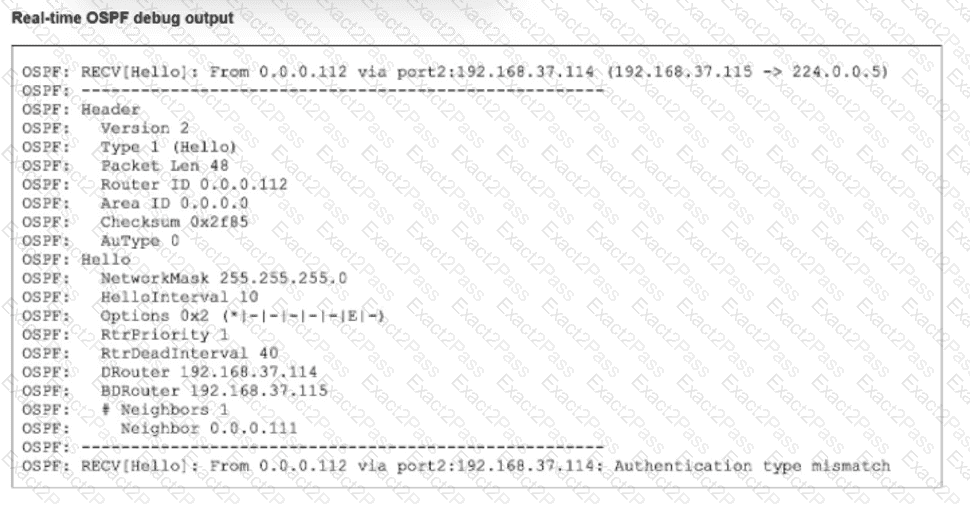
Which two reasons explain why the two FortiGate devices are unable to form an adjacency? (Choose two.)


A.

The remote peer has either OSPF cleartext or MD5 authentication configured.

B.

There is an OSPF authentication configuration mismatch.

C.

The local FortiGate does not have OSPF authentication configured

D.

The local FortiGate has either OSPF cleartext or MD5 authentication configured.

Go to page: