Summer Sale Special Limited Time 70% Discount Offer - Ends in 0d 00h 00m 00s - Coupon code: buysanta

Exact2Pass Menu

Fortinet NSE 7 - Secure Networking 7.6 Architect

Last Update 22 hours ago Total Questions : 146

The Fortinet NSE 7 - Secure Networking 7.6 Architect content is now fully updated, with all current exam questions added 22 hours ago. Deciding to include NSE7_FSN_AR-7.6 practice exam questions in your study plan goes far beyond basic test preparation.

You'll find that our NSE7_FSN_AR-7.6 exam questions frequently feature detailed scenarios and practical problem-solving exercises that directly mirror industry challenges. Engaging with these NSE7_FSN_AR-7.6 sample sets allows you to effectively manage your time and pace yourself, giving you the ability to finish any Fortinet NSE 7 - Secure Networking 7.6 Architect practice test comfortably within the allotted time.

Question # 21

In IKEv2, which exchange establishes the first CHILD_SA?

A.

IKE_SA_INIT

B.

INFORMATIONAL

C.

CREATE_CHILD_SA

D.

IKE_AUTH

Question # 22

Exhibit.

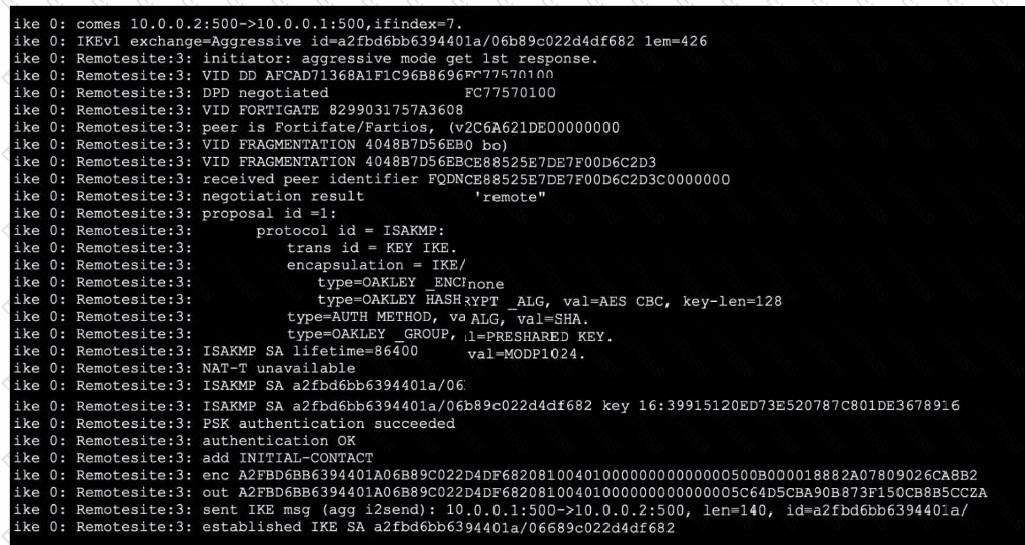
Refer to the exhibit, which contains partial output from an IKE real-time debug.

Which two statements about this debug output are correct? (Choose two.)

A.

Perfect Forward Secrecy (PFS) is enabled in the configuration.

B.

The local gateway IP address is 10.0.0.1.

C.

It shows a phase 2 negotiation.

D.

The initiator provided remote as its IPsec peer ID.

Question # 23

Refer to the exhibit, which shows a partial output from the get router info routing-table database command.
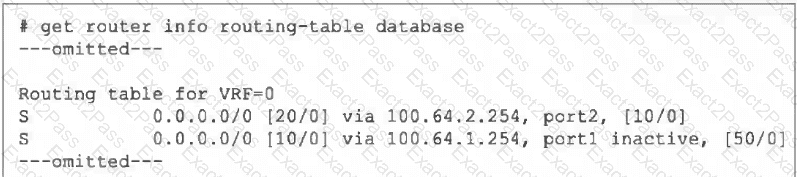
The administrator wants to configure a default static route for port3 and assign a distance of 50 and a priority of 0.

What will happen to the port1 and port2 default static routes after the port3 default static route is created?

A.

The port2 default static route will be injected into the forwarding information base (FIB).

B.

The port1 default static route will be injected into the FIB.

C.

Neither of the routes shown in the output will be injected into the FIB.

D.

Both default static routes shown in the output will be injected into the FIB.

Question # 24

What is the correct order of the IKEv2 request-and-response protocol?

A.

Create_Child_SA, IKEAUTH, IKESAJNIT

B.

Create_Child_SA, IKE_SA_INIT. IKE_AUTH

C.

IKE SA INIT, IKE AUTH. Create Child SA OIKE AUTH.

D.

IKE_AUTH_IKE_SA_INIT, Create_Child_SA

Question # 25

Refer to the exhibit.

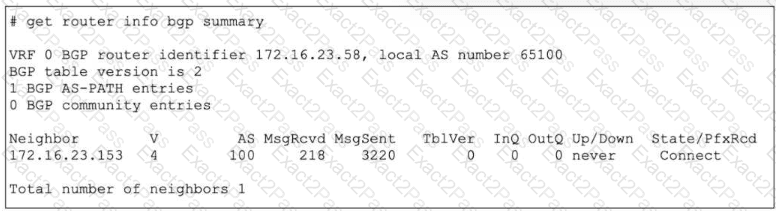
The output of a BGP debug command is shown.

Why has the local router at 172.16.23.58 been unable to establish adjacency with its only neighbor?

A.

The neighbor router has become unreachable, which is evident by the low ratio of messages received to messages sent.

B.

The local router has not received an OPEN message from the neighbor.

C.

The local router has not received a SYN/ACK packet from the neighbor.

D.

There is no active route to the BGP neighbor.

Question # 26

Which Iwo actions does FortiGate take after an administrator enables the auxiliary session selling? (Choose two.)

A.

FortiGate only offloads auxiliary sessions.

B.

FortiGate accelerates all ECMP traffic to the NP6 processor

C.

FortiGates creates a now auxiliary session for each packet it receives.

D.

FortiGate creates two sessions in case of a routing change.

Question # 27

Refer to the exhibit.

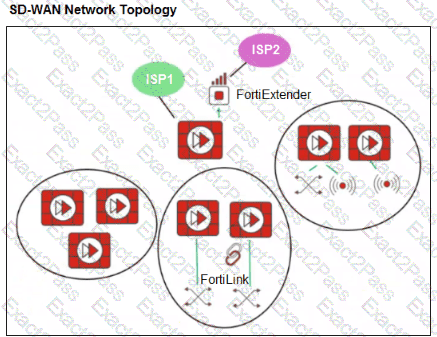
You want to configure SD-WAN on a network, as shown in the exhibit. The network contains many FortiGate devices. Some are used as next-generation firewalls (NGFWs), and some are deployed with extensions such as FortiSwitch, FortiAP, or FortiExtender.

Which factor should you consider when planning the deployment? (Choose one answer.)

A.

You can build an SD-WAN topology that includes all devices. The hubs must be devices without extensions.

B.

You should exclude FortiGate devices with FortiLink connections from the SD-WAN topology.

C.

You should build multiple SD-WAN topologies. Each topology should contain only one type of extension.

D.

You can build an SD-WAN topology that includes all devices. The hubs can be FortiGate devices with FortiExtender.

Question # 28

Refer to the exhibit.

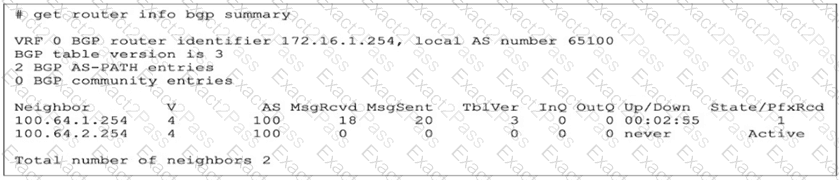
The output of the get router info bgp summary command is shown.

Which statement regarding adjacencies between the local router and its neighbors is correct?

A.

The local router and neighbor 100.64.2.254 are unable to establish adjacency until the adjacency with neighbor 100.64.1.254 ceases.

B.

The local router and neighbor 100.64.2.254 are unable to establish adjacency because the TCP session could not be established.

C.

The local router and neighbor 100.64.1.254 established adjacency because the priority of 100.64.1.254 is higher than that of 100.64.2.254.

D.

The local router and neighbor 100.64.2.254 are unable to establish adjacency because AS 100 is already used by neighbor 100.64.1.254.

Question # 29

Refer to the exhibit, which shows the port1 interface configuration on FortiGate and partial session information for ICMP traffic.

What happens to the session information if a routing change occurs that affects this session?

A.

Only the interface and gateway information for dev=7 will be removed.

B.

The session information will not change unless the current route has been removed from the routing table.

C.

The session will be flagged as dirty but no route lookups will be performed.

D.

Sessions involving port7 or port19 will not have their routing information flushed.

Question # 30

Exhibit.

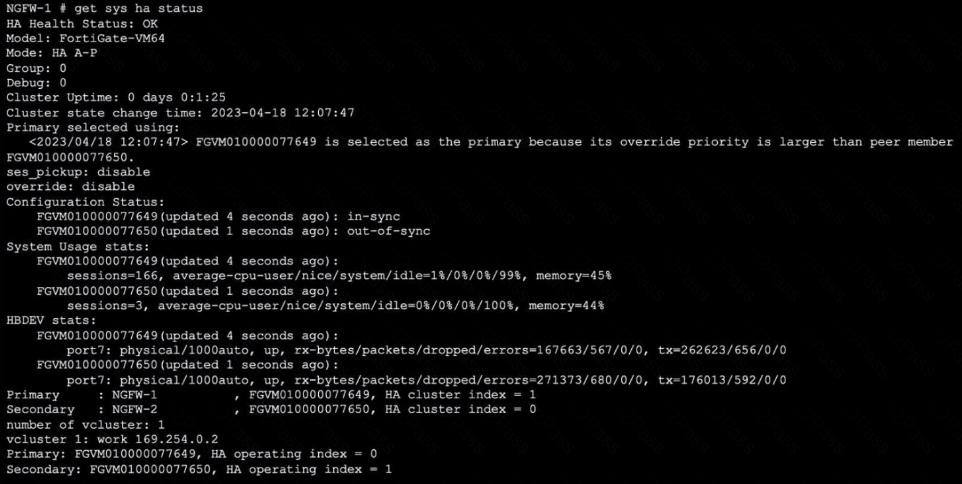
Refer to the exhibit, which shows the output of get system ha status.

NGFW-1 and NGFW-2 have been up for a week.

Which two statements about the output are true? (Choose two.)

A.

If a configuration change is made to the primary FortiGate at this time, the secondary will initiate a synchronization reset.

B.

If port 7 becomes disconnected on the secondary, both FortiGate devices will elect itself as primary.

C.

If FGVM...649 is rebooted. FGVM...650 will become the primary and retain that role, even after FGVM...649 rejoins the cluster.

D.

If no action is taken, the primary FortiGate will leave the cluster because of the current sync status.

Go to page: