Winter Sale Special Limited Time 70% Discount Offer - Ends in 0d 00h 00m 00s - Coupon code: buysanta

Exact2Pass Menu

Fortinet NSE 7 - Secure Networking 7.6 Architect

Last Update 13 hours ago Total Questions : 177

The Fortinet NSE 7 - Secure Networking 7.6 Architect content is now fully updated, with all current exam questions added 13 hours ago. Deciding to include NSE7_FSN_AR-7.6 practice exam questions in your study plan goes far beyond basic test preparation.

You'll find that our NSE7_FSN_AR-7.6 exam questions frequently feature detailed scenarios and practical problem-solving exercises that directly mirror industry challenges. Engaging with these NSE7_FSN_AR-7.6 sample sets allows you to effectively manage your time and pace yourself, giving you the ability to finish any Fortinet NSE 7 - Secure Networking 7.6 Architect practice test comfortably within the allotted time.

Question # 11

Refer to the exhibit showing a debug output.

An administrator deployed FSSO in DC Agent Mode but FSSO is failing on FortiGate. Pinging FortiGate from where the collector agent is deployed is successful.

The administrator then produces the debug output shown in the exhibit.

What could be causing this error message?

A.

The TCP port 445 is blocked between FortiGate and collector agent.

B.

The collector agent preshared password is mismatched.

C.

The FortiGate cannot resolve the active directory server name.

D.

The FortiGate and the collector agent are using different TCP ports.

Question # 12

What are two functions of automation stitches? (Choose two.)

A.

You can configure automation stitches on any FortiGate device in a Security Fabric environment.

B.

You can configure automation stitches to execute actions sequentially by taking parameters from previous actions as input for the current action.

C.

You can set an automation stitch configured to execute actions in parallel to insert a specific delay between actions.

D.

You can create automation stitches to run diagnostic commands and attach the results to an email message when CPU or memory usage exceeds specified thresholds.

Question # 13

Which three common FortiGate-to-collector-agent connectivity issues can you identify using the FSSO real-time debug? (Choose three.)

A.

The SSL certificate used for FSSO over SSL has expired.

B.

The connection was refused. There may be a mismatch of the TCP port.

C.

FortiGate cannot reach the IP address of the collector agent.

D.

The pro-shared key does not match

E.

The group filters do not match.

Question # 14

Refer to the exhibit, which shows the output of a debug command.
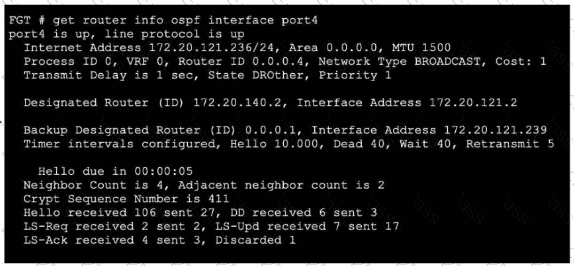
Which two statements about the output are true? (Choose two.)

A.

The interlace is part of the OSPF backbone area.

B.

There are a total of five OSPF routers attached to the vorz4 network segment

C.

One of the neighbors has a router ID of 0.0.0.4.

D.

In the network connected to port4, two OSPF routers are down.

Question # 15

Refer to the exhibit.

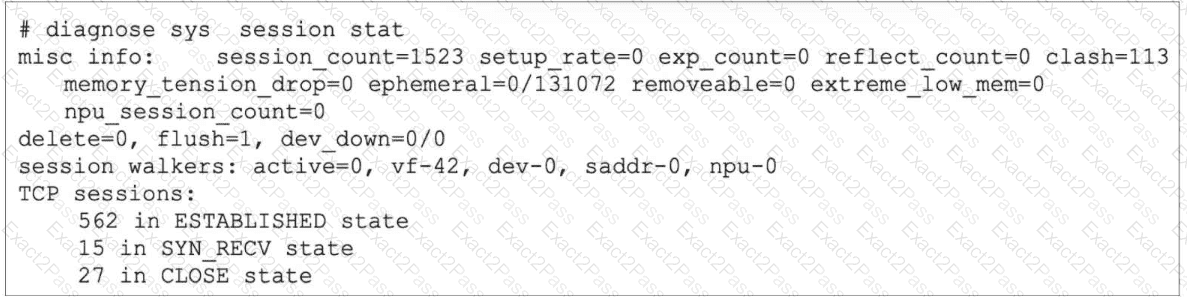
The partial output of diagnose sys session stat command is shown.

Which statement about the output shown in the exhibit is correct?

A.

113 sessions have been dropped because of memory page exhaustion.

B.

There have been 131072 recorded ephemeral sessions but there are no current ones.

C.

562 TCP sessions have their proto_state set to 01 if there is no inspection.

D.

27 sessions have expired but are still in the session table in case any out-of-order packets arrive.

Question # 16

If you configure set tcp-mss-sender and set tcp-mss-receiver in a firewall policy, how does it affect the size and handling of TCP packets in the network?

A.

Applying the commands in a firewall policy determines the largest payload a device can handle in a single TCP segment.

B.

The maximum segment size permitted in the firewall policy determines whether TCP packets are allowed or denied.

C.

The TCP packet modifies the packet size only if no fragmentation occurs.

D.

The commands affect both the payload size of the packet and the size of the IP header for handling TCP packets.

Question # 17

Refer to the exhibit, which shows a partial output of the fssod daemon real-time debug command.

What two conclusions can you draw from the output? (Choose two.)

A.

The workstation with IP 10.124.2.90 will be polled frequently using TCP port 445 to see if the user is still logged on.

B.

The logon event can be seen on the collector agent installed on Windows.

C.

FSSO is using DC agent mode to detect logon events.

D.

FSSO is using agentless polling mode to detect logon events.

Question # 18

Refer to the exhibit.

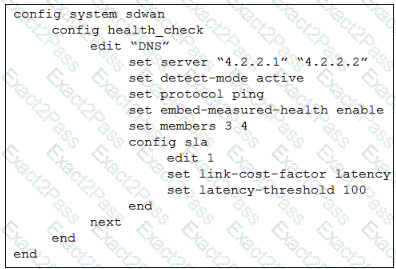
The health-check configuration on a FortiGate device used as a spoke is shown.

You notice that the hub FortiGate does not prioritize the traffic as expected.

Which two configuration elements should you check on the hub? (Choose two.)

A.

The performance SLA uses the same criteria.

B.

The performance SLA has the parameter priority-out-sla configured.

C.

The performance SLA uses the same members.

D.

The performance SLA is configured with set embedded-measure accept.

Question # 19

Exhibit.

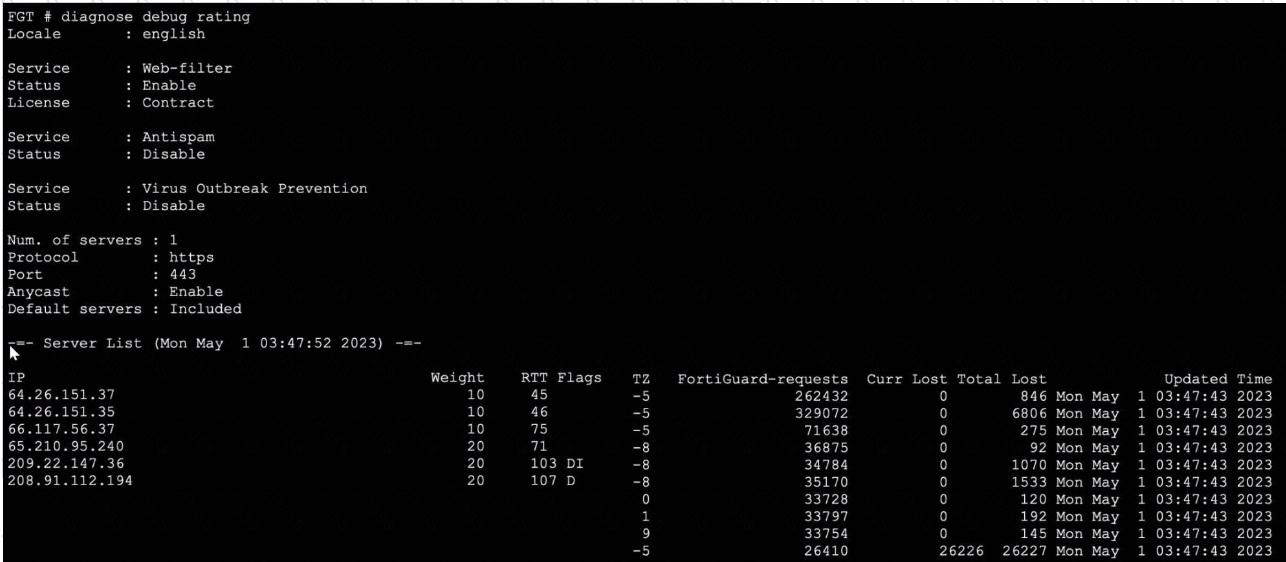
Refer to the exhibit, which shows the output of a diagnose command.

What can you conclude about the debug output in this scenario?

A.

The first server provided to FortiGate when it performed a DNS query looking for a list of rating servers, was 121.111.236.179.

B.

There is a natural correlation between the value in the FortiGuard-requests field and the value in the Weight field.

C.

FortiGate used 64.26.151.37 as the initial server to validate its contract.

D.

Servers with a negative TZ value are less preferred for rating requests.

Question # 20

Refer to the exhibit, which shows the output of a policy route table entry.

Which type of policy route does the output show?

A.

An ISDB route

B.

A regular policy route

C.

A regular policy route, which is associated with an active static route in the FIB

D.

An SD-WAN rule

Go to page: