Exact2Pass

Last Update 9 hours ago Total Questions : 91
The Fortinet NSE 7 - Security Operations 7.6 Architect content is now fully updated, with all current exam questions added 9 hours ago. Deciding to include NSE7_SOC_AR-7.6 practice exam questions in your study plan goes far beyond basic test preparation.
You'll find that our NSE7_SOC_AR-7.6 exam questions frequently feature detailed scenarios and practical problem-solving exercises that directly mirror industry challenges. Engaging with these NSE7_SOC_AR-7.6 sample sets allows you to effectively manage your time and pace yourself, giving you the ability to finish any Fortinet NSE 7 - Security Operations 7.6 Architect practice test comfortably within the allotted time.
Exhibit:
Which observation about this FortiAnalyzer Fabric deployment architecture is true?
Your company is doing a security audit To pass the audit, you must take an inventory of all software and applications running on all Windows devices
Which FortiAnalyzer connector must you use?
You want to trigger an incident when multiple failed logins from the same host are followed by a successful login on that same host within 15 minutes. The rule must correlate all events by source IP address and user to ensure they belong to the same login sequence. Which three configurations achieve this goal? Choose three answers.
Refer to Exhibit:
You are tasked with reviewing a new FortiAnalyzer deployment in a network with multiple registered logging devices. There is only one FortiAnalyzer in the topology.
Which potential problem do you observe?
You want to automate a workflow on FortiSOAR so that whenever an incident is moved to the Aftermath phase, it is automatically set to status Resolved and assigned to a purple team specialist as incident lead to write an incident report. In addition, a manual task, assigned to the same specialist, will be created so they are aware of the pending work. Which three steps will accomplish this task? Choose three answers.
Review the incident report. A fake HR login page was sent to several employees through email. The page copied the company’s branding and captured usernames and passwords. The attacker later used the stolen credentials to sign in through the company’s web VPN. Which two MITRE ATT & CK tactics best characterize this report? Choose two answers.
Refer to the exhibits.
The Malicious File Detect playbook is configured to create an incident when an event handler generates a malicious file detection event.
Why did the Malicious File Detect playbook execution fail?
Refer to the exhibit.
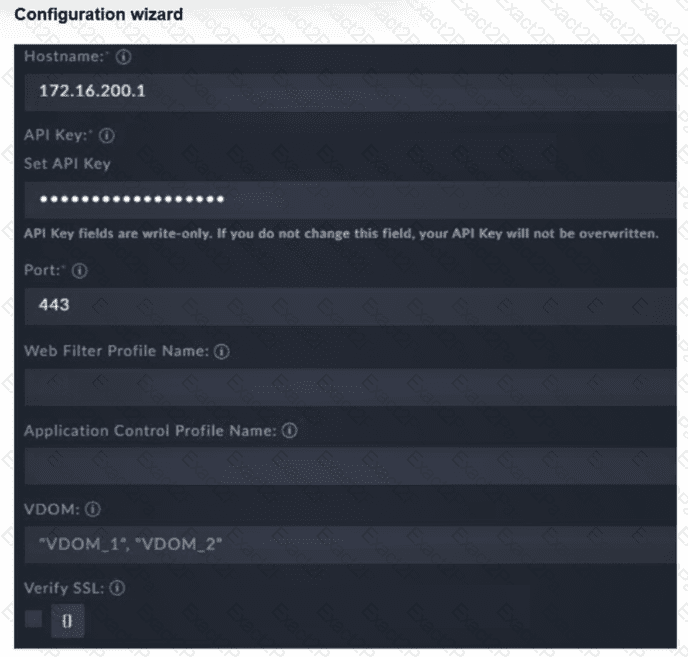
You must configure the FortiGate connector to allow FortiSOAR to perform actions on a firewall. However, the connection fails. Which two configurations are required? (Choose two answers)
Which role does a threat hunter play within a SOC?
Which statement describes automation stitch integration between FortiGate and FortiAnalyzer?

