
Summer Sale Special Limited Time 70% Discount Offer - Ends in 0d 00h 00m 00s - Coupon code: buysanta

Exact2Pass Menu

Splunk Core Certified Consultant

Last Update 8 hours ago Total Questions : 85

The Splunk Core Certified Consultant content is now fully updated, with all current exam questions added 8 hours ago. Deciding to include SPLK-3003 practice exam questions in your study plan goes far beyond basic test preparation.

You'll find that our SPLK-3003 exam questions frequently feature detailed scenarios and practical problem-solving exercises that directly mirror industry challenges. Engaging with these SPLK-3003 sample sets allows you to effectively manage your time and pace yourself, giving you the ability to finish any Splunk Core Certified Consultant practice test comfortably within the allotted time.

Question # 1

Consider the search shown below.

What is this search’s intended function?

A.

To return all the web_log events from the web index that occur two hours before and after the most recent high severity, denied event found in the firewall index.

B.

To find all the denied, high severity events in the firewall index, and use those events to further search for lateral movement within the web index.

C.

To return all the web_log events from the web index that occur two hours before and after all high severity, denied events found in the firewall index.

D.

To search the firewall index for web logs that have been denied and are of high severity.

Question # 2

In preparation for the deployment of a new environment for a customer, which of the following mappings are correct per PS best practices?
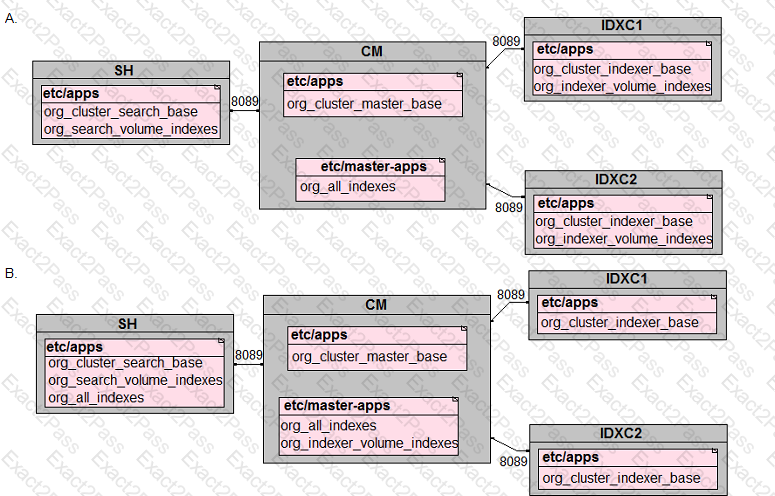
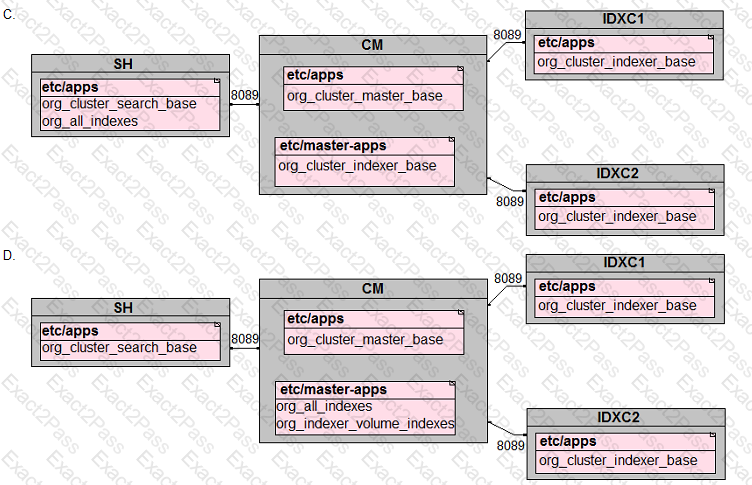
A.

Option A

B.

Option B

C.

Option C

D.

Option D

Question # 3

Which of the following is the most efficient search?

A.

index=www status=200 uri=/cart/checkout | append [search index = sales] | stats count, sum(revenue) as total_revenue by session_id | table total_revenue session_id

B.

(index=www status=200 uri=/cart/checkout) OR (index=sales) | stats count, sum (revenue) as total_revenue by session_id | table total_revenue session_id

C.

index=www | append [search index = sales] | stats count, sum(revenue) as total_revenue by session_id | table total_revenue session_id

D.

(index=www) OR (index=sales) | search (index=www status=200 uri=/cart/checkout) OR (index=sales) | stats count, sum(revenue) as total_revenue by session_id | table total_revenue session_id

Question # 4

When can the Search Job Inspector be used to debug searches?

A.

If the search has not expired.

B.

If the search is currently running.

C.

If the search has been queued.

D.

If the search has expired.

Question # 5

A customer with a large distributed environment has blacklisted a large lookup from the search bundle to decrease the bundle size using distsearch.conf. After this change, when running searches utilizing the lookup that was blacklisted they see error messages in the Splunk Search UI stating the lookup file does not exist.

What can the customer do to resolve the issue?

A.

The search needs to be modified to ensure the lookup command specifies parameter local=true.

B.

The blacklisted lookup definition stanza needs to be modified to specify setting allow_caching=true.

C.

The search needs to be modified to ensure the lookup command specified parameter

blacklist=false.

D.

The lookup cannot be blacklisted; the change must be reverted.

Question # 6

A customer has three users and is planning to ingest 250GB of data per day. They are concerned with search uptime, can tolerate up to a two-hour downtime for the search tier, and want advice on single search head versus a search head cluster. (SHC).

Which recommendation is the most appropriate?

A.

The customer should deploy two active search heads behind a load balancer to support HA.

B.

The customer should deploy a SHC with a single member for HA; more members can be added later.

C.

The customer should deploy a SHC, because it will be required to support the high volume of data.

D.

The customer should deploy a single search head with a warm standby search head and a rsync process to synchronize configurations.

Question # 7

A customer has written the following search:

How can the search be rewritten to maximize efficiency?
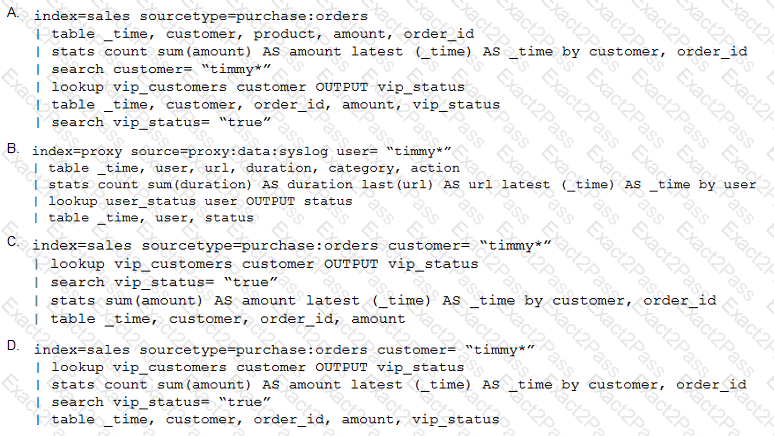
A.

Option A

B.

Option B

C.

Option C

D.

Option D

Question # 8

A customer’s deployment server is overwhelmed with forwarder connections after adding an additional 1000 clients. The default phone home interval is set to 60 seconds. To reduce the number of connection failures to the DS what is recommended?

A.

Create a tiered deployment server topology.

B.

Reduce the phone home interval to 6 seconds.

C.

Leave the phone home interval at 60 seconds.

D.

Increase the phone home interval to 600 seconds.

Question # 9

The data in Splunk is now subject to auditing and compliance controls. A customer would like to ensure that at least one year of logs are retained for both Windows and Firewall events. What data retention controls must be configured?

A.

maxTotalDataSizeMB and frozenTimePeriodInSecs

B.

coldToFrozenDir and coldToFrozenScript

C.

Splunk Volume and maxTotalDataSizMB

D.

Splunk Volume and frozenTimePeriodInSecs

Question # 10

A customer has the following Splunk instances within their environment: An indexer cluster consisting of a cluster master/master node and five clustered indexers, two search heads (no search head clustering), a deployment server, and a license master. The deployment server and license master are running on their own single-purpose instances. The customer would like to start using the Monitoring Console (MC) to monitor the whole environment.

On the MC instance, which instances will need to be configured as distributed search peers by specifying them via the UI using the settings menu?


A.

Just the cluster master/master node.

B.

Indexers, search heads, deployment server, license master, cluster master/master node.

C.

Search heads, deployment server, license master, cluster master/master node

D.

Deployment server, license master

Go to page:
