Spring Sale Special Limited Time 70% Discount Offer - Ends in 0d 00h 00m 00s - Coupon code: buysanta

Exact2Pass Menu

Understanding Cisco Cybersecurity Operations Fundamentals (CBROPS)

Last Update 7 hours ago Total Questions : 476

The Understanding Cisco Cybersecurity Operations Fundamentals (CBROPS) content is now fully updated, with all current exam questions added 7 hours ago. Deciding to include 200-201 practice exam questions in your study plan goes far beyond basic test preparation.

You'll find that our 200-201 exam questions frequently feature detailed scenarios and practical problem-solving exercises that directly mirror industry challenges. Engaging with these 200-201 sample sets allows you to effectively manage your time and pace yourself, giving you the ability to finish any Understanding Cisco Cybersecurity Operations Fundamentals (CBROPS) practice test comfortably within the allotted time.

Question # 111

A security incident occurred with the potential of impacting business services. Who performs the attack?

A.

malware author

B.

threat actor

C.

bug bounty hunter

D.

direct competitor

Question # 112

How does an attack surface differ from an attack vector?

A.

An attack vector recognizes the potential outcomes of an attack, and the attack surface is choosing a method of an attack.

B.

An attack surface identifies vulnerable parts for an attack, and an attack vector specifies which attacks are feasible to those parts.

C.

An attack surface mitigates external vulnerabilities, and an attack vector identifies mitigation techniques and possible workarounds.

D.

An attack vector matches components that can be exploited, and an attack surface classifies the potential path for exploitation

Question # 113

What is data tunneling?

A.

Encrypted information is returned to its original format.

B.

Data is split into packets and transported to the destination.

C.

Packets are transformed into bytes and assembled by a receiver.

D.

Malicious data is hidden within legitimate system processes.

Question # 114

What is the difference between vulnerability and risk?

A.

A vulnerability is a sum of possible malicious entry points, and a risk represents the possibility of the unauthorized entry itself.

B.

A risk is a potential threat that an exploit applies to, and a vulnerability represents the threat itself

C.

A vulnerability represents a flaw in a security that can be exploited, and the risk is the potential damage it might cause.

D.

A risk is potential threat that adversaries use to infiltrate the network, and a vulnerability is an exploit

Question # 115

What is indicated by an increase in IPv4 traffic carrying protocol 41 ?

A.

additional PPTP traffic due to Windows clients

B.

unauthorized peer-to-peer traffic

C.

deployment of a GRE network on top of an existing Layer 3 network

D.

attempts to tunnel IPv6 traffic through an IPv4 network

Question # 116

Which type of verification consists of using tools to compute the message digest of the original and copied data, then comparing the similarity of the digests?
A.

evidence collection order

B.

data integrity

C.

data preservation

D.

volatile data collection

Question # 117

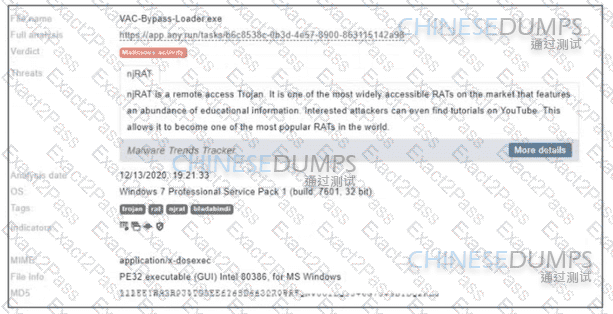
Refer to the exhibit. Where is the executable file?

A.

info

B.

tags

C.

MIME

D.

name

Question # 118

What is the difference between inline traffic interrogation (TAPS) and traffic mirroring (SPAN)?

A.

TAPS interrogation is more complex because traffic mirroring applies additional tags to data and SPAN does not alter integrity and provides full duplex network.

B.

SPAN results in more efficient traffic analysis, and TAPS is considerably slower due to latency caused by mirroring.

C.

TAPS replicates the traffic to preserve integrity, and SPAN modifies packets before sending them to other analysis tools

D.

SPAN ports filter out physical layer errors, making some types of analyses more difficult, and TAPS receives all packets, including physical errors.

Question # 119

Which type of evidence supports a theory or an assumption that results from initial evidence?

A.

probabilistic

B.

indirect

C.

best

D.

corroborative

Question # 120

Refer to the exhibit.

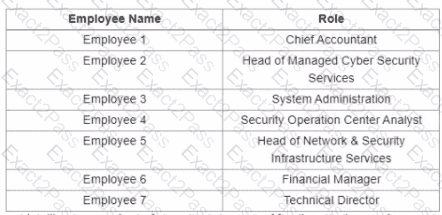
A suspicious IP address is tagged by Threat Intelligence as a brute-force attempt source After the attacker produces many of failed login entries, it successfully compromises the account. Which stakeholder is responsible for the incident response detection step?


A.

employee 5

B.

employee 3

C.

employee 4

D.

employee 2

Go to page: