Spring Sale Special Limited Time 70% Discount Offer - Ends in 0d 00h 00m 00s - Coupon code: buysanta

Exact2Pass Menu

Understanding Cisco Cybersecurity Operations Fundamentals (CBROPS)

Last Update 7 hours ago Total Questions : 476

The Understanding Cisco Cybersecurity Operations Fundamentals (CBROPS) content is now fully updated, with all current exam questions added 7 hours ago. Deciding to include 200-201 practice exam questions in your study plan goes far beyond basic test preparation.

You'll find that our 200-201 exam questions frequently feature detailed scenarios and practical problem-solving exercises that directly mirror industry challenges. Engaging with these 200-201 sample sets allows you to effectively manage your time and pace yourself, giving you the ability to finish any Understanding Cisco Cybersecurity Operations Fundamentals (CBROPS) practice test comfortably within the allotted time.

Question # 121

What is an evasion technique?

A.

injecting insecure malicious code into an application or a system

B.

blocking digital data using one or more mathematical methods

C.

building a payload that constructs a nonexistent signature in the antivirus database

D.

deleting update sources from an intrusion prevention system database

Question # 122

What is the difference between deep packet inspection and stateful inspection?

A.

Deep packet inspection gives insights up to Layer 7, and stateful inspection gives insights only up to Layer 4.

B.

Deep packet inspection is more secure due to its complex signatures, and stateful inspection requires less human intervention.

C.

Stateful inspection is more secure due to its complex signatures, and deep packet inspection requires less human intervention.

D.

Stateful inspection verifies data at the transport layer and deep packet inspection verifies data at the application layer

Question # 123

Which type of attack is a blank email with the subject " price deduction " that contains a malicious attachment?

A.

man-in-the-middle attack

B.

smishing

C.

phishing attack

D.

integrity violation

Question # 124

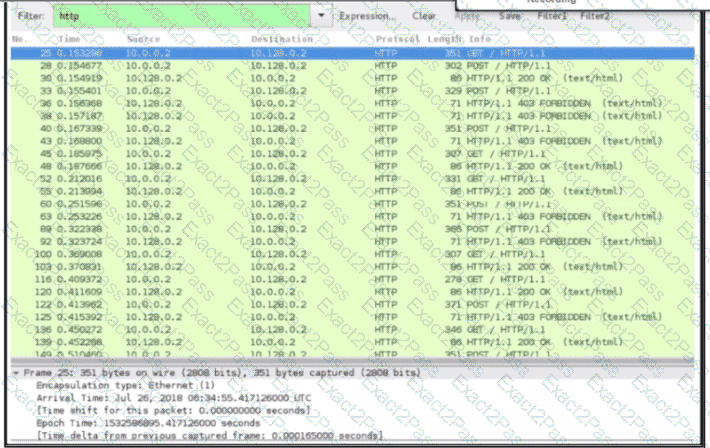
Exhibit.

An engineer received a ticket about a slowdown of a web application, Drug analysis of traffic, the engineer suspects a possible attack on a web server. How should the engineer interpret the Wiresharat traffic capture?

A.

10.0.0.2 sends GET/ HTTP/1.1 And Post request and the target responds with HTTP/1.1. 200 OC and HTTP/1.1 403 accordingly. This is an HTTP flood attempt.

B.

10.0.0.2 sends HTTP FORBIDDEN /1.1 And Post request, while the target responds with HTTP/1.1 200 Get and HTTP/1.1 403. This is an HTTP GET flood attack.

C.

10.128.0.2 sends POST/1.1 And POST requests, and the target responds with HTTP/1.1 200 Ok and HTTP/1.1 403 accordingly. This is an HTTP Reserve Bandwidth flood.

D.

10.128.0.2 sends HTTP/FORBIDDEN/ 1.1 and Get requests, and the target responds with HTTP/1.1 200 OK and HTTP/1.1 403. This is an HTTP cache bypass attack.

Question # 125

What is the difference between indicator of attack (loA) and indicators of compromise (loC)?

A.

loA is the evidence that a security breach has occurred, and loC allows organizations to act before the vulnerability can be exploited.

B.

loA refers to the individual responsible for the security breach, and loC refers to the resulting loss.

C.

loC is the evidence that a security breach has occurred, and loA allows organizations to act before the vulnerability can be exploited.

D.

loC refers to the individual responsible for the security breach, and loA refers to the resulting loss.

Question # 126

Which artifact is used to uniquely identify a detected file?

A.

file timestamp

B.

file extension

C.

file size

D.

file hash

Question # 127

Which evasion technique is indicated when an intrusion detection system begins receiving an abnormally high volume of scanning from numerous sources?

A.

resource exhaustion

B.

tunneling

C.

traffic fragmentation

D.

timing attack

Question # 128

Which type of evasion technique is accomplished by separating the traffic into smaller segments before transmitting across the network?

A.

tunneling

B.

fragmentation

C.

encryption

D.

proxies

Question # 129

An engineer received a flood of phishing emails from HR with the source address HRjacobm@companycom. What is the threat actor in this scenario?

A.

phishing email

B.

sender

C.

HR

D.

receiver

Question # 130

Which attack represents the evasion technique of resource exhaustion?

A.

SQL injection

B.

man-in-the-middle

C.

bluesnarfing

D.

denial-of-service

Go to page: