Exact2Pass

Last Update 16 hours ago Total Questions : 476
The Understanding Cisco Cybersecurity Operations Fundamentals content is now fully updated, with all current exam questions added 16 hours ago. Deciding to include 200-201 practice exam questions in your study plan goes far beyond basic test preparation.
You'll find that our 200-201 exam questions frequently feature detailed scenarios and practical problem-solving exercises that directly mirror industry challenges. Engaging with these 200-201 sample sets allows you to effectively manage your time and pace yourself, giving you the ability to finish any Understanding Cisco Cybersecurity Operations Fundamentals practice test comfortably within the allotted time.
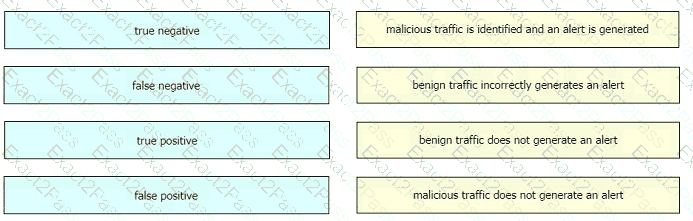
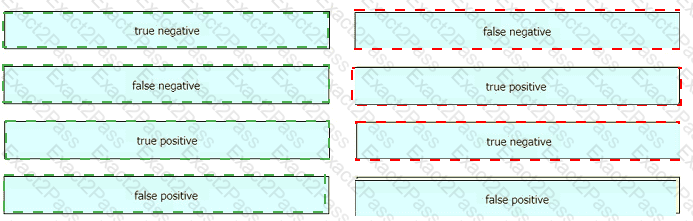
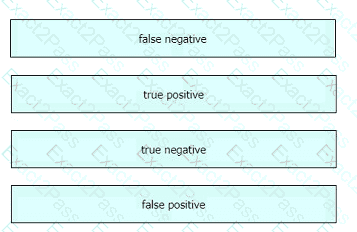
Drag and drop the event term from the left onto the description on the right.
What does cyber attribution identify in an investigation?
An engineer is working on the implementation of digital certificates for new cntical web applications One of the requirements is that the https connection must be validated and protected against malicious network impersonators The server will be exposed externally from the DMZ network Which certificate must be used?
What is the difference between a threat and an exploit?
Which classification of cross-site scripting attack executes the payload without storing it for repeated use?
Which technology assures that the information transferred from point A to point B is unaltered and authentic?
Refer to the exhibit.
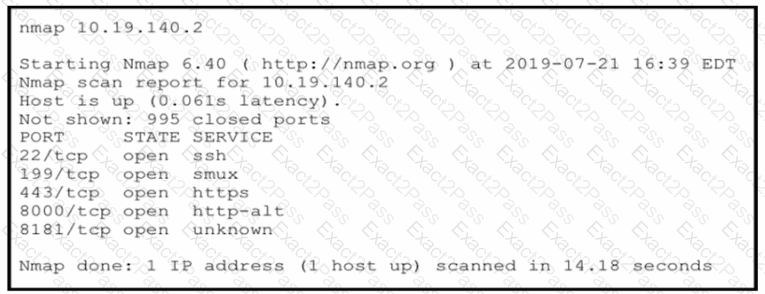
An attacker gained initial access to the company s network and ran an Nmap scan to advance with the lateral movement technique and to search the sensitive data Which two elements can an attacker identify from the scan? (Choose two.)
Which two elements are used for profiling a network? (Choose two.)
What is the difference between authentication and authorization?
An engineer is investigating a case of the unauthorized usage of the “Tcpdump” tool. The analysis revealed that a malicious insider attempted to sniff traffic on a specific interface. What type of information did the malicious insider attempt to obtain?


 A screenshot of a computer Description automatically generated