Spring Sale Special Limited Time 70% Discount Offer - Ends in 0d 00h 00m 00s - Coupon code: buysanta

Exact2Pass Menu

Implementing Cisco Enterprise Advanced Routing and Services (300-410 ENARSI)

Last Update 5 hours ago Total Questions : 642

The Implementing Cisco Enterprise Advanced Routing and Services (300-410 ENARSI) content is now fully updated, with all current exam questions added 5 hours ago. Deciding to include 300-410 practice exam questions in your study plan goes far beyond basic test preparation.

You'll find that our 300-410 exam questions frequently feature detailed scenarios and practical problem-solving exercises that directly mirror industry challenges. Engaging with these 300-410 sample sets allows you to effectively manage your time and pace yourself, giving you the ability to finish any Implementing Cisco Enterprise Advanced Routing and Services (300-410 ENARSI) practice test comfortably within the allotted time.

Question # 106

Refer to the exhibit.

A junior engineer updated a branch router configuration. Immediately after the change, the engineer receives calls from the help desk that branch personnel cannot reach any network destinations. Which configuration restores service and continues to block 10.1.1.100/32?

A.

route-map FILTER-IN deny 5

B.

ip prefix-list 102 seq 15 permit 0.0.0.0/32 le 32

C.

ip prefix-list 102 seq 5 permit 0.0.0.0/32 le 32

D.

route-map FILTER-IN permit 20

Question # 107

Which security feature can protect DMVPN tunnels?

A.

IPsec

B.

TACACS+

C.

RTBH

D.

RADIUS

Question # 108

Which protocol does MPLS use to support traffic engineering?

A.

Tag Distribution Protocol (TDP)

B.

Resource Reservation Protocol (RSVP)

C.

Border Gateway Protocol (BGP)

D.

Label Distribution Protocol (LDP)

Question # 109

Which two statements about VRF-Lite configurations are true? (Choose two.)

A.

They support the exchange of MPLS labels

B.

Different customers can have overlapping IP addresses on different VPNs

C.

They support a maximum of 512.000 routes

D.

Each customer has its own dedicated TCAM resources

E.

Each customer has its own private routing table.

F.

They support IS-IS

Question # 110

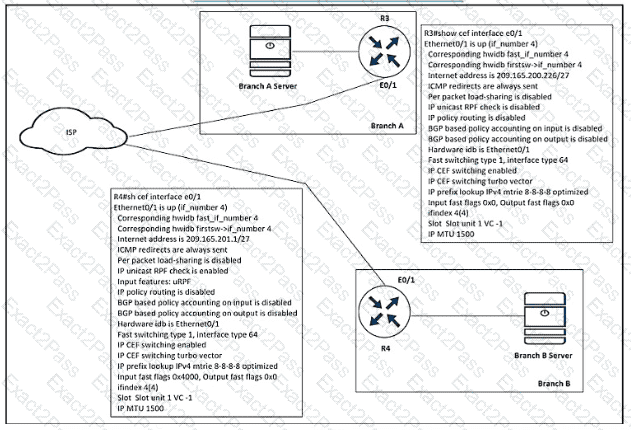
Refer to the exhibit. an engineer is trying to get 192.168.32.100 forwarded through 10.1.1.1, but it was forwarded through 10.1.1.2. What action forwards the packets through 10.1.1.1?

A.

Configure EIGRP to receive 192.168.32.0 route with lower admin distance.

B.

A. Configure EIGRP to receive 192.168.32.0 route with longer prefix than /19.

C.

A. Configure EIGRP to receive 192.168.32.0 route with lower metric.

D.

A. Configure EIGRP to receive 192.168.32.0 route with equal or longer prefix than /24.

Question # 111

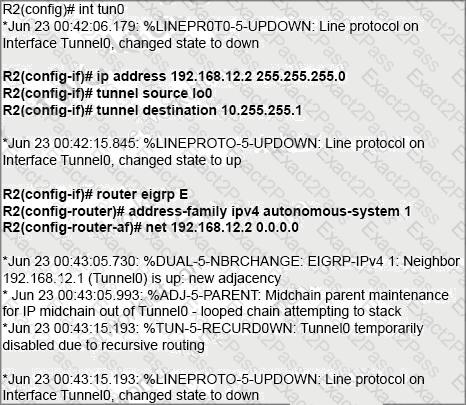
Refer to the exhibit.

An engineer configures a static route on a router, but when the engineer checks the route

to the destination, a different next hop is chosen. What is the reason for this?

A.

Dynamic routing protocols always have priority over static routes.

B.

The metric of the OSPF route is lower than the metric of the static route.

C.

The configured AD for the static route is higher than the AD of OSPF.

D.

The syntax of the static route is not valid, so the route is not considered.

Question # 112

What is an advantage of using BFD?

A.

It detects local link failure at layer 1 and updates routing table.

B.

It detects local link failure at layer 2 and updates routing protocols.

C.

It has sub-second failure detection for layer 1 and layer 3 problems.

D.

It has sub-second failure detection for layer 1 and layer 2 problems.

Question # 113

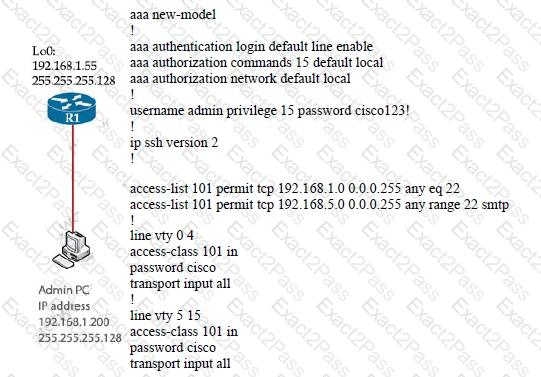
Refer to the exhibit.

Network operations cannot read or write any configuration on the device with this configuration from the operations subnet. Which two configurations fix the issue? (Choose two.)

A.

Configure SNMP rw permission in addition to community ciscotest.

B.

Modify access list 1 and allow operations subnet in the access list.

C.

Modify access list 1 and allow SNMP in the access list.

D.

Configure SNMP rw permission in addition to version 1.

E.

Configure SNMP rw permission in addition to community ciscotest 1.

Question # 114

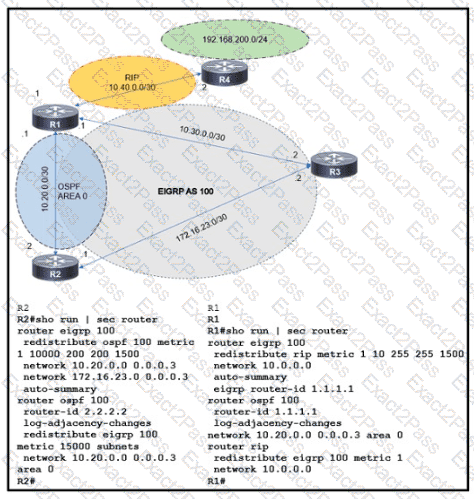
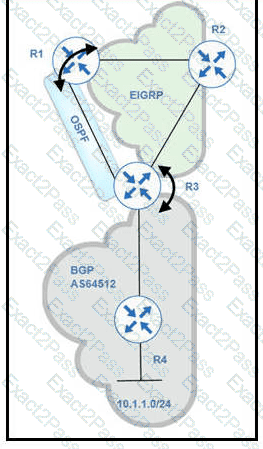
Refer to the exhibit.

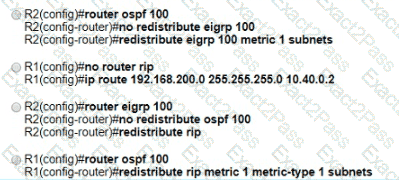
Redistribution is enabled between the routing protocols, and nowPC2 PC3, and PC4 cannot reach PC1. What are the two solutions to fix the problem? (Choose two.)

A.

Filter RIP routes back into RIP when redistributing into RIP in R2

B.

Filter OSPF routes into RIP FROM EIGRP when redistributing into RIP in R2.

C.

Filter all routes except RIP routes when redistributing into EIGRP in R2.

D.

Filter RIP AND OSPF routes back into OSPF from EIGRP when redistributing into OSPF in R2

E.

Filter all routes except EIGRP routes when redistributing into OSPF in R3.

Question # 115

What is a function of IPv6 ND inspection?

A.

It learns and secures bindings for stateless autoconfiguration addresses in Layer 3 neighbor tables

B.

It learns and secures bindings for stateless autoconfiguration addresses in Layer 2 neighbor tables

C.

It learns and secures bindings for stateful autoconfiguration addresses in Layer 2 neighbor tables.

D.

It learns and secures bindings for stateful autoconfiguration addresses in Layer 3 neighbor tables.

Question # 116

What is the output of the following command:

show ip vrf

A.

Show ' s default RD values

B.

Displays IP routing table information associated with a VRF

C.

Show ' s routing protocol information associated with a VRF.

D.

Displays the ARP table (static and dynamic entries) in the specified VRF

Question # 117

While working with software images, an engineer observes that Cisco DNA Center cannot upload its software image directly from the device. Why is the image not uploading?

A.

The device must be resynced to Cisco DNA Center.

B.

The software image for the device is in install mode.

C.

The device has lost connectivity to Cisco DNA Center.

D.

The software image for the device is in bundle mode

Question # 118

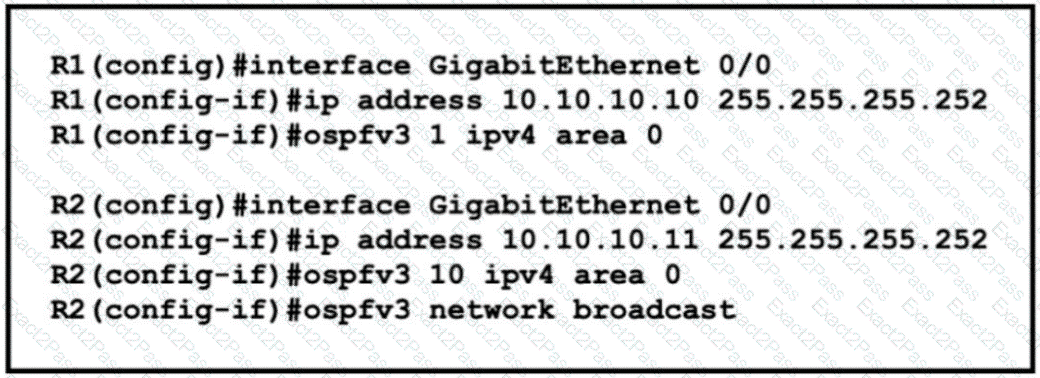
Refer to the exhibit.

The R1 and R2 configurations are:

The neighbor is not coming up. Which two sets of configurations bring the neighbors up? (Choose two.)

A.

R2ip route 10.1.1.1 255.255.255.255 192.168.1.1!router bgp 200neighbor 10.1.1.1 tti-security hops 1neighbor 10.1.1.1 update-source loopback 0

B.

R2ip route 10.1.1.1 255.255.255.255 192.168.1.1!router bgp 200neighbor 10.1.1.1 disable-connected-checkneighbor 10.1.1.1 update-source loopback 0

C.

R2ip route 10.1.1.2 255.255.255.255 192.168.1.2!router bgp 100neighbor 10.1.1.2 ttl-security hops 1neighbor 10.1.1.2 update-source loopback 0

D.

R1ip route 10.1.1.2 255.255.255.255 192.168.1.2!router bgp 100neighbor 10.1.1.1 ttl-security hops 1neighbor 10.1.1.2 update-source loopback 0

E.

R1ip route 10.1.1.2 255.255.255.255 192.168.1.2!router bgp 100neighbor 10.1.1.2 disable-connected-checkneighbor 10.1.1.2 update-source Loopback0

Question # 119

While troubleshooting connectivity issues to a router, these details are noticed:

Standard pings to all router interfaces, including loopbacks, are successful.

Data traffic is unaffected.

SNMP connectivity is intermittent.

SSH is either slow or disconnects frequently.

Which command must be configured first to troubleshoot this issue?

A.

show policy-map control-plane

B.

show policy-map

C.

show interface | inc drop

D.

show ip route

Question # 120

Which label operations are performed by a label edge router?

A.

SWAP and POP

B.

SWAP and PUSH

C.

PUSH and PHP

D.

PUSH and POP

Go to page: