Spring Sale Special Limited Time 70% Discount Offer - Ends in 0d 00h 00m 00s - Coupon code: buysanta

Exact2Pass Menu

Designing Cisco Enterprise Wireless Networks (ENWLSD)

Last Update 19 hours ago Total Questions : 286

The Designing Cisco Enterprise Wireless Networks (ENWLSD) content is now fully updated, with all current exam questions added 19 hours ago. Deciding to include 300-425 practice exam questions in your study plan goes far beyond basic test preparation.

You'll find that our 300-425 exam questions frequently feature detailed scenarios and practical problem-solving exercises that directly mirror industry challenges. Engaging with these 300-425 sample sets allows you to effectively manage your time and pace yourself, giving you the ability to finish any Designing Cisco Enterprise Wireless Networks (ENWLSD) practice test comfortably within the allotted time.

Question # 81

APs in a remote office recently have been converted from local mode to FlexConnect to take advantage of the local switching. After the change, remote wireless users report voice quality issues and bad quality on wireless IP phones while roaming. A debug is performed, and it is noticed that the 802.11r Fast Transition is not working as expected, like on local mode AP, though the same WLAN configuration is in place. What is the cause of the issue regarding the FlexConnect APs?

A.

They do not support 802.11r FT.

B.

They must be added into AP groups along with a common RF profile.

C.

They must be in a FlexConnect group to support 802.11r FT.

D.

They must be added to AP groups to support fast roaming methods.

Question # 82

Why is Dynamic Frequency Selection (DFS) important in WLAN design?

A.

To allow use of radar-detected channels in 2.4 GHz

B.

To increase AP transmit power beyond regulations

C.

To enable usage of additional 5 GHz channels while avoiding radar interference

D.

To reduce co-channel interference on 6 GHz

Question # 83

Which antenna type is best for covering a long corridor in a building?

A.

Omni-directional antenna

B.

Patch antenna

C.

Yagi antenna

D.

Dipole antenna

Question # 84

A customer called with a requirement that internal clients must be on different subnets depending on the building they are in. All access points are operating in local mode and will not be modified, and this is a single controller solution. Which design approach creates the desired result?

A.

Create AP groups for each desired location, map the correct VLANs to the internal SSID, and add the access points for that location.

B.

Create an SSID place it to the desired VLAN under WLANs and configure 802.1x in ISE to assign the correct VLAN based on the SSID from which the client is authenticating

C.

Create FlexConnect groups, place the access points in, and set the correct VLAN to SSID mapping based on location.

D.

Create mobility anchors for the SSID and on the controller under the internal SSID create a foreign map to the desired VLAN based on location.

Question # 85

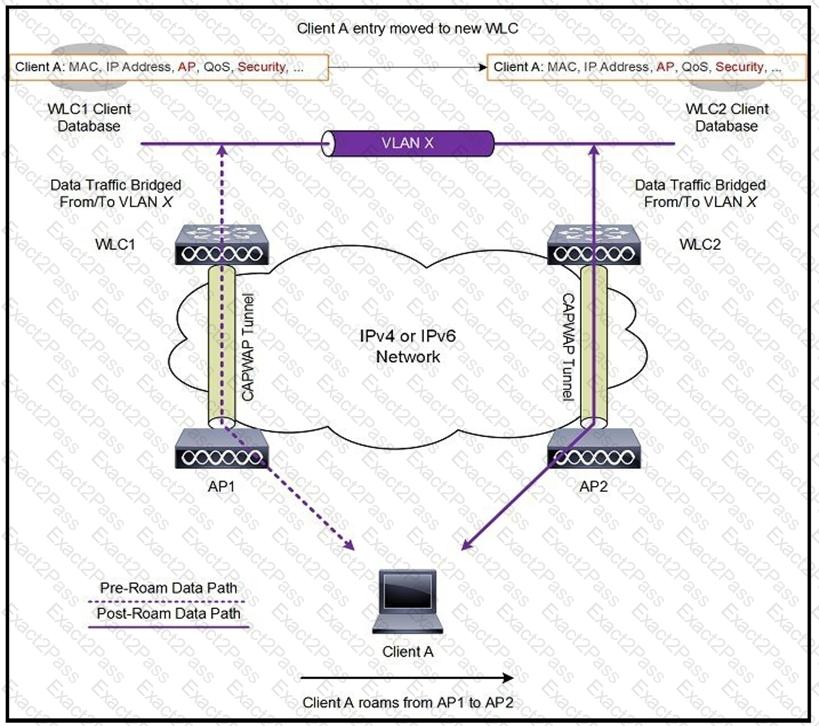
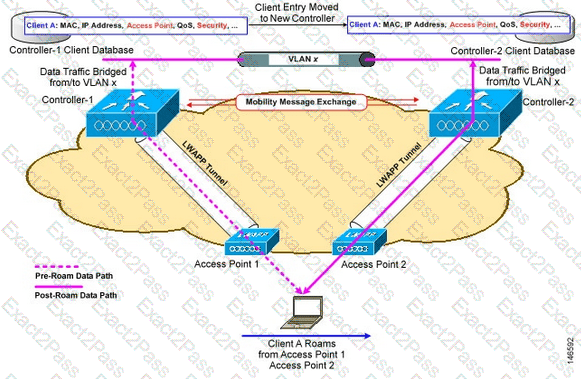
Refer to the exhibit.

A client roams between two APs that are registered to two different controllers, where

each controller has an interface in the client subnet. Both controllers are running AireOS. Which scenario explains the client roaming behavior?


A.

Controllers exchange mobility control messages (over UDP port 16666) and the client database entry is moved from the original controller to the new controller.

B.

Controllers do not exchange mobility control messages (over UDP port 16666) andthe client database, entry is not moved from the original controller to the newcontroller.

C.

Controllers exchange mobility control messages (over UDP port 16666) and a new client session is started with the new controller.

D.

Controllers exchange mobility control messages (over UDP port 16666) and the client database entry is tunneled from the original controller to the new controller.

Go to page: