Exact2Pass

Last Update 14 hours ago Total Questions : 444
The Securing Networks with Cisco Firepower (300-710 SNCF) v1.2 content is now fully updated, with all current exam questions added 14 hours ago. Deciding to include 300-710 practice exam questions in your study plan goes far beyond basic test preparation.
You'll find that our 300-710 exam questions frequently feature detailed scenarios and practical problem-solving exercises that directly mirror industry challenges. Engaging with these 300-710 sample sets allows you to effectively manage your time and pace yourself, giving you the ability to finish any Securing Networks with Cisco Firepower (300-710 SNCF) v1.2 practice test comfortably within the allotted time.
Which action must be taken on the Cisco FMC when a packet bypass is configured in case the Snort engine is down or a packet takes too long to process?
A network engineer sets up a secondary CiscoFMC that is integrated with Cisco Security Packet Analyzer What occurs when the secondary CiscoFMC synchronizes with the primary Cisco FMC?
A network administrator registered a new FTD to an existing FMC. The administrator cannot place the FTD in transparent mode. Which action enables transparent mode?
A financial services firm is configuring split-tunnel remote access VPN on a Cisco Secure Firewall Threat Defence managed by Cisco Secure Firewall Management Center. Only traffic to 10.0 0.0/8 and 172 16 0 0/12 must traverse the VPN tunnel Internet traffic must exit locally on the client. Internal DNS queries must traverse the VPN tunnel to the corporate DNS server at 10.1.1.53 for the domain corp.finserv.local. Cisco Secure Client is deployed on all endpoints. Which configuration must be done to accomplish the task?
Refer to the exhibit.
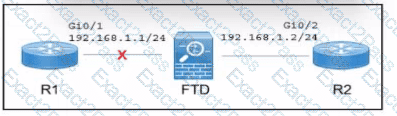
A Cisco Secure Firewall Threat Defense (FTD) device is deployed in inline mode with an inline set. The network engineer wants router R2 to remove the directly connected route M 68.1.0/24 from its routing table when the cable between routed R1 and the Secure FTD device Is disconnected. Which action must the engineer take?
1
A network engineer is logged into the Cisco AMP for Endpoints console and sees a malicious verdict for an identified SHA-256 hash. Which configuration is needed to mitigate this threat?
Network users experience issues when accessing a server on a different network segment. An engineer investigates the issue by performing packet capture on Cisco Secure Firewall Threat Defense. The engineer expects more data and suspects that not all the traffic was collected during a 15-minute can’t captured session. Which action must the engineer take to resolve the issue?
An engineer is configuring a Cisco Secure Firewall Threat Defense device and warns to create a new intrusion rule based on the detection of a specific pattern in the data payload for a new zero-day exploit. Which keyword type must be used to add a Line that identifies the author of the rule and the date it was created?
A company is in the process of deploying intrusion prevention with Cisco FTDs managed by a Cisco FMC. An engineer must configure policies to detect potential intrusions but not block the suspicious traffic. Which action accomplishes this task?
Which action should you take when Cisco Threat Response notifies you that AMP has identified a file as malware?

