Exact2Pass

Last Update 20 hours ago Total Questions : 393
The Fundamentals of financial accounting content is now fully updated, with all current exam questions added 20 hours ago. Deciding to include BA3 practice exam questions in your study plan goes far beyond basic test preparation.
You'll find that our BA3 exam questions frequently feature detailed scenarios and practical problem-solving exercises that directly mirror industry challenges. Engaging with these BA3 sample sets allows you to effectively manage your time and pace yourself, giving you the ability to finish any Fundamentals of financial accounting practice test comfortably within the allotted time.
Refer to the exhibit.

A business has the following trading account for its most recent year:
What is its rate of inventory turnover for the year?
A company uses the straight line method of depreciation for its plant and machinery. Depreciation is at a rate of 20% per annum.
A major item of machinery was purchased in 2003 at a cost of $240,000. At the time, it was estimated that the plant had an estimated useful life of five years and a residual value at the end of its useful life of $20,000.
As a result of rapid changes in technology it was decided to sell the machinery in 2006 for $80,000. It is the company ' s policy to charge a full year ' s depreciation in the year of acquisition and none in the year of disposal.
What was the profit/loss arising on the disposal of the asset?
Refer to the Exhibit.
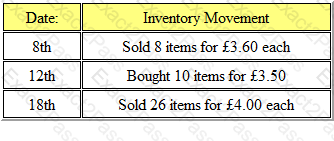
At the beginning of the month, an organization had opening inventory of 30 units of a product, valued at £3.00 each. During the month, it had inventory movements, occurring on the following dates:
Using the FIFO method of inventory valuation, the closing inventory at the end of the month was:
Give your answer to 2 decimal places.
Refer to the Exhibit.
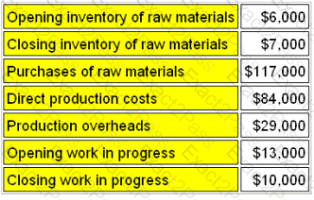
The following information is available for the period for AC Limited, a manufacturing company:
The factory cost of goods completed for the period was
Refer to the exhibit.
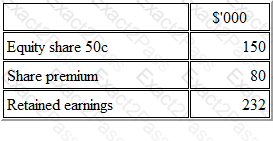
ABC has the equity balances at the end of year 1.
During year 2 ABC issues 100,000 new shares at a price of $1.10
What is the balance on share premium at the end of year 2?
STU has an accounting period end of 31 December 20X8 During the year STU paid $4,800 for business insurance to cover the year to 30 June 20X9 The amount paid for business insurance for 30 June 20X8 was $4,500.
What is the insurance expense to be recognized in the statement of profit or loss of STU for the year ended 31 December 20X8? Give your answer to the nearest $
Which of the following transactions affects profit but does not affect cash?
A company ' s payables days has reduced from 60 days to 55 days.
Which of the following could be a possible explanation for this?
A trial balance is extracted from the ledger accounts at the end of each accounting period.
Which of the following will a trial balance do?
Which one of the following does not apply when the historical cost convention is being followed?

