Exact2Pass

Last Update 19 hours ago Total Questions : 202
The Advanced Management Accounting content is now fully updated, with all current exam questions added 19 hours ago. Deciding to include P2 practice exam questions in your study plan goes far beyond basic test preparation.
You'll find that our P2 exam questions frequently feature detailed scenarios and practical problem-solving exercises that directly mirror industry challenges. Engaging with these P2 sample sets allows you to effectively manage your time and pace yourself, giving you the ability to finish any Advanced Management Accounting practice test comfortably within the allotted time.
A large company that sells a single product has many customers. The contribution per unit of the product is $40. Data for the company as a whole are given below.

Using customer profitability analysis, what is the total annual profit for this customer?
Company TTM has the opportunity to invest $60,000 in a project. The project is anticipated to produce annual returns of $12,500 each year for 8 years. The cost of capital is 12%.
What is the net present value of the project? Give your answer to the nearest whole number.
Which of the following is a key objective when agreeing a basis for setting transfer prices?
A product requires one each of three different components.
Faulty components are identified only at the end of the manufacturing process.
The following average fault rates have been identified:
Component A – 1 in 100
Component B – 1 in 20
Component C – 1 in 10
The probability that a unit of finished product contains no faulty components is:
There is a 60% probability of a project yielding a positive net present value (NPV) of $280,000 and a 30% probability of it yielding a positive NPV of $140,000.
The only other possible outcome is that the project will yield a negative NPV of $160,000.
What is the expected value of the project ' s NPV?
A company is considering investing $680,000 in a machine to manufacture a new product. A consultant has been appointed to advise on the investment and the company is committed to paying $10,000 to the consultant in year 1, even if the project does not go ahead.
300,000 units of the new product will be produced and sold each year. Unit cost and revenue information based on this level of output is as follows.
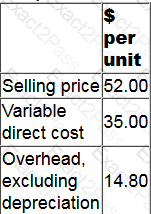
60% of the overhead cost is variable. Of the remainder, 10% consists of allocated head office overheads.
The selling price will increase by 2% each year in line with inflation, beginning in year 2. Fixed price contracts mean that all unit costs will remain unaltered.
Taxation information:
• 100% first year allowance will be available for the purchase of the machinery.
• The taxation rate is 30% of taxable profits, payable in the year after that in which the liability arises.
For the purpose of deciding whether to proceed with the investment, what is the relevant cash flow in year 2?
Which of the following statements is TRUE about the activity based costing system when compared to absorption costing method?
A learning curve applies to the manufacture of the first 256 units of a product.
During the manufacture of the first 255 units, the time taken to produce each successive unit is expected to:
The following cash flows are forecast for a potential investment project.
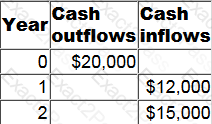
The cost of capital for the project is 12% per year and the company uses a straight line depreciation policy.
What is the modified internal rate of return (MIRR) of the project?
Give your answer to the nearest whole percentage.
The directors of a company wish to evaluate two mutually exclusive capital investment projects. Both projects have conventional cash flows: an initial outflow followed by a series of annual cash inflows.
The directors are aware of the following three investment appraisal methods: internal rate of return (IRR), net present value (NPV) and accounting rate of return (ARR).
The directors have asked for your advice about which method should be used to evaluate these two projects.
Which of the following is valid advice to give to the directors?

