Exact2Pass

Last Update 20 hours ago Total Questions : 393
The Fundamentals of financial accounting content is now fully updated, with all current exam questions added 20 hours ago. Deciding to include BA3 practice exam questions in your study plan goes far beyond basic test preparation.
You'll find that our BA3 exam questions frequently feature detailed scenarios and practical problem-solving exercises that directly mirror industry challenges. Engaging with these BA3 sample sets allows you to effectively manage your time and pace yourself, giving you the ability to finish any Fundamentals of financial accounting practice test comfortably within the allotted time.
The following is an extract of the trial balance of XYZ as at 31 December 20X7
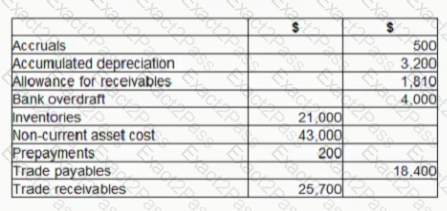
What is the total value of assets to be included in the statement of financial position? Give your answer to the nearest $

Which ONE of the following does not apply to the preparation of management accounts?
A company has a receivables balance at the end of the year of £120,000. The company maintains an allowance for receivables at 3% of closing receivables. The opening balance on the allowance was £ 2,880. During the year bad debts of £ 3,000 were written off
The total charge for bad debts for the year is £
Refer to the Exhibit.
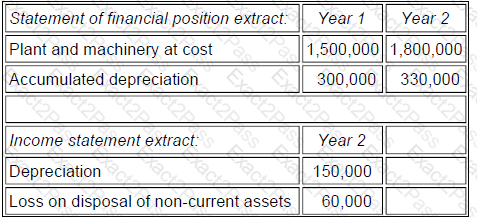
The following information is available relating to the non-current assets of Company X:
Non-current assets that had originally cost $225,000 and had a carrying value of $105,000 were sold during the year.
The figure for purchases of non-current assets to be shown in the statement of cash flows will be, to the nearest $1,000:
Which of the following is an example of where the historic cost convention should be applied?
Your organization owed VAT of $22,700 at the beginning of the month.
During the month, it sold standard-rated goods with a net value of $600,000. Its purchases and expenses during the same month amounted to $188,000 including VAT. It paid VAT to the Revenue and Customs, of $33,400. The VAT rate is 17.5%
At the end of the month, the balance on the VAT account was:
Which THREE of the following internal controls are procedures to help detect errors?
Which of the following would be a role of the management accountant?
Refer to the Exhibit.

From the following information, calculate the value of sales for the period:
Value of sales is
In a manufacturing company, prime costs is the total of

