Exact2Pass

Last Update 3 hours ago Total Questions : 1259
The Chartered Wealth Manager (CWM) Certification Level II Examination content is now fully updated, with all current exam questions added 3 hours ago. Deciding to include CWM_LEVEL_2 practice exam questions in your study plan goes far beyond basic test preparation.
You'll find that our CWM_LEVEL_2 exam questions frequently feature detailed scenarios and practical problem-solving exercises that directly mirror industry challenges. Engaging with these CWM_LEVEL_2 sample sets allows you to effectively manage your time and pace yourself, giving you the ability to finish any Chartered Wealth Manager (CWM) Certification Level II Examination practice test comfortably within the allotted time.
Section A (1 Mark)
A testator sometimes make two wills one relating to his property in his native country and other relating to his property in some foreign country this type of will is called
Section A (1 Mark)
Deduction u/s 80U in case of permanent physical disability (including blindness) allowed to:
Section C (4 Mark)
Read the senario and answer to the question.
As a CWM® which option would you recommend from the following to Neeraj and Kapil so that their tax liability is minimum if they invest in the debt based scheme
Section A (1 Mark)
The principle that people do not buy or rent real estate, but judge properties as different sets of benefits and costs is called
Section B (2 Mark)
As a result of a lawsuit, Catherine was awarded $300,000 for compensatory damages and $400,000 for punitive damages. What is the taxable income resulting from this suit?
Section B (2 Mark)
Calculate the value at which an office building can be priced from the following information:
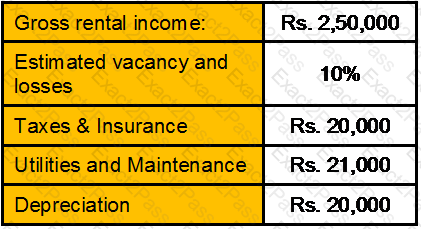
A similar building has 8% capitalization rates.
Section C (4 Mark)
Suppose Sunil visits his favorite coffee shop and encounters his good friend Rohit. Rohit raves about his stockbroker, whose firm employs an analyst who appears to have made many recent successful stock picks. The conversation goes something like this:
SUNIL: Hi, Rohit, how are you?
ROHIT: Hi, Sunil. I’m doing great! I’ve been doing superbly in the market recently.
SUNIL: Really? What’s your secret?
ROHIT: Well, my broker has passed along some great picks made by an analyst at her firm.
SUNIL: Wow, how many of these tips have you gotten?
ROHIT: My broker gave me three great stock picks over the past month or so. Each stock is up now, by over 10 percent.
SUNIL: That’s a great record. My broker seems to give me one bad pick for every good one. It sounds like I need to talk to your broker; she has a much better record!
Which of the following biases have been exhibited by Gaurav?
Section A (1 Mark)
The two components of EPS are
Section B (2 Mark)
Equity stock of X ltd. is currently selling at Rs. 35/- per share. The dividend expected next year is Rs. 2/- per share and the investor’s required return in this stock is 15 % per annum. If the constant Growth Model applies to X ltd. then calculate the Growth Rate.
Section A (1 Mark)
The most profitable credit card customers for a bank are those that:
Section B (2 Mark)
As per Double Taxation Avoidance Agreement, the Royalties in UAE is charged at:
Section A (1 Mark)
………………………arises by operation of law eg trust created under MWP Act
Section A (1 Mark)
Which of following is not an exclusion under a health policy?
Section C (4 Mark)
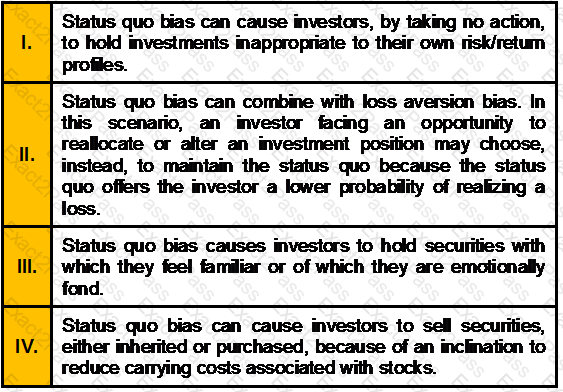
Which of the following statements is/are correct?
Section B (2 Mark)
Jaipur Golden Railroad reported net income of Rs770 million in 1993, after interest expenses of Rs. 320 million. (The corporate tax rate was 36%.) It reported depreciation of Rs.960 million in that year, and capital spending was Rs1.2 billion. The firm also had Rs. 4 billion in debt outstanding on the books, rated AA (carrying a yield to maturity of 8%), trading at par (up from Rs3.8 billion at the end of 1992). The beta of the stock is 1.05, and there were 200 million shares outstanding (trading at Rs 60 per share), with a book value of Rs5 billion. Jaipur Golden paid 40% of its earnings as dividends and working capital requirements are negligible. (The treasury Bill rate is 7%.)
Estimate the free cash flow to the firm in 1993.
Section A (1 Mark)
Debt ratio is
Section B (2 Mark)
In 2011-12, an individual receives a net dividend of £648. The equivalent gross income is:
Section A (1 Mark)
Which of the following industry categories is said to be “bought to be sold?”
Section A (1 Mark)
Customer services are defined as:
Section A (1 Mark)
A document which is used to hand over the legal powers to sign on legal documents pertaining to the property to someone other than the owner is called_____________
Section A (1 Mark)
In case of non-resident, who is carrying on shipping business, his Indian income shall be presumed to be:
Section A (1 Mark)
All of the following are examples of capital expenditures except:
Section A (1 Mark)
According to the __________________ if irrational traders cause deviations from fundamental value, rational traders will often be powerless to do anything about it.
Section A (1 Mark)
Fiscal termites are factors that threaten the integrity of tax systems, and most of which relate to the internationalization of tax. These are:

Section C (4 Mark)
Read the senario and answer to the question.
Sajan and Jennifer want to accumulate funds for their vacation expenses as per their determined goal. They want to invest a fixed amount immediately from the Bonus amount he has received, and then in the beginning of every financial year till April, 2020 in a separate scheme of an Equity Mutual Fund. He would withdraw the required amount annually as adjusted for inflation from the Scheme from April, 2021 till April, 2036 for undertaking vacation trips. What approximate amount should be invested every year to achieve this goal?
Section B (2 Mark)
If two customers choose exactly the same package of certain service, but customer A calls for help weekly and customer B calls only twice a year, which is most valuable customer?
Section B (2 Mark)
Amit has just received new information regarding his investment in PLC ltd. The new information appears to be in conflict with earlier forecast of what the stock price should be at this point. He is still willing to incorporate the new information into his forecast and to revise it accordingly.
Which behavioral heuristic is Amit displaying?
Section A (1 Mark)
Long-term cash flow improvement may not be achieved by
Section A (1 Mark)
A bank is considering making a loan to Sumit Nayyar. Mr. Sumit has Rs 1,00,000 in the bank right now but generally keeps a balance of Rs 4,50,000 most of the year. What aspect of evaluating a consumer loan application is this fact concerned with?
Section B (2 Mark)
Which of the following statements is correct?
Section A (1 Mark)
When markets are in equilibrium, the CML will be upward sloping
Section B (2 Mark)
Consider the one-factor APT. The variance of returns on the factor portfolio is 6%. The beta of a well-diversified portfolio on the factor is 1.1. The variance of returns on the well-diversified portfolio is approximately __________.
Section A (1 Mark)
The________________ deals with the double-edged enigma of why individuals like dividends (in developed country where dividends are taxable) and why this method of income distribution persists in light of quite burdensome double taxation.
Section B (2 Mark)
Any income chargeable under the based “Salaries” is exempt from tax under Section 10(6)(viii), if it is received by any non resident individual as remuneration for services rendered in connection with his employment in a foreign ship where his total stay in India does not exceed a period days in that previous year.
Section A (1 Mark)
For a “single income family” priority is on
Section B (2 Mark)
Withholding Tax Rates for payments made to Non-Residents are determined by the Finance Act passed by the Parliament for various years. The current rates for Technical Services are:
Section C (4 Mark)
Which of the following would you consider the best indicator of an undervalued firm?

Section C (4 Mark)
United Healthcare, a health maintenance organization, is expected to have high earning growth for the next five years and 6% after that. The dividend payout ratio will be only 10% during the high growth phase, but will increase to 60% in steady state. The return on equity was 21% in the most recent time period and is expected to stay at that level for the next 5 years. The stock has a beta of 1.65 currently, but the beta is expected to drop to 1.10 in steady state. (The treasury bill rate is 7.25%.)
Estimate the price/book value ratio for United Healthcare, given the inputs above.
Section A (1 Mark)
Which of the following is not a derivative transaction?
Section C (4 Mark)
Suppose ABC Ltd. is trading at Rs 4500 in June. An investor, Mr. A, shorts Rs 4300 Put by selling a July Put for Rs. 24 while shorting an ABC Ltd. stock. The net credit received by Mr. A is Rs. 4500 + Rs. 24 = Rs. 4524.
What would be the Net Payoff of the Strategy?
• If ABC Ltd closes at 4053
• If ABC Ltd closes at 5025
Section A (1 Mark)
Which of the following is a market anomaly?
Section B (2 Mark)
A fixed-rate mortgage for Rs210 000 with monthly payments is amortized over 20 years. The interest rate is 4.85% compounded semi-annually for a 7-year term. How much of the mortgage principal has been repaid by the end of the 7-year term?
Section C (4 Mark)
Suppose that an investor makes an investment in Stock ABC and that over the next 12 months ABC appreciates by 10 percent. He then thinks of selling ABC for normal portfolio rebalancing purposes, but then come across an item in the, The Economic Times that sparks new optimism: Could ABC climb even higher?
Which answer describes the likeliest response from an investor with regard to exhibiting Regret Aversion Bias, given ABC’s recent performance and this new information?

Section B (2 Mark)
Actual Loss ratio is
Section C (4 Mark)
Read the senario and answer to the question.
Vinay wants to have 80% of the desired retirement corpus from his monthly savings from now itself. If he expects to earn 12% p.a. on these savings, how much amount should the couple save at the end of each month to achieve this target?
Section C (4 Mark)
Mohan recommend that the stock of AZB Ltd. is a good purchase at Rs. 25. You do an analysis of the firm, determining that the Rs. 1.40 dividend and earnings should continue to grow indefinitely at 8% annually. The firm’s beta co-efficient is 1.34 and the yield on Treasury bills is 7.4%. If you expect the market to earn a return of 12 % should you follow Mohan’s suggestion?
Section B (2 Mark)
You buy a share of ABC Ltd for Rs. 20. You expect it to pay dividends of Re.1, Rs.1.10 and Rs.1.21 in coming three years. Calculate the growth rate in dividend:
Section C (4 Mark)
Rhona has a daughter Zena five years old. She wants to plan for Zena’s education and has found out that she would be requiring 2,75,000 at her age 18 and another 4,50,000 on her age 25. She also wants to have Rs. 10,00,000 for Zena’s Marriage which she expects at the age of 28. She wants to deposit the entire amount for these expenses today in an account that pays a ROI of 15% per annum compounded annually. What would this amount be?
Section A (1 Mark)
The two primary tools of a technical analyst are:
Section B (2 Mark)
If a stock GHI ltd pays an annual dividend of Rs. 5 and plans to follow this policy for ever, then what would be the ate of return that investor would realize given the current market price of stock is 100?

