Exact2Pass

Last Update 3 hours ago Total Questions : 1259
The Chartered Wealth Manager (CWM) Certification Level II Examination content is now fully updated, with all current exam questions added 3 hours ago. Deciding to include CWM_LEVEL_2 practice exam questions in your study plan goes far beyond basic test preparation.
You'll find that our CWM_LEVEL_2 exam questions frequently feature detailed scenarios and practical problem-solving exercises that directly mirror industry challenges. Engaging with these CWM_LEVEL_2 sample sets allows you to effectively manage your time and pace yourself, giving you the ability to finish any Chartered Wealth Manager (CWM) Certification Level II Examination practice test comfortably within the allotted time.
Section A (1 Mark)
Conclusions about technical analysis suggest that:
Section B (2 Mark)
Which one of the above statements is/are not a important needs of clients in the context of relationship management?

Section B (2 Mark)
NRIs are granted a special benefit by way of an option of being taxed at concessional tax rate of ________ as regards "investment income" and _______ as regards "long term capital gains" arising from "specified assets.
Section A (1 Mark)
Endorsements modify
Section B (2 Mark)
The modified duration of a bond is 7.87. The percentage change in price using duration for a yield decrease of 110 basis points is closest to:
Section B (2 Mark)
On 1st February 2009, Mr. Dutt took a personal loan of Rs. 1,00,000 for a period of 3 years at an 21% rate of interest .The loan is to be on monthly EMI on monthly reducing balance method.
What would be interest and principal amount to be paid in November 2011?
Section A (1 Mark)
The first step of portfolio management is:
Section A (1 Mark)
Which of the following statements regarding inflation and investing are true?
Section A (1 Mark)
Fiscal policy is difficult to implement quickly because
Section C (4 Mark)
Division Z is a profit centre, which produces four products A, B, C and D, Each product is sold in the external market also. Date for the period is as follows:
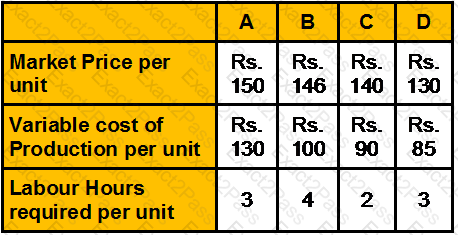
Product D can be transferred to division Y but the maximum quantity that might be required for transfer is 2,500 units of D.
The maximum sales in the external market are:

Division Y can purchase the same product at a slightly cheaper price of Rs. 125 per unit instead of receiving transfer of product D from division Z.
What should be transfer price for each unit for 2500 units of D, if the total labour hours available in division Z is:
Section A (1 Mark)
Fundamental Analysis of security valuation includes …………
Section C (4 Mark)
Read the senario and answer to the question.
Vinay has come across two projects, each with a 12% required rate of return and under given cash flows:
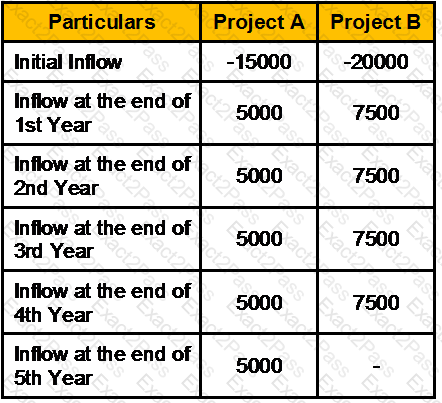
If the projects are independent, you being a CWM® would advise Vinay to:
Section A (1 Mark)
Individuals define risk as:
Section C (4 Mark)
You are given the following set of data:
Historical Rate of Return
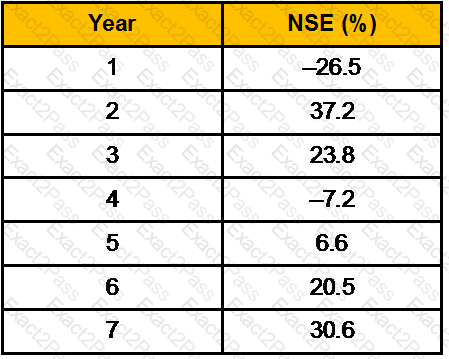
Determine the arithmetic average rates of return and standard deviation of returns of the NSE over the period given.
Section A (1 Mark)
Which of the following is a risk of using credit derivatives?
Section A (1 Mark)
A public trust is created for the benefit of
Section A (1 Mark)
Technical analysis reflects the idea that stock prices
Section A (1 Mark)
_____________ is defined as fairness in spending in US.
Section A (1 Mark)
Which of the following is not a broad category of Alpha drivers?
Section B (2 Mark)
In order to determine the residential status of an NRI returning to India for permanent settlement, for the year of return, besides the stay not exceeding 181 days an additional condition is applicable that of stay not totalling to____________ days or more in relevant year if his stay in earlier ___________ years totaled to 365 days or more.
Section A (1 Mark)
Which one of the following statements is false?
Section B (2 Mark)
Reliable ltd. has current earnings per share of Rs. 5. Assume a dividend – payout ratio of 50 percent. Earnings grow at a rate of 9 percent per year. If the required rate of return is 14 percent, what is its current value?
Section C (4 Mark)
Dinex Ltd, a leader in the development and manufacture of electronic devices, reported earnings per share of Rs 2.02 in 2003, and paid no dividends. These earnings are expected to grow 14% a year for five years (2004 to 2008) and 7% a year after that. The firm reported depreciation of Rs 2 million in 2003 and capital spending of Rs 4.20 million, and had 7 million shares outstanding. The working capital is expected to remain at 50% of revenues, which were Rs 106 million in 2003, and are expected to grow 6% a year from 2004 to 2008 and 4% a year after that. The firm is expected to finance 10% of its capital expenditures and working capital needs with debt. Dinex Ltd had a beta of 1.20 in 2003, and this beta is expected to drop to 1.10 after 2008. The current risk free rate is 7%.
Estimate the value per share today, based upon the FCFE model.
Section B (2 Mark)
The Motor Vehicle Insurance Policy has inbuilt cover for death/disability of driver/owner caused by accident during the use of the insured motor vehicle up to Rs. __________ in case of car/commercial vehicle and Rs. _________ in case of two wheelers.
Section A (1 Mark)
Rapid accumulation stage suggests that the net worth is ________
Section B (2 Mark)
In the year to 31 March 2012, A Ltd (which is UK resident) made a UK trading profit of £100,000. The company's only other income consisted of rents received of £52,500 (net) from an investment property in Germany. These rents were received net of withholding tax of 25%. A Ltd has no associated companies.
The credit for double tax relief that will be given in the corporation tax computation for the year will be:
Section A (1 Mark)
The covariance of market’s returns and stock returns is 0.005. The standard deviation of market’s return is 5%. What is the stock’s beta?
Section A (1 Mark)
An example of a highly cyclical industry is ________.
Section A (1 Mark)
The use of P/E ratios to select stocks suggests that
Section A (1 Mark)
A ____________________ tax system takes the same percentage of each person's income, regardless of whether the income is high, medium, or low.
Section C (4 Mark)
Suppose Nifty is at 4500 in May. An investor, Mr. A, executes a Short Strangle by selling a Rs. 4300 Nifty Put for a premium of Rs. 23 and a Rs. 4700 Nifty Call for Rs 43.
What would be the Net Payoff of the Strategy?
• If Nifty closes at 3735
• If Nifty closes at 5265
Section B (2 Mark)
Which of the following is true with regard to wealth planner’s liability?
Section B (2 Mark)
_____________ begins with the price at which a product that has been purchased from an Associated Enterprise AE is resold to an independent enterprise
Section C (4 Mark)
Puspinder Singh Ahluwalia took a housing loan on 1st. of June 2009 (EMI in arrear) of Rs. 50 lacs at a ROI of 10.75% p.a. compounded monthly for 12 years. He wants to know the deduction in taxable income he can claim u/s 24 of the IT act for the FY 2011 -12
Section B (2 Mark)
As per Double Taxation Avoidance Agreement, the Royalties in UK is charged at:
Section A (1 Mark)
Generally speaking, high severity of losses will be accompanied by
Section A (1 Mark)
All but one of the following are advantages of exchange-traded funds:
Section B (2 Mark)
You purchased one XYZ March 50 call and sold one XYZ March 55 call. Your strategy is known as
Section C (4 Mark)
Mr. Peter sells a Nifty Put option with a strike price of Rs. 4000 at a premium of Rs. 21.45 and buys a further OTM Nifty Put option with a strike price Rs. 3800 at a premium of Rs. 3.00 when the current Nifty is at 4191.10, with both options expiring on 31st July.
What would be the Net Payoff of the Strategy?
• If Nifty closes at 3800
• If Nifty closes at 4500
Section B (2 Mark)
Which of the following two outcomes is an example of Loss Aversion Bias:

Section A (1 Mark)
Wealth Conservation is _____________
Section A (1 Mark)
The proposed Fair Tax would change the U.S. tax system and instead:
Section B (2 Mark)
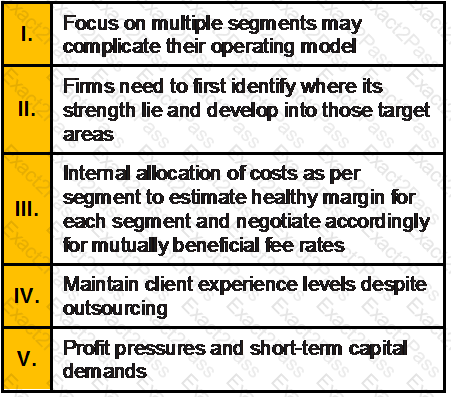
Which of the following is/are the Potential Challenges for wealth management players in India:
Section C (4 Mark)
Mr. XYZ is bullish about ABC Ltd stock. He buys ABC Ltd. at current market price of Rs. 4000 on 4th July. To protect against fall in the price of ABC Ltd. (his risk), he buys an ABC Ltd. Put option with a strike price Rs. 3900 (OTM) at a premium of Rs. 143.80 expiring on 31st July.
What would be the Net Payoff of the Strategy?
• If ABC Ltd closes at 3458
• If ABC Ltd closes at 4352
Section B (2 Mark)
The feature of the APT that offers the greatest potential advantage over the CAPM is the ______________.
Section B (2 Mark)
After making an investment, assume that an investor overhears a news report that has negative implications regarding the potential outcome of the investment he has just executed. How likely is he to then seek information, if he exhibits self attribution bias, that could confirm that you’ve made a bad decision?
Section A (1 Mark)
CRM is considered as a:
Section A (1 Mark)
A zero-investment portfolio with a positive expected return arises when _________.
Section C (4 Mark)
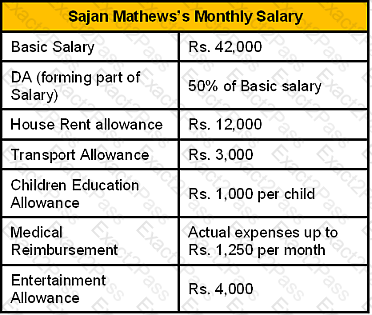
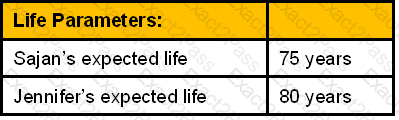
Sajan Mathews, aged 29 years (as on 2nd April, 2010), is working with a Multi National Company since December 2004. He has approached you, a CWM® for preparing his wealth plan. He is staying in his own house at Ahmedabad. His wife Jennifer, aged 31 years, is a fashion designer. She has earned a net profit of Rs. 4 lakh in FY 2008-09. They have a son, Mark of age 4 years (born on 12.02.2006), and a daughter, Stephanie (born on of 23.09.2009). Sajan is also supporting his parents staying in their own house at Surat to whom he sends Rs. 10,000 p.m. His monthly house hold expenses are Rs. 30000 p.m. (excludes his investments, payment of premia and EMIs). Sajan normally gets 5% increase in his gross salary year-on-year in the beginning of every financial year, apart from bonus. The effect for this year is yet to take place, though he has received a bonus of Rs. 3,31,680 for the year 2009-10. He has taken a family floater policy for health insurance involving an annual premium of Rs. 16268 and a total cover of Rs. 15 lakh.
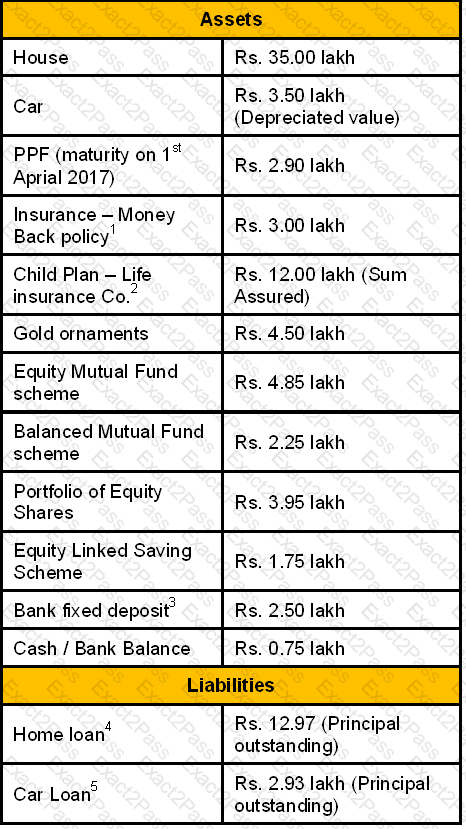
Current Assets & Liabilities of the Family (As on 31st March, 2010 unless otherwise specified in foot notes)
____________
1. Purchased on 25th October, 2006, annual premium paid Rs. 14,798
2. Purchased on Mark’s 2nd birthday for a term of 15 years; annual premium Rs. 41,374
3. Subscribed on 01.09.2008 @ 10% p.a., with interest credited quarterly to his savings account; renewed at same rate for one year on 01.09.2009 without penal provision for premature withdrawal
4. Home loan of Rs. 17 lakh taken on 1st November, 2004 at a fixed interest of 7.5% p.a. for a 15 year term.
5. Car loan of Rs. 4.50 lakh taken on 1st April, 2008 at a fixed interest of 11.25% p.a. for a 4-year term.
Goals:
1. To provide for higher education of Mark and Stephanie. Initial expenses at their respective age of 18 years, Rs. 3 lakh (current cost), and subsequently Rs. 2 lakh p.a. for the next two years, and Rs. 3.5 lakh p.a. for the following 2 years.
2. Marriage expenses of Rs. 15 lakh (current cost) for each child at their respective age of 27 years.
3. Retirement corpus at the age of 58 years to sustain 70% of pre-retirement household expenses till his lifetime and 50% till stephanie’s expected life.
4. A Bigger house valued at Rs. 50 lakh today, a year from now.
5. To build a separate fund for vacation expenses of Rs. 2 lakh (at current cost) every year 10 years from now so that the corpus so built is self-sustaining till the marriage of Stephanie.
Assumptions:
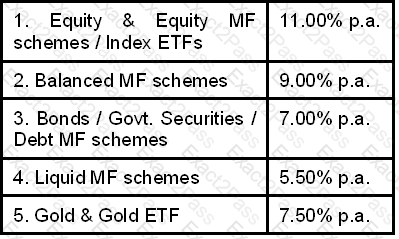
Regarding long-term pre-tax returns on various asset classes:
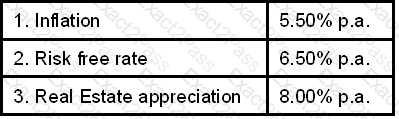
Regarding economic factors:
Section C (4 Mark)
As an investor you have a required rate of return of 14 percent for investments in risky stocks. You have to analyze three risky firms and must decide which (if any) to purchase. Your information is
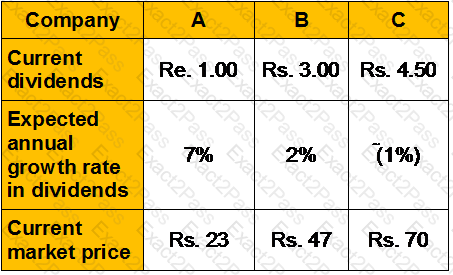
What is the maximum price? Which (if any) should buy?

