Exact2Pass

Last Update 2 hours ago Total Questions : 1259
The Chartered Wealth Manager (CWM) Certification Level II Examination content is now fully updated, with all current exam questions added 2 hours ago. Deciding to include CWM_LEVEL_2 practice exam questions in your study plan goes far beyond basic test preparation.
You'll find that our CWM_LEVEL_2 exam questions frequently feature detailed scenarios and practical problem-solving exercises that directly mirror industry challenges. Engaging with these CWM_LEVEL_2 sample sets allows you to effectively manage your time and pace yourself, giving you the ability to finish any Chartered Wealth Manager (CWM) Certification Level II Examination practice test comfortably within the allotted time.
Section B (2 Mark)
When the income of an individual includes Rs. 20000 as the income of his minor child in terms of section 64(1A), taxable income in this respect will be:
Section C (4 Mark)
Phoenix Ltd has Rs 50,00,000 in total assets. The company’s assets are financed with Rs 10,00,000 of debt, and Rs 40,00,000 million of common equity. The company’s income statement is summarized below:
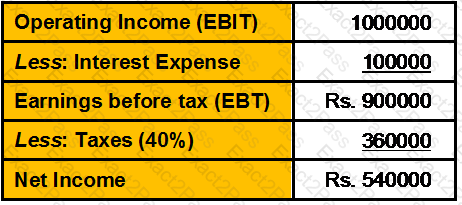
The company wants to increase its assets by Rs 10, 00,000, and it plans to finance this increase by issuing Rs 10, 00,000 in new debt. This action will double the company’s interest expense, but its operating income will remain at 20 percent of its total assets, and its average tax rate will remain at 40 percent. If the company takes this action, which of the following will occur:
Section C (4 Mark)
Read the senario and answer to the question.
Calculate the retirement corpus required by Raman to generate his post-retirement expenses.
Section A (1 Mark)
__________ is a tangible company asset that can (and should) be inventoried and managed.
Section C (4 Mark)
Medicon is one the world's largest manufacturer of implantable biomedical devices, reported earnings per share in 1993 of Rs3.95, and paid dividends per share of Rs0.68. Its earnings are expected to grow 16% from 1994 to 1998, but the growth rate is expected to decline each year after that to a stable growth rate of 6% in 2003. The payout ratio is expected to remain unchanged from 1994 to 1998, after which it will increase each year to reach 60% in steady state. The stock is expected to have a beta of 1.25 from 1994 to 1998, after which the beta will decline each year to reach 1.00 by the time the firm becomes stable. (The Risk Free rate is 6.25%.)
Estimate the value per share, using the three-stage dividend discount model.
Section C (4 Mark)
A Portfolio manager is holding the following portfolio:
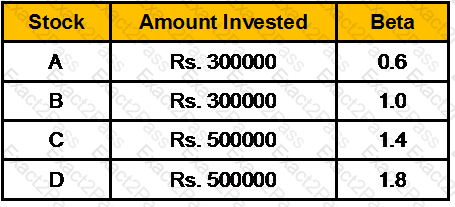
The risk free rate of return is 6% and the portfolio’s required rate of return is 12.5%. The manager would like to sell all of his holdings in stock A and use the proceeds to purchase more shares of stock D. What would be the portfolio’s required rate of return following this change?
Section A (1 Mark)
The "lockup" problem involved in rebalancing refers to the:
Section A (1 Mark)
Which of the following is true regarding the resistance level?
Section C (4 Mark)
Read the senario and answer to the question.
Harish wants to go abroad on a family vacation tour in January next year. A tour operator is offering him a package in which he has to pay only Rs. 20,000 on 1st January, 2011 which is 10% upfront amount, while the remaining amount is to be repaid in 36 EMIs of Rs. 7,500 each, first EMI payable on 1st February, 2011. Harish wants to know the annual effective rate of interest which he may incur in subscribing to this offer.
Section C (4 Mark)
As a CWM you are required to calculate the tax liability of an individual whose Taxable income is:
• $ 85650 in US dollars and he is a US citizen (single individual)
• $ 159000 in SGD and he is a citizen of Singapore
Section A (1 Mark)
An example of ________ is that a person may reject an investment when it is posed in terms of risk surrounding potential gains but may accept the same investment if it is posed in terms of risk surrounding potential losses.
Section B (2 Mark)
The income exemption threshold in respect of income year ending 30 June 2009 is as follows for an individual with two dependents in Mauritus is:
Section A (1 Mark)
The life-cycle theory of asset allocation proposes that as investors progress through life, their
Section B (2 Mark)
A dealer sold one January Nifty futures contract for Rs.250,000 on 15th January. Each Nifty futures contract is for delivery of 50 Nifties. On 25th January, the index closed at 5100. How much profit/loss did he make ?
Section C (4 Mark)
The following were P/E ratios for some Asian markets in February 1994, with relevant information on interest rates and economic growth:
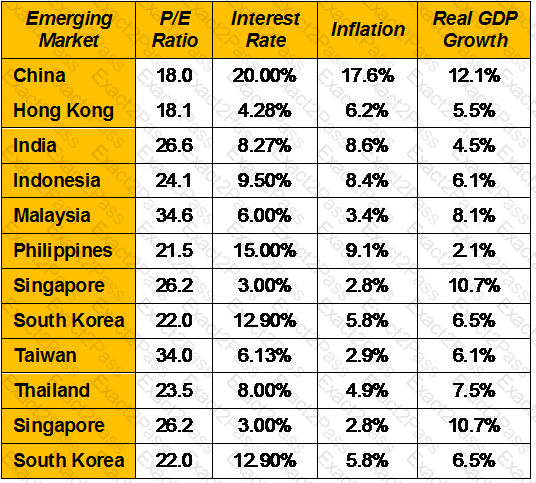
Assuming the dividend payout ratio in each of these countries is 60%, estimate the P/E ratio in South Korea and Thailand, based upon stable growth. (Use a risk premium of 7.5% over the risk-free rate in each country.)
Section C (4 Mark)
Belstate reported net income of Rs221 million in 1993 on revenues of Rs8298 million. It paid out 31% of its earnings as dividends, a payout ratio that is expected to remain level from 1994 to 1998, during which period earnings growth is expected to be 13.5%. After 1998, earnings growth is expected to decline to 6%, and the dividend payout ratio is expected to increase to 60%. The beta is 1.15 and this figure is expected to remain unchanged. The treasury bill rate is 7%.
Estimate the price/sales ratio for Walgreens, assuming its profit margin remains unchanged at 1993 levels.
Section B (2 Mark)
The lesson from the credit crisis of 2007-2009 is that securitized assets and credit swaps are:
Section B (2 Mark)
A bank has a limited geographic area. It would like to diversify its loan income with loans in other market areas but does not want to actually make loans in those areas because of their limited experience in those areas. Which type of credit derivative contract would you most recommend for this situation?
Section A (1 Mark)
____________means that people resist inequitable outcomes; i.e., they are willing to give up some material payoff to move in the direction of more equitable outcomes.
Section A (1 Mark)
In “CAMPARI” Model, R stands for:
Section A (1 Mark)
A company making an IPO can avail which of the following option?
Section A (1 Mark)
A cognitive heuristic in which people tend to reach conclusions based on the 'framework' within which a situation is presented; e.g. people are more lokely to recommend the use of a new procedure if it is described as having a '50% success rate' than a '50% failure rate'. Which of the following is most likely consistent with this bias?
Section A (1 Mark)
The last step in fundamental analysis is:
Section B (2 Mark)
Information processing errors consist of

Section B (2 Mark)
According to the put-call parity theorem, the value of a European put option on a non-dividend paying stock is equal to:
Section A (1 Mark)
As per Hindu succession Act
Section C (4 Mark)
A 14% semiannual-pay coupon bond has six years to maturity. The bond is currently trading at par. Using a 25 basis point change in yield, the effective duration of the bond is closest to:
Section A (1 Mark)
REITs offer all of these, except:
Section C (4 Mark)
Read the senario and answer to the question.
The present household expenses of Mr Bhatia is Rs. 3,00,000 p.a. but if he were to retire today he would require only Rs. 2,25,000 p.a. Calculate his required retirement corpus if interest rate is 12% p.a. and inflation rate is 7%.
Section C (4 Mark)
Read the senario and answer to the question.
Mrs. Deepika’s brother is impressed with Manav Fashion Ltd. an online clothing firm that focuses on the 18–22 age bracket. Their prices are much lower than their competitors, and the quality is high. Reading about the firm on its web site and in various financial newspapers, her brother has learned that the company plans to expand its clothing lines. The prevailing price of its share is 70 per share. Manav Fashion Ltd. has had recent annual earnings of Rs. 5 per share. Only three other companies have very similar business to Manav Fashion Ltd. and have stock that is traded and there PE ratios are as follows:
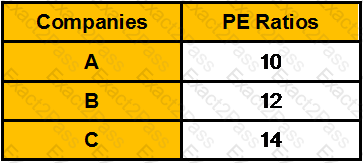
Her brother asked Mrs. Deepika to guide him in investing the Manav Fashion Ltd. Getting the query from her brother Mrs. Deepika asks your advice on this matter. As a Chartered Wealth Manager what will be your advice?
Section B (2 Mark)
A constant proportion portfolio insurance (CPPI) policy calls for:
Section C (4 Mark)
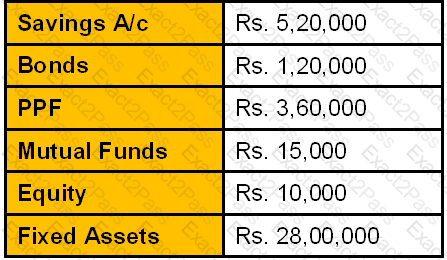
Mr. Bhatia, aged 43 is practicing as a Doctor at Nasik. His wife Mrs. Bhatia is a social worker. They reside in a flat they own along with their daughter Neena aged 9. Mr. Bhatia’s elder sister is residing in Canada whom he has not met since last 5 years. His another elder sister resides in USA whom he has not met since last 8 years. Mr. Bhatia will continue active practice upto the age of 75. Looking at the history of his family life expectancies, Mr. Bhatia believes he would survive upto 85. His gross monthly income currently is Rs. 1, 45,000. Their monthly expenses are Rs. 25,000/-(including Personal expenses Rs. 5000) and they save about Rs. 35,000/- every month. Mr. Bhatia has total assets of Rs. 38.25 lacs and total outstanding liability for Medical Equipment and car of Rs. 12.45 lacs, which gives Mr. Bhatia net worth of Rs. 25.80 lacs estimated as on March 2008. His current investments are as follows:
Mr. Bhatia is a moderate risk taker and minimizes his tax through various schemes. He has a minimal exposure to equity instruments, as substantial portion of his investments is locked in Debt instruments. But he is aware of the fact that capital growth without investing in direct equity or equity mutual funds is difficult. In the current scenario, the economy is positive, with a growth of more than 9% and hence equity will yield excellent returns.
Objectives:
1. Mr. Bhatia and his wife would like to start saving for their daughter Neena’s educational needs. They require Rs. 1,00,000 at her age of 15, 2 lacs when she is 16, and 8 lacs when she is 18 and 25 lacs when she is 21.
2. To provide Rs. 50 lacs for Neena’s wedding at the age of 25.
3. To provide for vacations with the family to US & Canada, Middle East and Europe.
4. To provide a retirement corpus for a period of 10 years
5. Purchase a new car worth Rs. 15 lacs in nest 6 months.
6. To buy a property worth Rs. 1 crore nearby of RML hospital.
Section A (1 Mark)
Under which of the following categories of General Warranty Deed does the Grantor warrants that the property is free of any liens or encumbrances unless they're specifically stated in the deed?
Section A (1 Mark)
Income from which trust is added to the beneficiary’s taxable income?
Section A (1 Mark)
What is the crucial determinant of value of a property?
Section A (1 Mark)
For a “single income family” priority is on
Section C (4 Mark)
Monika has a investment portfolio of Rs. 100000, a floor of Rs. 75000, and a multiplier of 2. So the initial portfolio mix is 50000 in stocks and 50000 in bonds. If stock market falls by 20%, what should Monika do?
Section A (1 Mark)
A muslim gentleman can leave his will, bequeathing all his properties to someone often than his legal heirs to the extent of…………….
Section A (1 Mark)
Mansi has deposited Rs. 7,00,000/- in a bank today @ ROI of 10 % per annum compounded monthly. She wants to know that if she withdraws this money in monthly installments at the END of the month for 7 years, then how much will be the each installment amount?
Section A (1 Mark)
Risk factors in the APT must possess all of the following the characteristics except:
Section A (1 Mark)
Deduction under section 80QQB is allowed in respect of royalty income to:
Section B (2 Mark)
Calculate the treynor measure, Sharpe measure and Jensen measure from the following data:
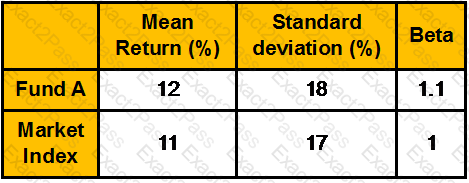
The mean risk free rate was 6 percent.
Section C (4 Mark)
Read the senario and answer to the question.
Assume Neeraj bought a second hand car in June 2007. Since the insurance premium was due, Neeraj paid it in the old owner’s name.Neeraj didn’t receive the original policy despite repeated requests. The car later met with an accident causing damages worth Rs. 10000. Neeraj had not transferred the car in his name, as Neeraj did not have the original documents. Can the insurer reject his claim?
Section B (2 Mark)
Shiva Industries Ltd. earns Rs. 2 per share and distributes 40% of its earnings as cash dividends. Its dividends grew annually at 7%. What will be the stock’s price if the required rate is 10%?
Section C (4 Mark)
What is the portfolios standard deviation if you put 25% of your money into stock A which has a standard deviation of 15% and rest into stocks B which has a standard deviation of 10%. The correlation coefficient between the returns of the stocks is .75.
Section A (1 Mark)
Disclaimers and assumptions are a part of
Section A (1 Mark)
A type of investor who is willing to risk his own capital and give up security to gain wealth is known as:
Section B (2 Mark)
If the commodity’s futures price declines

Section B (2 Mark)
The estimated Net Operating Income of an office building is Rs. 12000 per year. An appraiser decide the appropriate capitalization rate is 12% comprised of 10% return on investment and 2% for depreciation, what is the estimated value of the building?
Section A (1 Mark)
Surender is a driver who causes injuries to a pedestrian by his rash driving. The injured victim had to spend Rs.1000 in treating his injuries. Surender ‘s act has created liabilities under:

