Exact2Pass

Last Update 3 hours ago Total Questions : 1259
The Chartered Wealth Manager (CWM) Certification Level II Examination content is now fully updated, with all current exam questions added 3 hours ago. Deciding to include CWM_LEVEL_2 practice exam questions in your study plan goes far beyond basic test preparation.
You'll find that our CWM_LEVEL_2 exam questions frequently feature detailed scenarios and practical problem-solving exercises that directly mirror industry challenges. Engaging with these CWM_LEVEL_2 sample sets allows you to effectively manage your time and pace yourself, giving you the ability to finish any Chartered Wealth Manager (CWM) Certification Level II Examination practice test comfortably within the allotted time.
Section B (2 Mark)
Which of the following statements is / are correct?

Section B (2 Mark)
___________ applies where there are multiple transactions which are inter-related and cannot be evaluated separately for the purpose of determining arm’s length price of any one transaction.
Section A (1 Mark)
Which portion of his property can a muslim normally be guest according to muslim personal law?
Section A (1 Mark)
We prefer a sure gain from a much larger gain that is very likely but not certain. This makes us close winning positions even if we think that they are likely to get even better.
Section A (1 Mark)
Notice of loss should be given to the insurer within ________days of the event of loss.
Section C (4 Mark)
An investor Mr. Dayal, executes a Long Strangle by buying a Rs. 4300 Nifty Put for a premium of Rs. 23 and a Rs 4700Nifty Call for Rs 43. The Nifty is at 4500
The Net Payoff of Long Strangle
• If Nifty closes at 4100
• If Nifty closes at 5300
Section A (1 Mark)
Mr. X, partner of M/s XYZ, is assessable as
Section C (4 Mark)
Ms. Shweta wants to achieve the goal of higher education of her daughter after 15 years. She estimates that the funds required would be 30 lacs at then costs. She wants to invest monthly for this goal. You as a Wealth Manager suggest an asset allocation of 80% in Equity and 20% in Debt for 14 years and shifting the entire amount to liquid funds in the last year where the expected returns would be 6% p.a. If the returns in equity and debt funds are 14% and 8.50% respectively calculate the amount that needs to be invested in Equity and Debt Each Month.
Section A (1 Mark)
____________ may be responsible for the prevalence of active versus passive investments management.
Section A (1 Mark)
The____________________ in commercial real estate requires that the tenant pay a significant share of expenses of operation, as well as all taxes and insurance related to their rental unit.
Section C (4 Mark)
As a CWM you are required to calculate the tax liability of an individual whose taxable income is:
• $321500 in SGD and he is a Singapore citizen
• £ 35214p.a (only dividends) and he is a UK citizen
Section A (1 Mark)
A type of trust in which assets are passed down to the grantors grandchildren not the grantors children
Section A (1 Mark)
H Ltd, a UK resident company, owns 100% of the share capital of two other UK companies and 80% of the share capital of T SA, a company resident in Italy.H Ltd has three associated companies.
Section A (1 Mark)
A(n) _____________ is an over-the-counter agreement offering protection against loss when default occurs on a loan or other debt instrument.
Section B (2 Mark)
The expected returns and standard deviations of stock A and B are:

Manish buys Rs.20000 stock A and sells short Rs.10000 of stock B, using all the proceeds to buy more of stock A. The correlation between the two securities is 0.25. What are the expected return and the standard deviation of Manish’s portfolio?
Section B (2 Mark)
If an investor determines that next year’s earnings estimate is Rs2.00 per share and the company subsequently falters, the investor may not readjust the Rs2.00 figure enough to reflect the change because he or she is “anchored” to the Rs2.00 figure. This is not limited to downside adjustments—the same phenomenon occurs when companies have upside surprises
Which of the following Biases have been exhibited by the investor?
Section A (1 Mark)
The following is not a capital receipt
Section A (1 Mark)
Strategic asset allocation involves
Section A (1 Mark)
The eligibility Criteria for Self Employed Professionals & Businessman for minimum annual income of the applicant in case of personal loan is:
Section A (1 Mark)
A type of CRM Dominant characteristic which applies technology across organizational boundaries with a view to optimizing company, partner and customer value is known as_______________.
Section A (1 Mark)
Active portfolio management consists of __________.
Section A (1 Mark)
Short-term capital gain arising for the transfer of equity shares and units of equity oriented fund shall be taxable
Section B (2 Mark)
You write one XYZ February 50 put for a premium of Rs5. Ignoring transactions costs, what is the breakeven price of this position?
Section B (2 Mark)
Mr. A purchased certain shares of a company during the financial year 1987-88 for a sum of Rs.1,50,000/-. A sold the shares during the financial year 2011-12 for Rs.8,10,000/- when the market is at all time high. Calculate the amount of capital gains. [CII-12-13: 852,11-12: 785,10-11:711]
Section A (1 Mark)
If the deceased has two widows, four sons and two daughters then what is the share of each widow
Section A (1 Mark)
A 5 year ordinary annuity has a future value of Rs. 1,00,000/-. If ROI is 8 % per annum, then how much will be the amount of each payment ?
Section A (1 Mark)
Technical analysis differs from fundamental analysis because technical analysis:
Section B (2 Mark)
The Sachdeva family includes a financially well-informed couple, both aged thirty-two, and two children aged four and six. They are financially sound, but were not in the market during the bull market of the 2003 to 2007 as many of their neighbors were. The couple’s total income, Rs.12,00,000 which is not expected to grow significantly. They have saved Rs.15,00,000, which they hope will be the financial foundation from which they will send their children to college and retire comfortably. The Sachdeva’s suffer from:

Section A (1 Mark)
CRM as a discipline that depends on people, process, information and __________
Section B (2 Mark)
Payback period is
Section A (1 Mark)
Mr. Kashyap took a business premise on lease with the provision that he himself had to pay the insurance premium for fire and other perils on the premises and not the owner of the premises. This would be an instance of_______________ on the part of owner of the premises.
Section A (1 Mark)
______________ is a manifestation of mental accounting that can cause people to take on more risk as their wealth increases.
Section B (2 Mark)
Which of the following statements are correct with regard to Bailard, Biehl, and Kaiser Five-Way Model?

Section A (1 Mark)
Mr. Naresh is working in a reputed company and earning Rs. 5,00,000/- p.a. and is now 50 years old. He has invested Rs. 2,50,000/- in an annuity which will pay him after 5 years a certain amount p.a. at the end of every year for 10 years. Rate of interest is 8% p.a. Calculate how much he will receive at the end of every year after 5 years?
Section A (1 Mark)
How many types of power of attorney are there?
Section A (1 Mark)
An arbitrage opportunity exists if an investor can construct a __________ investment portfolio that will yield a sure profit.
Section C (4 Mark)
Mr. Rajesh constructs a Long Straddle Strategy with one Nifty Call Option having a Strike price of Rs. 4500 available at a premium of Rs. 122 and one Nifty Put Option with a strike price Rs. 4500 at a premium of Rs. 85
What would be the Net Payoff of the Strategy?
• If Nifty closes at 4234
• If Nifty closes at 4766
Section A (1 Mark)
Marketing relationships are:
Section B (2 Mark)
Mr. Subhash Bansal, a marketing manager is employed with IMFB limited. He took an advance of Rs. 1,20,000 against the salary of Rs. 30,000 per month in the month of March 2007. The gross salary of Mr Bansal for the assessment year 2007-08 shall be:
Section B (2 Mark)
Under the Workmen Compensation Policy, when the employment injury results in death, the insurance company pays 40 % of the monthly wages of the deceased multiplied by the relevant factor or Rs. _________ whichever is more.
Section B (2 Mark)
The current market price of a share of JVJ stock is Rs60. If a put option on this stock has a strike price of Rs55, the put
Section B (2 Mark)
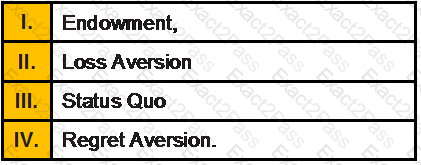
Which of the following Biases are exhibited by Passive Preserver?
Section B (2 Mark)
What is the outstanding balance after 60 payments on a 20-year mortgage that has monthly payments of Rs1062.32 and an interest rate of 5.8% compounded semi-annually?
Section B (2 Mark)
Lucy purchased a rental house a few years ago for $100,000. Total depreciation to date is $35,000. In the current year, she sells the house for $155,000 and pays $10,000 selling expenses. Calculate Lucy's gain on the sale.
Section C (4 Mark)
In addition to social security benefits of $6,000, Mr. and Mrs. Lopez have adjusted gross income of $36,000, tax-exempt interest of $1,000 and will file a joint return.
Determine the taxable portion of their social security benefits.
Section A (1 Mark)
The stage in venture Capital financing where the business plan is completed and presented to a venture capital firm is called________________.
Section C (4 Mark)
Read the senario and answer to the question.
Mr. Saxena is planning to visit USA for the very first time in his carrier to promote software of his company and is expected to stay long. He wants to plan his journey in such a manner so that he can get maximum tax benefits in the FY 2007–08 from the residential status point of view. What is the latest date when he can afford to leave India & earn status of an NRI to get maximum tax benefits in assessment year 2008–09?
Section B (2 Mark)
To pay for new equipment with a cash price of Rs7500, you need to borrow at 5.3% compounded monthly, then make monthly payments for 32 months. How much less would your payments be if you were able to save Rs2100 as a down payment before you purchase the new equipment?
Section A (1 Mark)
The __________ is NOT a market anomaly.
Section C (4 Mark)
Shekhar has an investment portfolio of Rs.100000; the initial portfolio mix is Rs. 50000 in stocks, Rs.30000 bonds and Rs.20000 in bank. If stock market goes up by 10%, what should Shekhar do under the constant mix policy?

