Exact2Pass

Last Update 3 hours ago Total Questions : 1259
The Chartered Wealth Manager (CWM) Certification Level II Examination content is now fully updated, with all current exam questions added 3 hours ago. Deciding to include CWM_LEVEL_2 practice exam questions in your study plan goes far beyond basic test preparation.
You'll find that our CWM_LEVEL_2 exam questions frequently feature detailed scenarios and practical problem-solving exercises that directly mirror industry challenges. Engaging with these CWM_LEVEL_2 sample sets allows you to effectively manage your time and pace yourself, giving you the ability to finish any Chartered Wealth Manager (CWM) Certification Level II Examination practice test comfortably within the allotted time.
Section A (1 Mark)
The factors contributing to a Credit Score are :

Section A (1 Mark)
Deduction under section 80C shall be allowed:
Section A (1 Mark)
Which of the following is not one a part of the primary stage in the Francis Buttle model?
Section B (2 Mark)
What an employee should check in his retirement benefit plan offered by the employer?
Section A (1 Mark)
You have added more money to a losing stock twice, despite no good news about the stock. You are likely demonstrating which type of judgment error?
Section B (2 Mark)
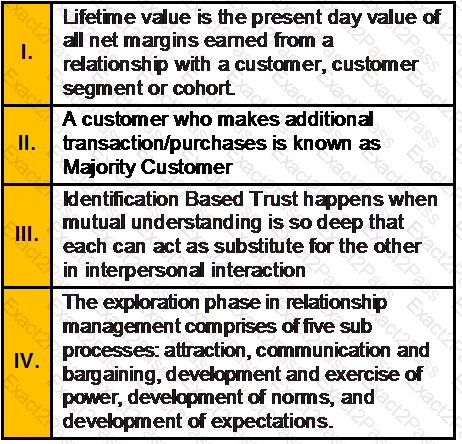
Which of the following statements is/are correct?
Section B (2 Mark)
As Per Article 12 Double Taxation Avoidance Agreement with US, _____per cent of the gross amount of the royalties or fees for included services as defined in this Article, where the payer of the royalties or fees is the Government of that Contracting State, a political sub-division or a public sector company.
Section A (1 Mark)
Which of the following statement is not true?
Section B (2 Mark)
Miss Femina aged 17, is married to Mr. Masculine. Her mother alone is alive income by way of interest on loans, of Miss Femina will be:-
Section A (1 Mark)
In a short call, profit is
Section C (4 Mark)
Maxis Ltd reported Earnings Per Share of Rs 2.10 in 1993, on which it paid dividends per share of Rs 0.69. Earnings are expected to grow 15% a year from 1994 to 1998, during which period the dividend payout ratio is expected to remain unchanged. After 1998, the earnings growth rate is expected to drop to a stable 6%, and the payout ratio is expected to increase to 65% of earnings. The firm has a beta of 1.40 currently, and it is expected to have a beta of 1.10 after 1998. The Risk Free Rate of Return is 6.25%.
What is the value of the stock, using the two-stage dividend discount model?
Section B (2 Mark)
____________ are good examples of the limits to arbitrage because they show that the law of one price is violated.

Section A (1 Mark)
An aggressive asset allocation would contain larger proportions of __________ than a conservative allocation.
Section A (1 Mark)
An individual is said to be a resident in India in the previous year (in which the Feb month has 29 days) if he is in India in that year for a period of ______days or more.
Section B (2 Mark)
You are given the following set of data on security ABC:

Calculate the expected return on security ABC?
Section B (2 Mark)
A bank has a long term relationship with a particular business customer. However, recently the bank has become concerned because of a potential deterioration in the customer's income. In addition, regulators have expressed concerns about the bank's capital position. The business customer has asked for a renewal of its Rs25 million dollar loan with the bank. Which credit derivative can help this situation?
Section A (1 Mark)
Every employer is obliged to ensure that his employees get a safe and secure workplace. In relation to the risks arising in the workplace which affects the employees, cover is provided through
Section B (2 Mark)
Which one of the following statements is/are correct?

Section B (2 Mark)
You have been asked to estimate the market value of an apartment complex that is producing annual net operating income of Rs44,500. Four highly similar and competitive apartment properties within two blocks of the subject property have sold in the past three months. All four offer essentially the same amenities and services as the subject. All were open-market transactions with similar terms of sale. All were financed with 30-year fixed-rate mortgages using 70 percent debt and 30 percent equity. The sale prices and estimated first-year net operating incomes were as follows:

What is the indicated value of the property using direct capitalization?
Section A (1 Mark)
Real estate property consists of:
Section C (4 Mark)
Read the senario and answer to the question.
Calculate the Net Worth of Mr. Adhikari as on 31/03/2009.
Section C (4 Mark)
Read the senario and answer to the question.
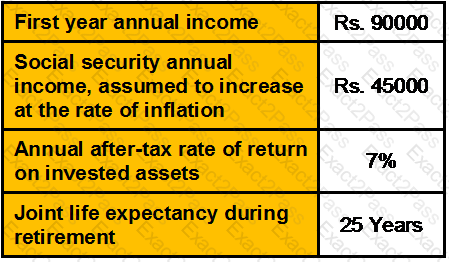
One commonly used method of calculating the total retirement fund necessary on the first day of retirement is to use the present value of an annuity due. The Pandeys’ anticipate that their annual retirement income will need to increase each year at the rate of inflation. Based on the following assumption, calculate the total amount needed to be in place when Shanker and Parvati retire (Round to the nearest Rs. 1000)
Section A (1 Mark)
What is the Present Value of an annuity which pays Rs. 10,000/- for 3 years at the END of each year, assuming ROI @ 7% per annum compounded annually?
Section C (4 Mark)
Read the senario and answer to the question.
Ms. Deepika is interested in investments in foreign markets. Her brother is working in one of reputed American company in India and that is offering him some shares under ESOP scheme. This company is not listed in India. It is listed in New York Stock Exchange. Ms. Deepika is asking her manager how this transaction will took place for her brother?
Section A (1 Mark)
______________is a risk whenever a decision maker commits resources to a course of action (thereby making an “investment”) in the hope of achieving a positive outcome and experiences disappointing results
Section A (1 Mark)
A covered call position is equivalent to a
Section A (1 Mark)
After the satisfaction of insured’s claim from the insurer, the insured should pursue in the recovering of rights from the 3rd party.
Section A (1 Mark)
Corrections are often followed by ________.
Section C (4 Mark)
Rate of 15% p.a compounded annually will be equal to ---------------- % per month.
Section A (1 Mark)
Total current assets of a company are Rs.960 lakh while the current liabilities (other than bank borrowings) are Rs.300 lakh. If the company borrowed Rs.350 lakh, what will be the amounts of Maximum Permissible Bank Finance (MPBF) under the (method I) of the Tandon committee recommendations?
Section C (4 Mark)
Read the senario and answer to the question.
Harish wants a monthly investment to achieve the goal of his children's higher education. For accumulation of fund you recommend Harish to invest in an investment vehicle which invests in the ratio of 20:80 in Debt and Equity. If Harish starts investing from 1st Dec 2010, what approximate amount should he set aside every month for each child to achieve the goal? Harish maintains separate investment accounts for Chirag and Vishesh and invests till they individually turn 21 years of age.
Section B (2 Mark)
The expected market return 16 percent. The risk-free rate of return is 7 percent, and AB Co. has a beta of 1.1. The risk premium is
Section B (2 Mark)
The Net Worth Required for an Individual is _________________ for a Partnership Firm is ____________________ and Body Corporate is______________ to fulfil the Capital Adequacy requirements under the SEBI Investment Advisor Regulations 2013.
Section A (1 Mark)
Companies can build interest and enthusiasm by using databases to remember customer preferences. This strategy helps to which of the following?
Section C (4 Mark)
Two friends Neeraj and Kapil, both belonging to the 33.66% tax bracket, have invested Rs. 10 lakhs in a debt-based scheme. The scheme is a regular run of the mill, assembly line product — nothing extraordinary about it.
The scheme has earned a distributable profit of 12%.
Kapil’s financial condition is not good and due to the business losses his assets are to be auctioned.
Neeraj is working in MNC and getting an annual package of Rs. 18 lakhs. This includes Rs. 270000 as dearness allowance (2/3 forms the part of retirement benefit). He is also earning an agricultural income of Rs. 54000.His expenses are Rs. 80000 per month.
Neeraj has also taken a housing loan in joint name of his wife Anita and himself. Property is also in the joint name and their contribution is equal. Annual outflow towards housing loan in terms of repayment of principal and interest is Rs. 300000. Out of this Rs. 198800 is toward interest.
Neeraj has also invested an equal amount in a portfolio consisting of securities A and B. Standard deviation of A is 12.43%; Standard deviation of B is 16.54%; Correlation coefficient is 0.82
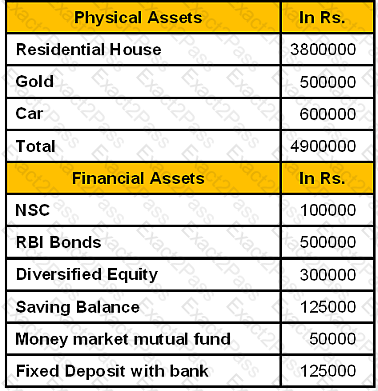
Assets held by Neeraj
Section A (1 Mark)
In Working Capital Finance, what should be the minimum current ratio the borrower needs to ensure the compliance under the first method of lending.
Section B (2 Mark)
Ramesh has invested Rs 3,000/- in Reliance Growth Fund two years ago and its worth is now 4,000/-. Ram has received dividend Rs.300 at the end of two years. Calculate Compounded annual growth rate (CAGR) of Ram’s investment.
Section A (1 Mark)
If a female dies without leaving any issue them property inherited from her father or mother the property will devolve upon
Section B (2 Mark)
Mr. Nimesh is bullish about ABC Ltd stock. He buys ABC Ltd. at current market price of Rs. 4000 on 4 July. To protect against fall in the price of ABC Ltd. (his risk), he buys an ABC Ltd. Put option with a strike price Rs.3900 (OTM) at a premium of Rs. 143.80 expiring on 31st July.
What would be the Pay-off of the strategy if the stock closes on 4200 at expiry?
Section A (1 Mark)
Riskier stocks have
Section C (4 Mark)
Paridhi has an investment portfolio of Rs.2,00,000; the initial portfolio mix is Rs.1,00,000 in stocks, Rs.60000 bonds and Rs.40000 in bank.
If market goes up by 10% and the value of bonds decreases by 10%, what should Paridhi do under the constant mix policy?
Section C (4 Mark)
Read the senario and answer to the question.
Harish wants to know what amount is eligible for deductible u/s 24 of Income Tax for housing loan repayments in computation of his Income tax liability for AY 2010-11.
Section C (4 Mark)
The assumptions concerning the shape of utility functions of investors differ between conventional theory and prospect theory. Conventional theory assumes that utility functions are __________ whereas prospect theory assumes that utility functions are __________.
Section A (1 Mark)
The premium on all other riders put together should not exceed _____ of the premium on the base policy
Section A (1 Mark)
The investors who buy the debt of troubled companies including subordinated debt, junk bonds, bank loans, and obligations to suppliers are called__________
Section B (2 Mark)
A client has a minor child she is concerned about what might happen if she was to die while the child was still young and unable to sensibly handle a sizeable in heritance one solution could be to draft her will so that the child receives the asset once reaching age 21 this is an example of
Section A (1 Mark)
You buy a investment plan by investing Rs. 6000/- per month for first 12years and Rs. 11000/- per month for next 12 years. If the rate of interest is 15% per annum compounded monthly . How much amount would you have after 24 years?
Section A (1 Mark)
Book building is used to help in better
Section B (2 Mark)
Which of the following statement is/are correct?

Section C (4 Mark)
Read the senario and answer to the question.
Mr. Mehta buys machinery for Rs. 80000 which is to be replaced after a period of two years. The replacement cost at that time will be Rs. 90000. As a Chartered Wealth Manager advice Mr. Mehta now what he should do after two year for the replacement of the said machinery?

