Exact2Pass

Last Update 3 hours ago Total Questions : 1259
The Chartered Wealth Manager (CWM) Certification Level II Examination content is now fully updated, with all current exam questions added 3 hours ago. Deciding to include CWM_LEVEL_2 practice exam questions in your study plan goes far beyond basic test preparation.
You'll find that our CWM_LEVEL_2 exam questions frequently feature detailed scenarios and practical problem-solving exercises that directly mirror industry challenges. Engaging with these CWM_LEVEL_2 sample sets allows you to effectively manage your time and pace yourself, giving you the ability to finish any Chartered Wealth Manager (CWM) Certification Level II Examination practice test comfortably within the allotted time.
Section A (1 Mark)
For making a personal financial statement for a client, the optimum cash levels would be
Section A (1 Mark)
Statman (1977) argues that ________ is consistent with some investors' irrational preference for stocks with high cash dividends and with a tendency to hold losing positions too long.
Section B (2 Mark)
According to the efficient markets view, value stocks earn higher expected return than growth stocks because:
Section A (1 Mark)
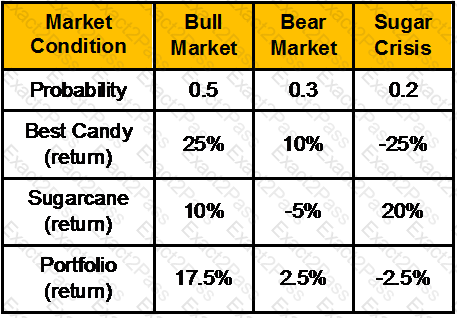
Given below is the portfolio return; calculate the expected portfolio rate of return:
Section A (1 Mark)
In the Balance sheet of a firm, the debt equity ratio is 2:1.The amount of long term sources is Rs.12 lac. What is the amount of tangible net worth of the firm?
Section A (1 Mark)
If a married couple (or civil partners) receive joint income, the amount of that income will normally be divided equally between them for tax purposes. True or False?
Section A (1 Mark)
Psychologists have found that people who make decisions that turn out badly blame themselves more when that decision was unconventional. The name for this phenomenon is
Section B (2 Mark)
When returns to an investor’s portfolio increase, to what does he believe the change in performance is mainly due (if the investor exhibits self attribution bias)?
Section C (4 Mark)
To create a common size income statement ____________ all items on the income statement by ____________.
Section A (1 Mark)
Which of the following is not true about traditional defined benefit plans?
Section B (2 Mark)
Suppose you have some money to invest and you hear about a great stock tip from your neighbor who is known to have a good stock market sense. He recommends you purchase shares in Petrolite, a company that makes a new kind of lighter fluid for charcoal grills.
What is your response to this situation if you exhibit Availability bias?

Section B (2 Mark)
From the following data in respect to the property price, calculate the value of the property for your client Mr. Nitin Sharma, as per the capitalization rate.

Section A (1 Mark)
The _______ is typically taken to be the risk-free rate.
Section B (2 Mark)
If Raman Industries Ltd. share price is Rs.50 and its current dividend is Rs.5/- per share which is growing at 7 percent rate per year, determine its required return?
Section A (1 Mark)
Any property inherited by a female Hindu from her husband or from her father in law, in the absence of any son or daughter of the deceased shall go to…..
Section A (1 Mark)
Equifax Credit Report Contain

Section A (1 Mark)
__________ organization try to segment their customers based on what product the customer purchased.
Section A (1 Mark)
Retiring early will need
Section C (4 Mark)
Consider the following information for three mutual funds
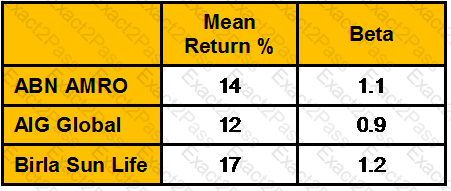
Risk free return is 6%. Calculate Treynor measure.
Section B (2 Mark)
X Ltd. has given a dividend of Rs. 3 per share last year. The company is growing at a constant rate of 5 % every year and the investor’s required rate at this share is 12 % per annum. Find out the Intrinsic value of this share.
Section B (2 Mark)
The current market price of a share of XYZ stock is Rs50. If a call option on this stock has a strike price of Rs45, the call
Section A (1 Mark)
When loans are securitized they are passed on to a ____________who pools the loans and sells securities.
Section A (1 Mark)
The quantum of deduction allowed u/s 80U is:
Section A (1 Mark)
…………………. Is implied in favor of the party creating it
Section A (1 Mark)
The trust which is empty at creation during life and tranfers the property into the trust at death is called ____________
Section A (1 Mark)
The January effect concerns:
Section C (4 Mark)
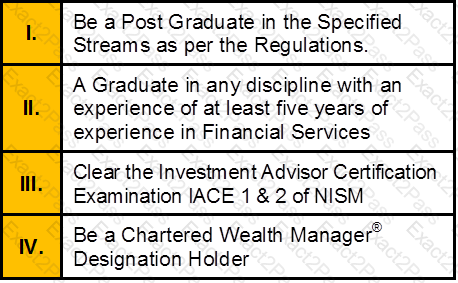
To fulfil the Educational Qualification to be registered as an Investment Advisor under the SEBI Investment Advisor Regulations 2013, The applicant must:
Section A (1 Mark)
Which of the Following needs to register as an' Investment Adviser' as per SEBI Investment Advisor Regulations 2013.
Section A (1 Mark)
One of the tax exemption under avoidance of Double Taxation is U/S Sec 10(6)(ii) for exemption on income received by the diplomats, ambassador, etc
Section C (4 Mark)
Nifty is at 3200. Mr. XYZ expects very little movement in Nifty. He sells 2 ATM Nifty Call Options with a strike price of Rs. 3200 at a premium of Rs. 97.90 each, buys 1 ITM Nifty Call Option with a strike price of Rs. 3100 at a premium of Rs. 141.55 and buys 1 OTM Nifty Call Option with a strike price of Rs. 3300 at a premium of Rs. 64.
What would be the Net Payoff of the Strategy?
• If Nifty closes at 3200
• If Nifty closes at 4212
Section A (1 Mark)
Monitoring and rebalancing a portfolio over time involves all of the following costs EXCEPT
Section A (1 Mark)
A(n) _________________________ occurs when two banks agree to exchange a portion or all of the loan repayments of their customers.
Section A (1 Mark)
A put option on a stock is said to be out of the money if
Section B (2 Mark)
Contribution under a defined benefit plan
Section A (1 Mark)
The premise of behavioral finance is that
Section A (1 Mark)
Vineet invests Rs. 5000/- per month at the beginning of the month for 10 years in Recurring Deposit account that pays 8.5% p.a interest compounded quarterly. What will be the accumulated amount in his account.
Section B (2 Mark)
As per Double Taxation Avoidance Agreement, the Interest Rate in Mauritius is charged at:
Section A (1 Mark)
Customer service facilitation includes EXCEPT:
Section B (2 Mark)
Mr. Jain is projecting an income stream providing Rs. 2,000/- for first 3 months, Rs. 3,200 for next 2 months, Rs. 4,500 for next 1 month, Rs. 3,700 for next 6 months and Rs. 800 for 2 months thereafter. EACH CASH FLOW starts from the beginning of the month. Please calculate the Present Value of this cash stream if rate of interest is 9 % per annum compounded monthly?
Section A (1 Mark)
If the intrinsic value of a stock is greater than market value, which of the following is a reasonable conclusion?
Section B (2 Mark)
An employee who is not resident in the UK will be liable to UK income tax:
Section A (1 Mark)
A swap that involves the exchange of one set of interest payments for another set of interest payments is called a(n)
Section A (1 Mark)
Mortgage loans:
Section A (1 Mark)
A forward contract differs from a futures contract in that:
Section B (2 Mark)
PPF is a
Section B (2 Mark)
How much principal is repaid in the 77th payment interval on a RS 147 000 25-year mortgage if the mortgage is amortized over 20 years and the payments are monthly with rate of interest being 7.2% compounded monthly?
Section A (1 Mark)
Which of the following is an assumption of the CMT?
Section A (1 Mark)
A market timing approach that increases the proportion of funds in stocks when the stock market is expected to be rising, and increases cash when the stock market is expected to be falling is a:
Section C (4 Mark)
National City Corporation, a bank holding company, reported earnings per share of Rs2.40 in 1993, and paid dividends per share of Rs1.06. The earnings had grown 7.5% a year over the prior five years, and were expected to grow 6% a year in the long term (starting in 1994). The stock had a beta of 1.05 and traded for ten times earnings. The treasury bond rate was 7%.
Estimate the P/E Ratio for National City Corporation and the long term growth rate that is implied in the firm's current P/E ratio.
Section C (4 Mark)
Harish Rawat has approached you on 26th Nov 2010, a Chartered Wealth Manager, for preparing a comprehensive Wealth plan to accomplish his financial goals. From your initial meeting, you have gathered the following information:
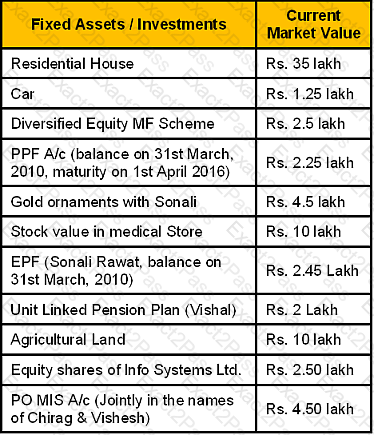
Harish Rawat, aged 44 years with life expectancy 70 years, is self-employed in Dehradun. Harish’s wife Sonali, aged 41 years with life expectancy 72 years, is working as a Assistant Manager in a Telecom
Company and is having a post-tax income of Rs. 4 lakh p.a. She is expected to retire at the age of 55 years. The couple has two children Chirag, aged 16 years and Vishesh, aged 10 years. Chirag is studying in 10th standard while Vishesh is studying in 4th standard. Harish’s net annual Income from retail medical store is Rs. 8 Lakh and their monthly household/living expenses, excluding housing loan EMI, are Rs. 32,500.
Harish is a Graduate. He earlier served in a pharmaceutical company as a medical representative for approx. 10 years. After separation from the company, he started his own wholesale business of medicines but could not sustain for long due to lack of working capital. He shut down his operations after 3.5 years. Thereafter he got a contract for retail medical shop in the premises of a nursing home. The terms of the contact are profit sharing in the ratio 50:50. Investment in stock and handling all activities of medical store are of Harish and no rent is charged by the owner of nursing home.
Harish had taken a housing loan of Rs. 15 Lakh disbursed on 1st April 2005. They are presently paying an EMI of Rs. 17,285 at the end of every month beginning from the month of disbursement. The loan is at fixed rate of interest of 11.25% p.a. (reducing monthly balance basis) with tenure of 15 years. Harish has taken a money back insurance plan of 20 year term with sum assured of Rs. 6 Lakh, the annual premium being Rs. 26,250. He has paid 14 annual premiums till date regularly. The policy provides for 20% of the basic sum assured to the insured as survival benefit after 4th, 8th, 12th, 16th years from the start of the policy. He has also taken a Mediclaim family floater policy which covers his spouse and two sons to the extent of Rs. 5 Lakh. He has also paid four regular annual premiums of Rs. 36,000 in a unit linked pension plan and next premium is due on 1st Dec 2010.
Harish’s parents are senior citizens and live in their own house in Haldwani District. Their only source of income is by way of interest received from their joint Senior Citizen Savings Scheme account. Harish’s younger brother, who is also self-employed, is living with his parents.
Harish had invested Rs. 1 lakh to buy 200 shares of a listed company, Mobizox, in the year 2001-02. The Company had issued Bonus shares in the ratio 1:1 in the year 2005-06.Harish also subscribed to the Company’s Rights issue of one share for every four shares held at a price of Rs. 250 per share in Feb 2010. Harish also invested Rs. 4 lakh in an Agriculture land at his native village in Haldwani in 2000-01.
Goals and aspirations
1. To make provision for their children’s higher education expenses at their respective age of 21 years.
2. Such expenses are Rs. 5 lakh for each child at current prices.
3. To make provision for children’s marriage expected at the end of 10 years and 15years from now; presently valued at Rs. 5 lakh each.
4. Build a corpus for his retirement at the age of 58 years
5. To go on vacation with family in January, 2011
Assumptions
1. Inflation is currently 6% p.a. and is likely to remain the same.
2. Risk free interest rate is at 7% p.a.
3. Return on equity MF is 12% p.a.
4. Return on debt MF is 8% p.a.
5. Cost Inflation index is 281 for 1995-96, is 406 for 2000-01, is 463 for 2003-04, is 551for 2007-08, is 582 for 2008-09 and is 632 for 2009-10.

