Exact2Pass

Last Update 7 hours ago Total Questions : 91
The Implementing Data Engineering Solutions Using Azure Databricks content is now fully updated, with all current exam questions added 7 hours ago. Deciding to include DP-750 practice exam questions in your study plan goes far beyond basic test preparation.
You'll find that our DP-750 exam questions frequently feature detailed scenarios and practical problem-solving exercises that directly mirror industry challenges. Engaging with these DP-750 sample sets allows you to effectively manage your time and pace yourself, giving you the ability to finish any Implementing Data Engineering Solutions Using Azure Databricks practice test comfortably within the allotted time.
You have an Azure Databricks workspace named Workspace1 that contains a lakehouse and is enabled for Unity Catalog.
You have a connection to a Microsoft SQL Server database named DB1.
You need to expose the schemas and tables of DB1 to meet the following requirements:
• The schemas and tables can be queried in Databricks.
• The schemas and tables appear alongside other Unity Catalog objects.
• The data is NOT copied into Databricks-managed storage.
Solution: You create a Lakeflow Connect pipeline and connect it to DB1. Does this meet the goal?
You have an Azure Databricks workspace that is enabled for Unity Catalog.
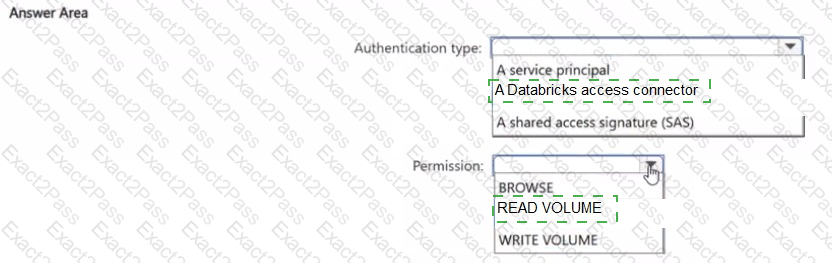
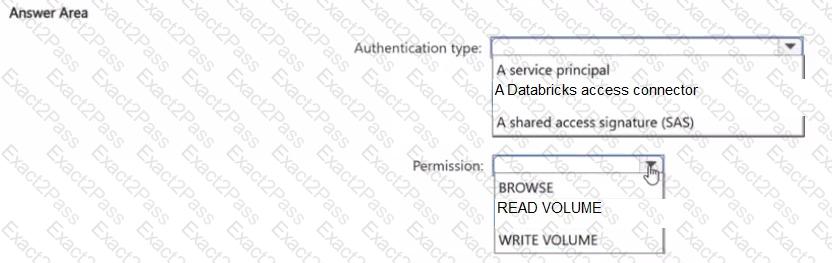
You need to create an external volume named Volume1 in an existing schema. Volume1 must expose files from an Azure Storage container. The solution must meet the following requirements:
• Ensure that authentication does NOT require storing credentials in Databricks
• Ensure that users can access the files, but NOT modify the files.
• Follow the principle of least privilege
Which type of authentication should you configure, and which permission should you grant to the users? To answer, select the appropriate options in the answer area.
NOTE: Each correct selection is worth one point.
You have an Azure Databricks workspace that is enabled for Unity Catalog.
You plan to create a job in Lakeflow Jobs named Job1 that:
• Ingests data from cloud storage
• Runs two independent transformation tasks
The transformation tasks must run only after the ingestion completes and must run in parallel.
You need to design the task logic for Job1.
What should you configure?
You have an Azure Databricks workspace that is enabled for Unity Catalog.
You have a Lakeflow Spark Declarative Pipelines (SDP) pipeline that writes numerical data to a table named Table1 by using a data quality validation rule named rule1.
You need to modify rule1 to meet the following requirements:
Ensure that amount is always greater than 0.
Prevent an update to Table1 from being committed when data that violates rule1 is detected.
Which statement should you execute?
You need to configure resiliency for a job in Lakeflow Jobs named Job1 to meet the pipeline deployment and operation requirements.
What should you do?
You have an Azure Databricks account that contains workspaces enabled for Unity Catalog.
You need to implement audit logging to meet the following requirements:
• Capture audit logs for all the workspaces in the account.
• Retain the audit logs for 90 days.
• Minimize storage and ingestion costs.
The logs will be reviewed only during security investigations and will NOT be queried regularly.
To where should you send the audit logs?
You have an Azure Databricks workspace that is enabled for Unity Catalog.
You need to recommend a pipeline that ingests files from cloud storage, performs cleansing and enrichment transformations, and writes created Delta tables for analytics. The solution must minimize development effort and provide built-in monitoring and automatic retries.
What should you include in the recommendation?
You have an Azure Databricks workspace that contains an all-purpose cluster named Cluster! You need to configure Cluster1 to meet the following requirements;
• The cluster must scale up automatically when workloads increase.
• The cluster must scale down automatically when workloads decrease.
The solution must minimize costs.
Which two actions should you perform? Each correct answer presents part of the solution.
NOTE: Each correct selection is worth one point.
You have an Azure Databricks workspace that is enabled for Unity Catalog and contains a Delta table named Orders.
You load the Orders table into an Apache Spark DataFrame named df.
You need to create a DataFrame that excludes rows where the order amount is null.
Solution: You run the following expression.
df.filter(df.order_amount != None)
Does this meet the goal?
You need to deploy Declarative Automation Bundles to a development environment. The solution must support automated and repeatable deployments across environments.
What should you use?