Exact2Pass

We have coached hundreds of network security engineers, systems administrators, and firewall technicians through this crucial professional-tier Fortinet milestone. Let's look closely at the modern digital infrastructure learning landscape. The technical professionals who stumble on this updated validation are almost always those who relied on generic, low-tier test pools—those flat, context-stripped answer repositories floating around unverified community boards. Those static, flat files simply cannot prepare you for real-world interface configurations or the intricate traffic choices tested on the real exam. Candidates frequently search online for the official fcp_fgt_ad-7.6 exam cost, which is positioned at a standard $400 USD across authorized proctoring tracks, and they quickly realize that a failed attempt means losing that investment entirely due to outdated study materials.At Exact2Pass, our framework targets the underlying structural logic, routing loops, and policy enforcement frameworks of the FortiOS 7.6 platform instead. Our study suite delivers comprehensive architectural breakdowns for every central SNAT rule configuration and high-availability synchronization scenario.
You will master actual production-grade core mechanics instead of leaning on short-sighted memorization shortcuts. We map out Equal-Cost Multi-Path (ECMP) load-balancing parameters, proxy-based content filtering engines, secure SD-WAN member selection rules, and IPsec Dead Peer Detection (DPD) monitoring mechanics step by step.Our learning material is built from the ground up by active security architects who manage distributed enterprise defenses daily. Because of that, we completely avoid mindless, repetitive question-and-answer lists. Instead, our workspace functions as an active training simulation that forces you to evaluate traffic flows, review system tables, and isolate interface drop-outs like a principal network administrator. You will learn the exact reason why a specific security profile or routing directive succeeds or breaks context under production constraints. That is how you build real confidence before logging into your official Pearson VUE dashboard to pass on your very first try.
Refer to the exhibit.
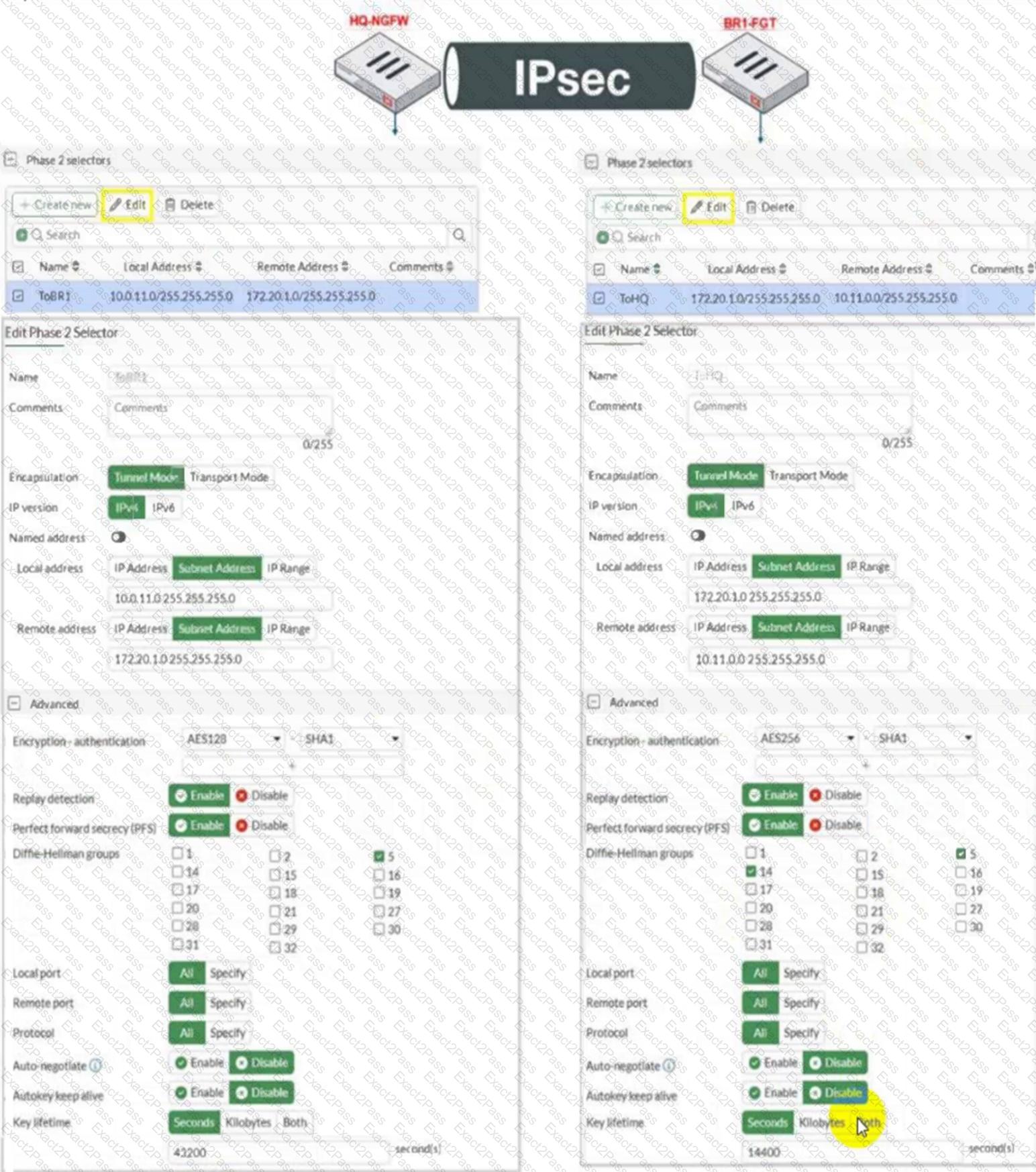
A network administrator is troubleshooting an IPsec tunnel between two FortiGate devices. The administrator has determined that phase 1 status is up, but phase 2 fails to come up.
Based on the phase 2 configuration shown in the exhibit, which two configuration changes will bring phase 2 up? (Choose two.)
Refer to the exhibit, which shows a partial configuration from the remote authentication server.

Why does the FortiGate administrator need this configuration?
Which statement correctly describes NetAPI polling mode for the FSSO collector agent?
Refer to the exhibits.
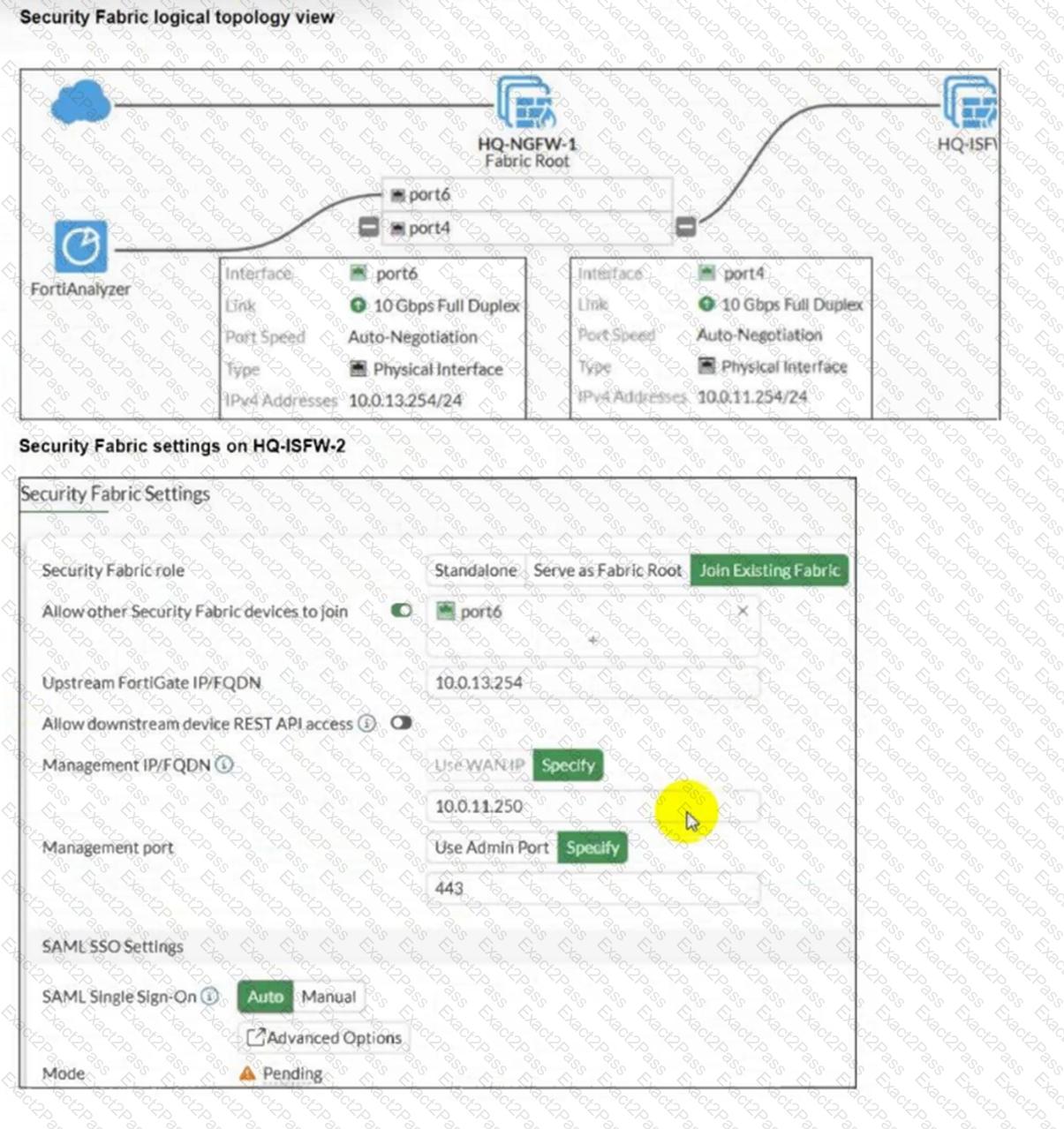
An administrator wants to add HQ-ISFW-2 in the Security Fabric. HQ-ISFW-2 is in the same subnet as HQ-ISFW. After configuring the Security Fabric settings on HQ-ISFW-2, the status stays Pending .
What can be the two possible reasons? (Choose two.)
Which two statements are correct when FortiGate enters conserve mode? (Choose two.)
What are three key routing principles in SD-WAN? (Choose three.)
An administrator configures FortiGuard servers as DNS servers on FortiGate using default settings.
What is true about the DNS connection to a FortiGuard server?
An administrator suspects that the Collector Agent is not forwarding login events to FortiGate.
What is the most effective troubleshooting step?
A network administrator is reviewing firewall policies in both Interface Pair View and By Sequence View. The policies appear in a different order in each view.
Why is the policy order different in these two views?
Refer to the exhibit, which shows an SD-WAN zone configuration on the FortiGate GUI.
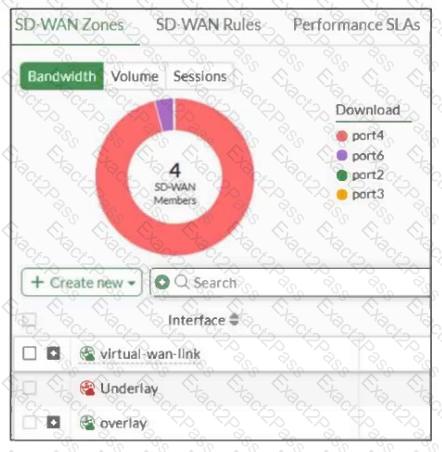
Based on the exhibit, which statement is true?

