Exact2Pass

Last Update 16 hours ago Total Questions : 267
The QMS ISO 9001:2015 Lead Auditor Exam content is now fully updated, with all current exam questions added 16 hours ago. Deciding to include ISO-9001-Lead-Auditor practice exam questions in your study plan goes far beyond basic test preparation.
You'll find that our ISO-9001-Lead-Auditor exam questions frequently feature detailed scenarios and practical problem-solving exercises that directly mirror industry challenges. Engaging with these ISO-9001-Lead-Auditor sample sets allows you to effectively manage your time and pace yourself, giving you the ability to finish any QMS ISO 9001:2015 Lead Auditor Exam practice test comfortably within the allotted time.
ISO 9001 addresses changes through several requirements, two examples of which are Clause 6.3 (Planning of Changes) and Clause 8.5.6 (Control of Changes). How do the requirements of Clause 8.5.6 differ from those of Clause 6.3?
Scenario 5: Mechanical-Electro (ME) Audit Stages
Mechanical-Electro, better known as ME, is an American company that provides mechanical and electrical services in China. Their services range from air-conditioning systems, ventilation systems, plumbing, to installation of electrical equipment in automobile plants, electronic manufacturing facilities, and food processing plants.
Due to the fierce competition from local Chinese companies and failing to meet customer requirements, ME ' s revenue dropped significantly. In addition, customers ' trust and confidence in the company decreased, and the reputation of the company was damaged.
In light of these developments, the top management of ME decided to implement a quality management system (QMS) based on ISO 9001. After having an effective QMS in place for over a year, they applied for a certification audit.
A team of four auditors was appointed for the audit, including Li Na as the audit team leader. Initially, the audit team conducted a general review of ME ' s documents, including the quality policy, operational procedures, inventory lists, QMS scope, process documentation, training records, and previous audit reports.
Li Na stated that this would allow the team to maintain a systematic and structured approach to gathering documents for all audit stages. While reviewing the documented information, the team observed some minor issues but did not identify any major nonconformities. Therefore, Li Na claimed that it was not necessary to prepare a report or conduct a meeting with ME ' s representatives at that stage of the audit. She stated that all areas of concern would be discussed in the next phase of the audit.
Following the on-site activities and the opening meeting with ME ' s top management, the audit team structured an audit test plan to verify whether ME’s QMS conformed to Clause 8.2.1 (Customer Communication) of ISO 9001.
To do so, they gathered information through group interviews and sampling. Li Na conducted interviews with departmental managers in the first group and then with top management. In addition, she chose a sampling method that sufficiently represented customer complaints from both areas of ME ' s operations.
The team members were responsible for the sampling procedure. They selected a sample size of 4 out of 45 customer complaints received weekly for electrical services and 2 out of 10 complaints for mechanical services.
Afterward, the audit team evaluated the evidence against the audit criteria and generated the audit findings.
According to scenario 5, Li Na conducted group interviews with departmental managers and top management by herself. Is this in accordance with audit best practices?
You are conducting a Stage 2 audit at an organisation that services refrigeration equipment for a large customer base. The scope of certification is “Provision of refrigeration equipment maintenance and repair services”. You are interviewing the Managing Director to learn more about the organisation and to explore how the requirements for policy, objectives, and risks and opportunities in ISO 9001 are addressed.
The Managing Director explains that they only use sub-contract refrigeration engineers and do not have any full-time refrigeration engineers, which helps to optimise overhead costs.
The Managing Director adds that the ISO 9001 requirements for the competence of personnel extend to both sub-contract and full-time staff.
You then asked 2 of the sub-contract engineers what they could do to contribute to the effectiveness of the quality management system, they replied stating that “we are not really sure as we have not been told how we could contribute”. The Managing Director added that this is not applicable as they only use sub-contractors who operate ISO 9001 certificated quality management systems. The documented information provided to the auditor confirms this.
Which clause in ISO 9001 has not been fulfilled in this instance?
You are an auditor and are in dialogue with the quality manager and the managing director of a small business that supplies specific IT
hardware and software for manufacturers of medical equipment.
You: " I would like to look at how you manage the design and development of your products.
Auditee: " We have made some strategic changes, the main one being that since last month we no longer produce the software of our
products in-house. "
You: " What has been the impact of that? "
Auditee: " We now subcontract the provision of the software needed for our hardware. This allowed us to concentrate our efforts on
the hardware and let specialised organisations develop the software. For the time being, we have subcontracted our software
requirements to three different organisations.
You: " What were the reasons for making the change? "
Auditee: " Our IT software section was a small operation, and we struggled to cope with new technologies. During busy periods, we
found it hard to meet lead times, and in quiet periods, we had staff with little to do. This was having an impact on customer
satisfaction. "
You: " How did you go about the change? "
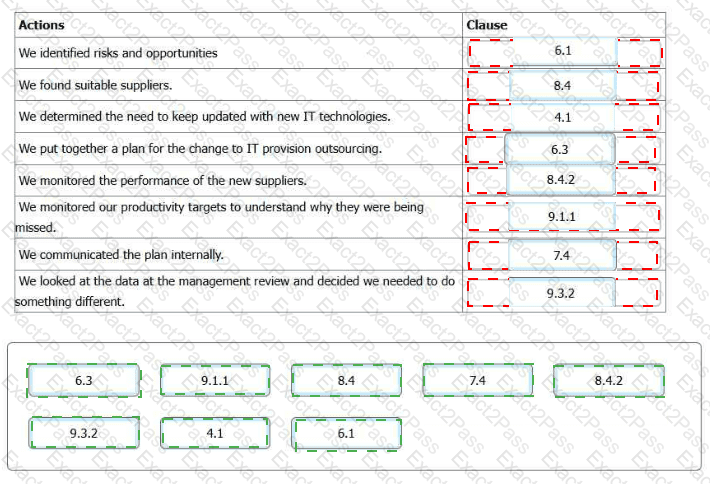
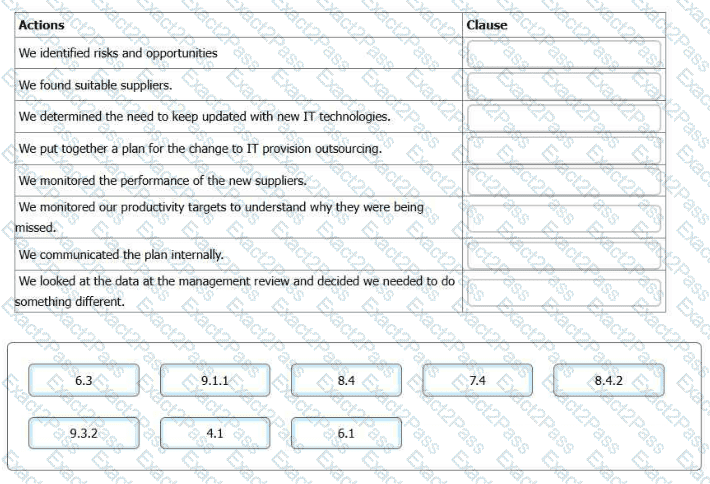
In relation to the auditor ' s question about how the change was managed, the auditee mentions the actions listed
below. Match the ISO 9001 clauses to show which action the requirement applies to.
To complete the table, click on the blank section you want to complete so it is highlighted in red and then click on the
ISO 9001 clauses listed below. Alternatively, drag and drop each clause to show which clause the action applies to.
Scenario 6: Davis Clinic (DC) is an American medical center focused on integrated health care. Since its establishment DC was committed to providing qualitative services for its clients, which is the reason why the company decided to implement a quality management system (QMS) based on ISO 9001. After a year of having an active QMS in place, DC applied for a certification audit.
A team of five auditors, from a well-known certification body, was selected to conduct the audit. Eva was appointed as the audit team leader. After three days of auditing, the team gathered to review and examine their findings. They also discussed the audit findings with DC ' s top management and then drafted the audit conclusions.
In the closing meeting, which was held between the audit team and the top management of DC. Eva presented two nonconformities that were detected during the audit. Eva stated that the company did not retain documented information regarding its outsourced services for an analysis laboratory and regarding the conducted management reviews. During the closing meeting, the audit team required from DCs top management to come up with corrective action plans within two weeks. Although the top management did not agree with the audit findings, the audit team insisted that the auditee must submit corrective actions within the given time frame in order for the audit activities to continue.
Once the action plans were evaluated, the audit team began preparing the audit report. Eva required from the team to provide accurate descriptions of the audit findings and the audit conclusions. The report was then distributed to all the interested parties involved in the audit, including the certification body Based on the report, the certification body together with Eva, as the audit team leader, made the certification decision.
Based on the scenario above, answer the following question:
The audit team delayed audit activities until DC’s top management submitted their action plans. Is this acceptable?
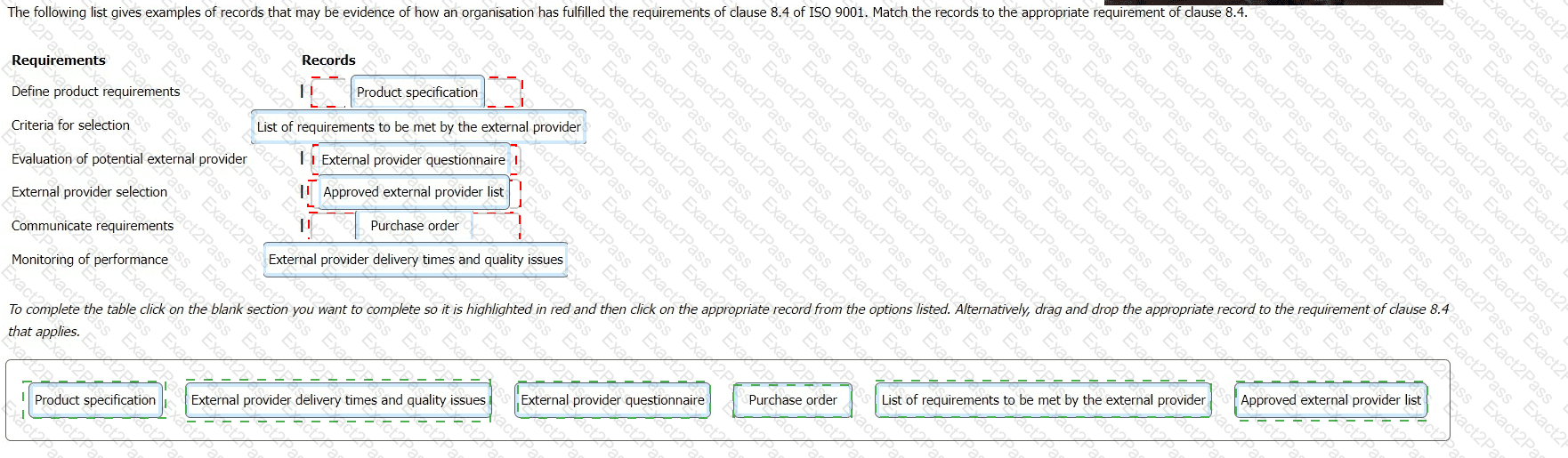
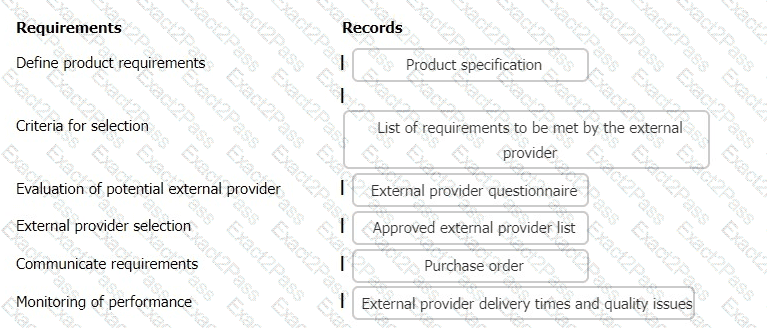
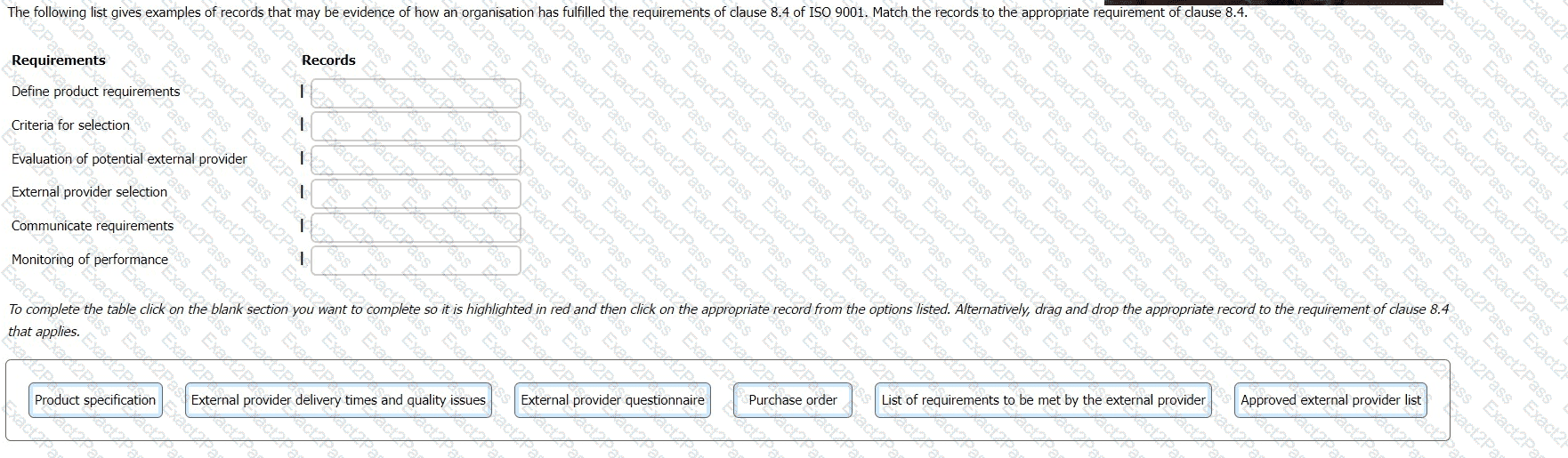
The following list gives examples of records that may be evidence of how an organisation has fulfilled the requirements of clause 8.4 of ISO 9001. Match the records to the appropriate requirement of clause 8.4.
The certification body has not been able to verify the implementation of corrective actions for any identified major nonconformity within six months after the last day of the Stage 2 audit. What must the certification body do in this case?
Scenario 4:
TD Advertising is a print management company based in Chicago. The company offers design services, digital printing, storage, and distribution. As TD expanded, its management recognized that success depended on adopting new technologies and improving quality.
To ensure customer satisfaction and quality improvement, the company decided to pursue ISO 9001 certification.
After implementing the QMS, TD hired a well-known certification body for an audit. Anne Key was appointed as the audit team leader. She received a document listing the audit team members, audit scope, criteria, duration, and audit engagement limits.
Anne reviewed the document and approved the audit mandate. The certification body and TD’s top management signed the certification agreement.
Before contacting TD, Anne reviewed the audit scope and noticed that TD made changes to it due to the adoption of new printing equipment. However, Anne disagreed with the changes, stating they would affect the audit timeline. She considered withdrawing from the audit.
Based on scenario 4, conducting which of the activities below is NOT the responsibility of Anne?
Scenario 5: Mechanical-Electro (ME) Audit Stages
Mechanical-Electro, better known as ME, is an American company that provides mechanical and electrical services in China. Their services range from air-conditioning systems, ventilation systems, plumbing, to installation of electrical equipment in automobile plants, electronic manufacturing facilities, and food processing plants.
Due to the fierce competition from local Chinese companies and failing to meet customer requirements, ME ' s revenue dropped significantly. In addition, customers ' trust and confidence in the company decreased, and the reputation of the company was damaged.
In light of these developments, the top management of ME decided to implement a quality management system (QMS) based on ISO 9001. After having an effective QMS in place for over a year, they applied for a certification audit.
A team of four auditors was appointed for the audit, including Li Na as the audit team leader. Initially, the audit team conducted a general review of ME ' s documents, including the quality policy, operational procedures, inventory lists, QMS scope, process documentation, training records, and previous audit reports.
Li Na stated that this would allow the team to maintain a systematic and structured approach to gathering documents for all audit stages. While reviewing the documented information, the team observed some minor issues but did not identify any major nonconformities. Therefore, Li Na claimed that it was not necessary to prepare a report or conduct a meeting with ME ' s representatives at that stage of the audit. She stated that all areas of concern would be discussed in the next phase of the audit.
Following the on-site activities and the opening meeting with ME ' s top management, the audit team structured an audit test plan to verify whether ME’s QMS conformed to Clause 8.2.1 (Customer Communication) of ISO 9001.
To do so, they gathered information through group interviews and sampling. Li Na conducted interviews with departmental managers in the first group and then with top management. In addition, she chose a sampling method that sufficiently represented customer complaints from both areas of ME ' s operations.
The team members were responsible for the sampling procedure. They selected a sample size of 4 out of 45 customer complaints received weekly for electrical services and 2 out of 10 complaints for mechanical services.
Afterward, the audit team evaluated the evidence against the audit criteria and generated the audit findings.
Li Na chose a sampling method that sufficiently represents customer complaints from both areas of ME’s operations. Which sampling method fits that description?
(Which of the following two activities can be carried out on-site by an auditor with no human interaction ?)