Exact2Pass

Last Update 16 hours ago Total Questions : 267
The QMS ISO 9001:2015 Lead Auditor Exam content is now fully updated, with all current exam questions added 16 hours ago. Deciding to include ISO-9001-Lead-Auditor practice exam questions in your study plan goes far beyond basic test preparation.
You'll find that our ISO-9001-Lead-Auditor exam questions frequently feature detailed scenarios and practical problem-solving exercises that directly mirror industry challenges. Engaging with these ISO-9001-Lead-Auditor sample sets allows you to effectively manage your time and pace yourself, giving you the ability to finish any QMS ISO 9001:2015 Lead Auditor Exam practice test comfortably within the allotted time.
Noitol is an organisation specialising in the design and production of e-learning training materials for the insurance market. During an ISO 9001 audit of the development department, the auditor asks the Head of Development about the process used for validation of the final course design. She states that they usually ask customers to validate the product with volunteers. She says that the feedback received often leads to key improvements.
The auditor samples the design records for a recently completed course for the 247 Insurance organisation. Design verification was carried out but there was no validation report. The Head of Development advises that this customer required the product on an urgent basis, so the validation stage was omitted. When asked, the Head estimates that this occurs about 50% of the time. She confirms that they always ask for feedback and often make changes. There is no record of feedback in the design file for the course.
The auditor decides to review the training course design process in more depth.
Select three options that provide a meaningful audit trail for this process.
During a third-party audit of a pharmaceutical organisation (CD9000) site of seven COVID-19 testing laboratories in various terminals at
a major international airport, you interview the CD 9000 ' s General Manager (GM), who was accompanied by Jack, the legal compliance
expert. Jack is acting as the guide in the absence of the Technical Manager due to him contracting COVID-19.
You: " What external and internal issues have been identified that could affect CD9000 and its quality management system? "
GM: " Jack guided us on this. We identified issues like probable competition of another laboratory organisation in the airport, legal
requirements on COVID-19 continuously changing, the shortage of competent laboratory analysists, the epidemic declining soon,
shortage of chemicals for the analysis. It was quite a good experience. "
You: " Did you document these issues? "
GM: " No. Jack said that ISO 9001 does not require us to document these issues. "
You: " How did you determine the risks associated with the issues and did you plan actions to address them? "
GM: " I am not sure. The Technical Manager is responsible for this process. Jack may be able to answer this question in his absence. "
Select two options for how you would respond to the General Manager ' s suggestion:
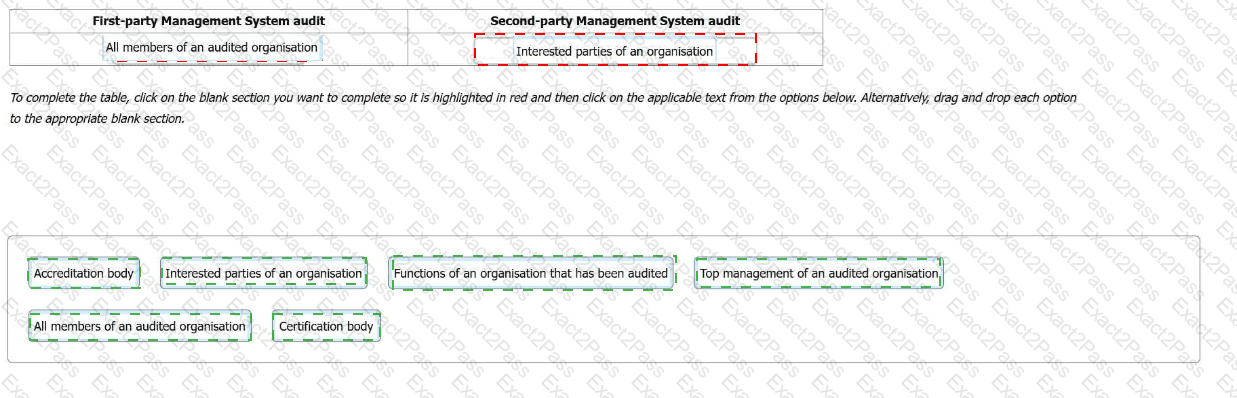
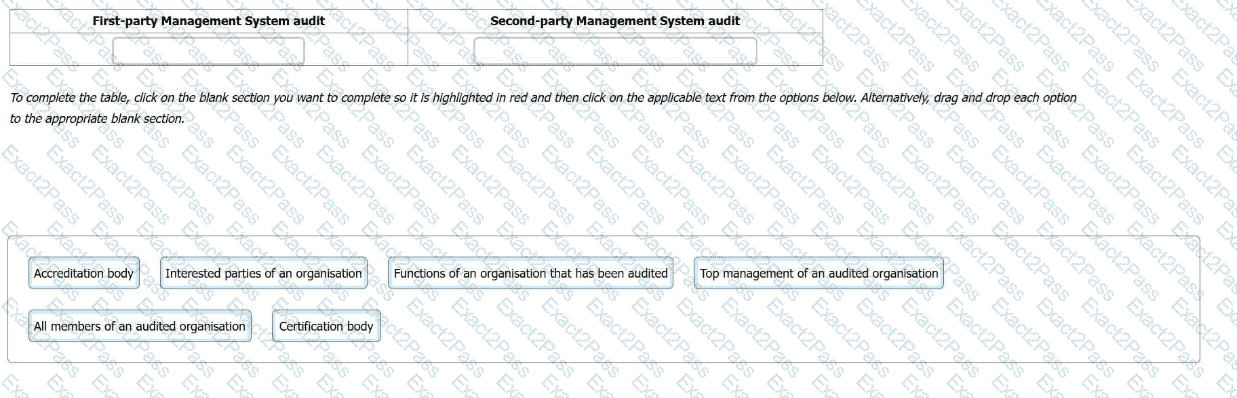
Match the following potential audit client options to the type of audit.
XYZ Corporation is an organisation that employs 100 people. As the audit team leader, you are conducting a certification audit at Stage 1. When reviewing the quality management system (QMS)
documentation, you find that quality objectives have been set for every employee in the organisation except top management. The Quality Manager complains that this has created a lot of resistance
to the QMS, and the Chief Executive is asking questions about how much it will cost. He asks for your opinion on whether this is the correct method of setting objectives.
How would you respond with the following options? Select three.
Scenario 7: POLKA is a car manufacturing company based in Stockholm, Sweden. The company has around 14,000 employees working in different sectors which help with the design, painting, assembling, and test drives of the final product. The company is widely known for its qualitative products and affordable prices. In order to retain their reputation, POLKA implemented a quality management system (QMS) based on ISO 9001.
Before applying for certification, the company decided to conduct an internal audit to check whether there are any nonconformities in their QMS and if the requirements of ISO 9001 are being fulfilled. The top management appointed Sean, the internal auditor, as the team leader of the internal audit team. Sean required from the top management to have unrestricted access to the employees and executives of POLKA and to the documented information. Furthermore, Sean required to establish a team with a large number of auditors, considering the size and the complexity of the organization. The top management of POLKA agreed with Sean ' s requirements.
The top management, in cooperation with Sean, assigned 10 more employees to the audit team. Following that. Sean planned the audit activities and assigned the roles and responsibilities to each auditor. They began by interviewing employees of different manufacturing departments to check whether they are aware of the process of the QMS implementation. While conducting these activities, one of the auditors asked Sean for permission to audit the department in which he worked on a daily basis, as he was very familiar with the processes of the department.
Along the way, the teams findings showed that the staff were trained, documented information was updated, and the QMS fulfilled the requirements of ISO 9001. The internal audit took three weeks to complete, and on the last week the audit team held a final meeting
The team shared their results and together drafted the audit report This report was submitted to the top management of the company. The report was maintained as documented information, and was available to the relevant interested parties.
Based on the scenario above, answer the following question:
Sean requested unrestricted access to the employees, executives, and documented information of POLKA. Is this in accordance with audit best practices?
(Select from the options which two of the following documented information examples are prepared by the auditor as a member of an audit team.)
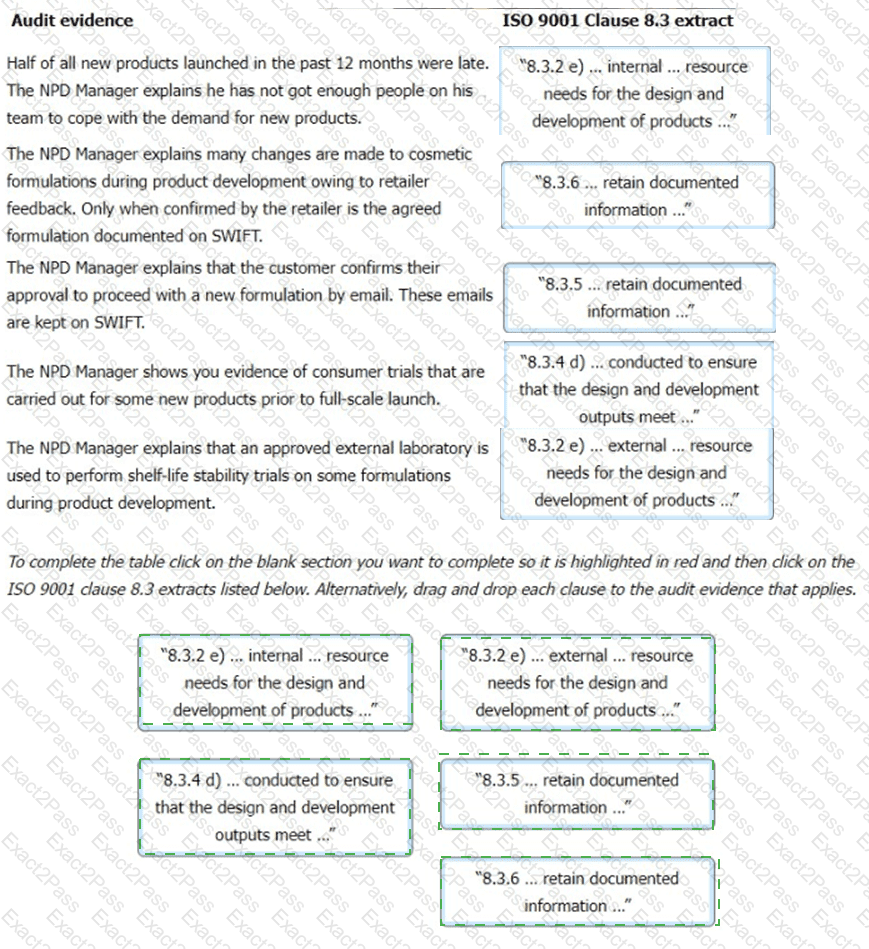
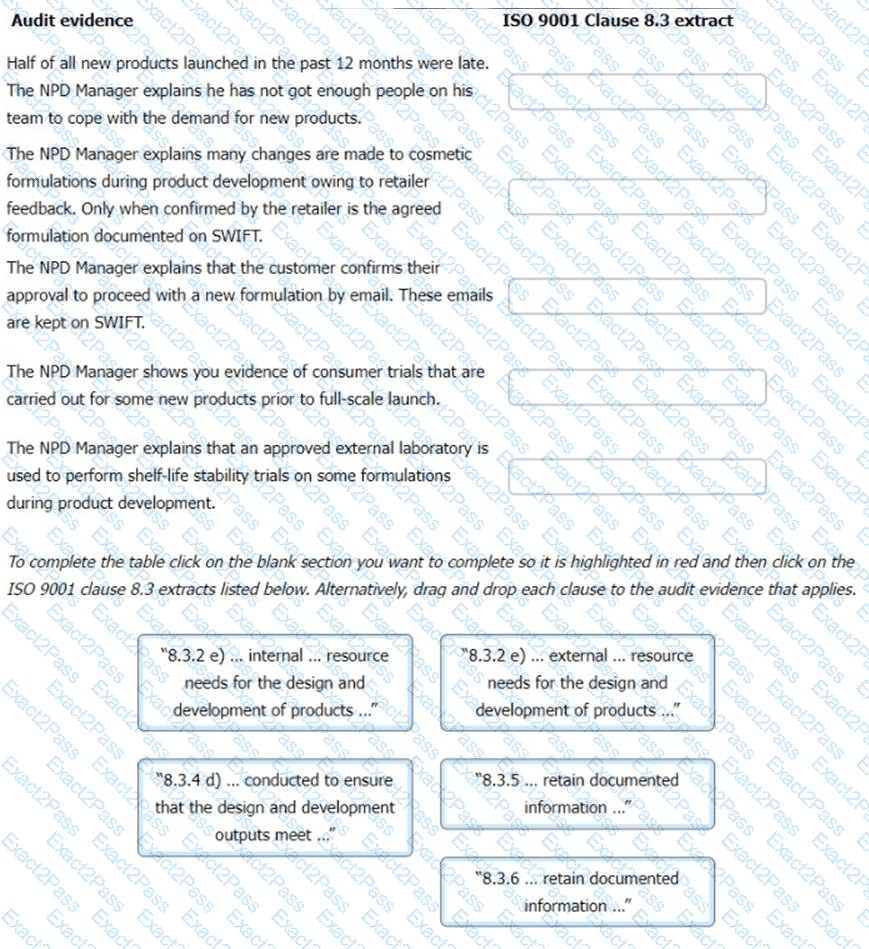
You are carrying out an audit at a single-site organisation seeking certification to ISO 9001 for the first time. The organization manufactures cosmetics for major retailers and the name of the retailer supplied appears on the product packaging. Sales turnover has increased significantly over the past five years.
You are interviewing the new Product Development Manager. You note that a software application called SWIFT is used to help control the product development process.
You have gathered audit evidence as outlined in the table. Match the ISO 9001 clause 8.3 extracts to the audit evidence.
A person who provides specific knowledge or expertise to the audit team during the audit is known as a/an:
According to the guidance provided in ISO 19011, a second-party opening meeting should cover many elements.
From the following options, select the four items that should not be included in the opening meeting.
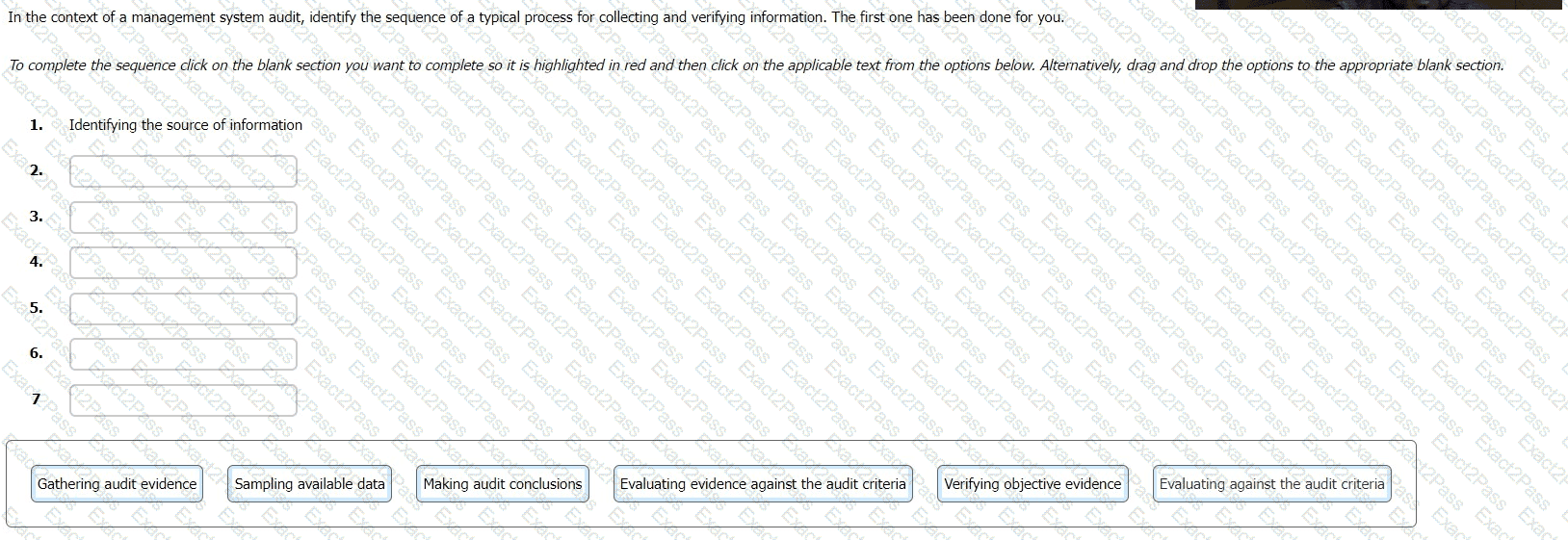
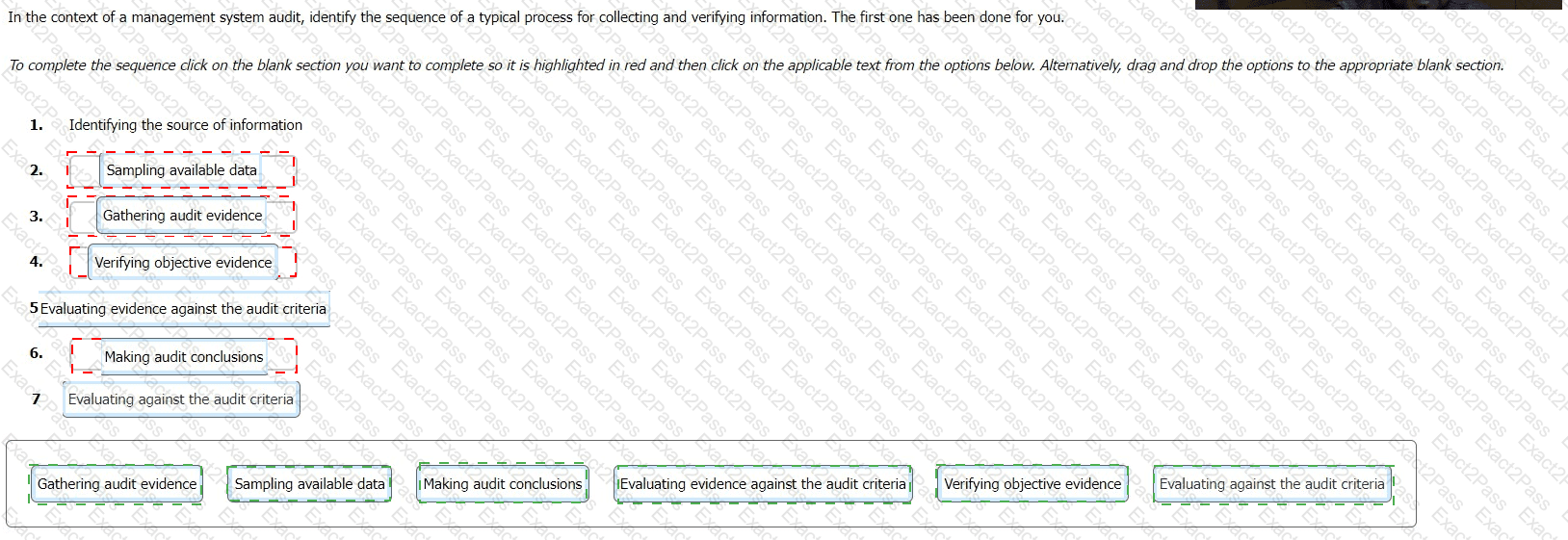
In the context of a management system audit, identify the sequence of a typical process for collecting and verifying information. The first one has been done for you.
To complete the sequence click on the blank section you want to complete so it is highlighted in red and then click on the applicable text from the options below. Alternatively, drag and drop the options to the appropriate blank section.