Exact2Pass

Last Update 16 hours ago Total Questions : 267
The QMS ISO 9001:2015 Lead Auditor Exam content is now fully updated, with all current exam questions added 16 hours ago. Deciding to include ISO-9001-Lead-Auditor practice exam questions in your study plan goes far beyond basic test preparation.
You'll find that our ISO-9001-Lead-Auditor exam questions frequently feature detailed scenarios and practical problem-solving exercises that directly mirror industry challenges. Engaging with these ISO-9001-Lead-Auditor sample sets allows you to effectively manage your time and pace yourself, giving you the ability to finish any QMS ISO 9001:2015 Lead Auditor Exam practice test comfortably within the allotted time.
Scenario 1: AL-TAX is a company located in California which provides financial and accounting services. The company manages the finances of 17 companies and now is seeking to expand their business even more The CEO of AL-TAX, Liam Durham, claims that the company seeks to provide top-notch services to their clients Recently, there were a number of new companies interested in the services provided by AL-TAX.
In order to fulfill the requirements of new clients and further improve quality, Liam discussed with other top management members the idea of implementing a quality management system (QMS) based on ISO 9001. During the discussion, one of the members of the top management claimed that the size of the company was not large enough to implement a QMS. In addition, another member claimed that a QMS is not applicable for the industry in which AL TAX operates. However, as the majority of the members voted for implementing the QMS. Liam initiated the project.
Initially, Liam hired an experienced consultant to help AL-TAX with the implementation of the QMS. They started by planning and developing processes and methods for the establishment of a QMS based on ISO 9001. Furthermore, they ensured that the quality policy is appropriate to the purpose and context of AL TAX and communicated to all employees. In addition, they also tried to follow a process that enables the company to ensure that its processes are adequately resourced and managed, and that improvement opportunities are determined.
During the implementation process, Liam and the consultant focused on determining the factors that could hinder their processes from achieving the planned results and implemented some preventive actions in order to avoid potential nonconformities Six months after the implementation of the QMS. AL-TAX conducted an internal audit. The results of the internal audit revealed that the QMS was not fulfilling all requirements of ISO 9001. A serious issue was that the QMS was not fulfilling the requirements of clause 5.1.2 Customer focus and had also not ensured clear and open communication channels with suppliers.
Throughout the next three years, the company worked on improving its QMS through the PDCA cycle in the respective areas. To assess the effectiveness of the intended actions while causing minimal disruptions, they tested changes that need to be made on a smaller scale. After taking necessary actions, AL-TAX decided to apply for certification against ISO 9001.
Based on the scenario above, answer the following question:
The CEO of AL-TAX hired an experienced consultant to help with the implementation of the QMS. Is this required from ISO 9001?
You are conducting a third-party audit to ISO 9001 and the next item on your audit plan is ' internal auditing ' .
When reviewing a sample of audit records up to 5 years previously, you find that many contain non-conformance reports and no actions have been taken. You interview the Quality Manager.
You: " I have noted that many of the older files contain non-conformances that have not had any corrective action taken. "
Quality Manager: " Because the business is always changing, the departmental managers tell me that the non-conformances are no longer applicable. I made a decision that any non-conformance over 3 years old is automatically closed "
You: " Do you obtain any confirmation beforehand from the appropriate departments that the non-conformances are no longer applicable. "
Quality Manager: " No, because they are so old I consider that they are no longer appropriate. Please remember that we take a risk-based approach which means we audit where and when it is considered important to do so.
Select one course of action you would now take from the options.
You are leading a Stage 2 certification audit of a multi-site organisation and have received the audit schedule below;
Head Office and Site 1 – Day 1
Site 2 (150 km from HQ) – Days 2 and 3
During Day 1 of the audit, the client informs you that the laboratory at Site 2 has been closed for decontamination due to a serious outbreak of an infectious disease among workers. In Site 2, all other functions could be audited as planned.
As the audit team leader, what would you do?
Choose the best acceptable action you could take:
At the end of a second-party audit, the audit team enters the meeting room to hold the closing meeting; only two people
are present and waiting for them: the Health and Safety supervisor and the administrative officer. Neither has participated in
the audit. However, the team had previously agreed with the auditee Quality Manager on two nonconformities identified
during the audit (NC1 and NC2).
They said:
Health and Safety supervisor: " Good evening. We are sorry to inform you that the general manager was involved in a
serious car accident, and the other two managers have had to leave urgently to attend to the emergency. "
Administration officer: " Our quality manager, before leaving, left a written message about ' NC2 ' . He declares that the
correction and corrective action have been already implemented and has attached some documents to the message as
evidence of these actions. Therefore, he expects that ' NC2 ' will not be included in the report. "
Which one of the following would be your preferred answer to the Quallty Manager ' s request?
The procedures of an organisation require that all purchase orders have to be signed by the Purchasing Manager, or, in her absence, by the Production Manager. During an audit carried out in November 2020, an auditor determined that during three weeks in February 2020, the purchase orders were not signed. You raise a nonconformance under Clause 8.4.3 of ISO 9001:2015.
Which one of the following answers would you accept as a ' correction ' from the Purchasing Manager?
Which statement regarding the drafting of the audit conclusions is correct?
An internal auditor of a manufacturer of polystyrene packaging products for the electronics industry raised a nonconformity against section 10.3 of ISO 9001 in Report IA202. The nonconformity (NC 3) stated:
" The reject rate of the finished product of 9.7% needs improvement as it doesn ' t meet the stated objective of top management of 5%. "
As the third-party auditor reviewing the internal audit process, you come across the nonconformity. For corrective action, the Quality Manager conducted an investigation into the reject rates. He reported that the collection baskets for products ejecting from the moulding machines were not large enough. About 6% of products fell onto the wet and dirty factory floor. Management stated that replacing the baskets was too costly and ordered the Maintenance Manager to ensure that the floor was kept clean and dry to prevent rejects. The auditor later checked the factory floor, which was wet and dirty in places.
From the following nonconformities, select three that the auditor could raise to ISO 9001.
You are conducting an ISO 9001 audit of a Materials Recycling Facility (MRF). The organisation processes
waste plastics into raw materials for plastic bottle manufacturers. You reach the manual picking line where operators are removing contaminant materials from incoming products, such as plastic bags, plastic film and badly contaminated items that would compromise the recycling process. You interview the line supervisor.
You: " Why are these plastic items being rejected at this stage? "
Auditee: " They do not meet our processing standards. "
You: " What is the reason for that? "
Auditee: " These items are likely to damage the machinery down the line. They can also compromise our
quality standards. We need to protect our reputation for good quality output materials. "
You: " What happens to the rejected items? "
Auditee: " Some get melted down in another process later on and some are disposed of as waste products that cannot be recycled. "
You: " What happens to the waste products? "
Auditee: " I ' m not sure. I suppose they go to landfill. "
Which two. of the following actions would you take to investigate further?
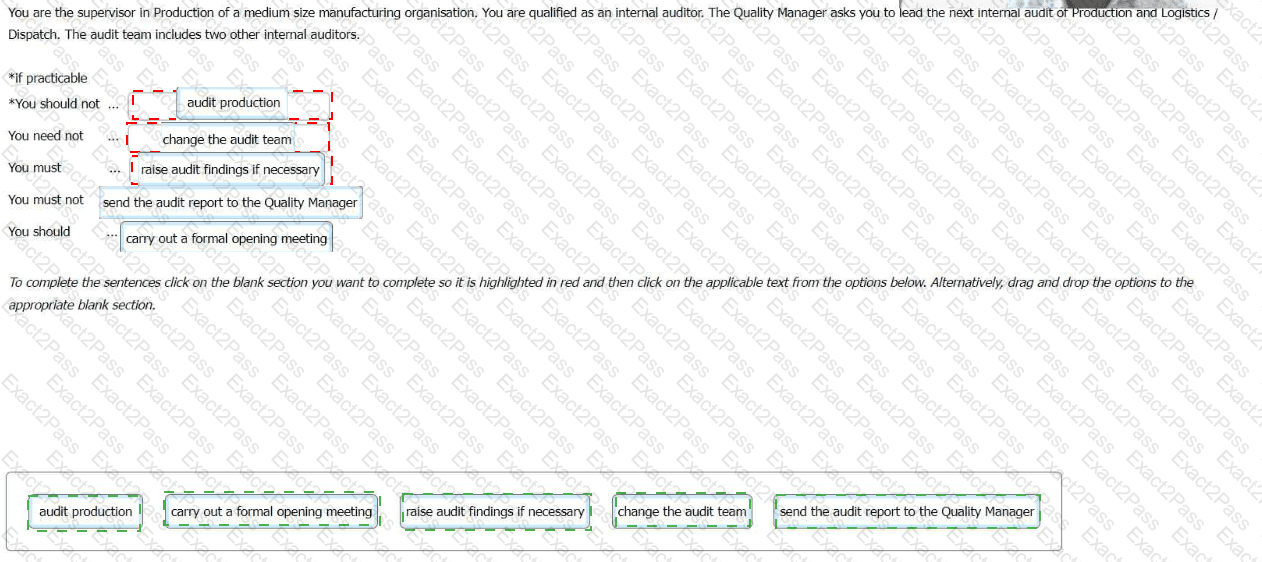
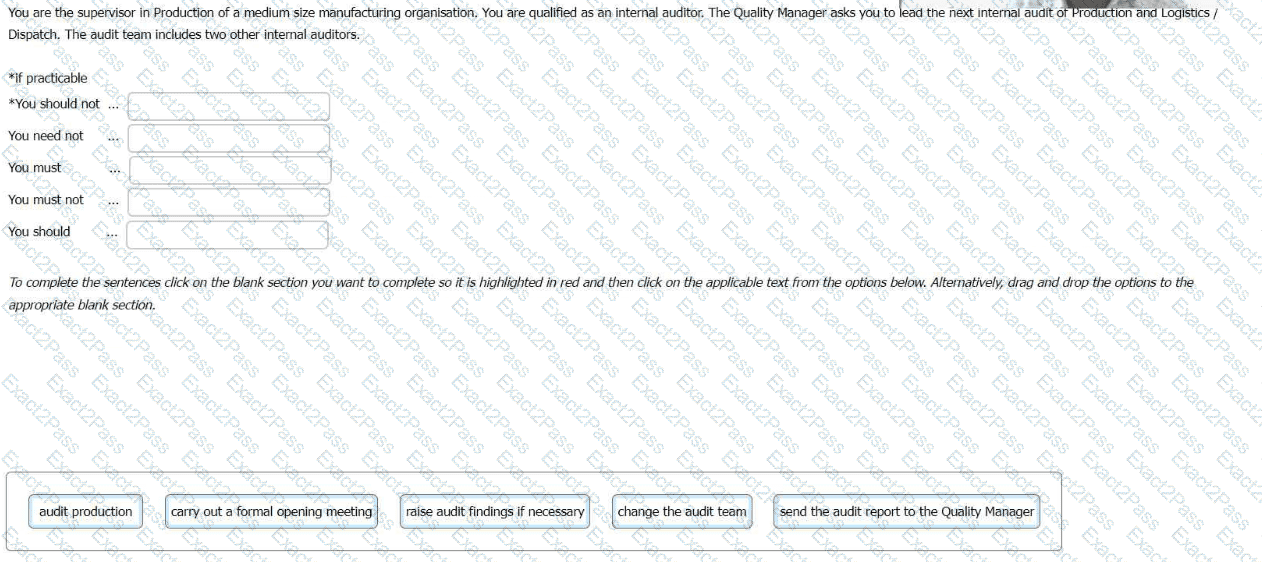
You are the supervisor in Production of a medium size manufacturing organisation. You are qualified as an internal auditor. The Quality Manager asks you to lead the next internal audit of Production and Logistics Dispatch. The audit team includes two other internal auditors.
Which of the following subjects should an auditor discuss when communicating with the auditee’s top management?