Exact2Pass

Last Update 16 hours ago Total Questions : 267
The QMS ISO 9001:2015 Lead Auditor Exam content is now fully updated, with all current exam questions added 16 hours ago. Deciding to include ISO-9001-Lead-Auditor practice exam questions in your study plan goes far beyond basic test preparation.
You'll find that our ISO-9001-Lead-Auditor exam questions frequently feature detailed scenarios and practical problem-solving exercises that directly mirror industry challenges. Engaging with these ISO-9001-Lead-Auditor sample sets allows you to effectively manage your time and pace yourself, giving you the ability to finish any QMS ISO 9001:2015 Lead Auditor Exam practice test comfortably within the allotted time.
Which two of the following are the key expected results of a quality management system that conforms to the requirements of ISO 9001:2015?
ABC is a worldwide fast-food organisation. One of the branches, in downtown Cape Town, decided to
implement an ISO 9001 quality management system and you are the audit team leader (with two other
auditors) that will carry out the certification audits, Stage 2.
ABC receive the orders by phone or internet; some of the employees deliver the ordered food to indicated
addresses. The normal menu includes 15 different types of hamburgers; however, in the last two weeks,
due to a shortage of a special type of meat, they can only prepare six of the 15 varieties.
During the internal meeting of the audit team, you ask one of the auditors to describe what she has
observed. She audited the reception of orders from customers (via phone or internet) and the
communication of the orders to the kitchen. She noticed that the menu offering food on the website is still
the normal one, with 15 different hamburgers, and during a 30-minute period, she observed many
customers reluctantly accepting something other than the hamburger they preferred.
You, as audit team leader, inform the Quality Manager of your concern about the major nonconformity,
since you consider this a serious breach of the basic principles of quality that lasted two weeks without
action being taken.
Right at the beginning of the Closing meeting, you discuss the nonconformity with the General Manager.
She got quite upset and said she was going to make a complaint to the certification body and left the
room; the Quality Manager was the only member of ABC left with the audit team. The Quality Manager said the General Manager would not come back to the meeting.
What would you do? Choose the best from the following options:
In the context of a third-party audit, select the issue which is not expected to be included in the audit plan.
Scenario 3:
Fin-Pro is a financial institution in Austria offering commercial banking, wealth management, and investment services. The company faced a significant loss of customers due to failing to improve service quality as they expanded.
To regain customer confidence, top management implemented a QMS based on ISO 9001. After a year, they contacted ACB, a local certification body, to pursue ISO 9001 certification.
The audit team was led by Emilia, an experienced lead auditor, and included three auditors. After an agreement was reached, ACB sent the audit objectives to the audit team.
The audit team began by gathering information about Fin-Pro’s understanding of ISO 9001 requirements. While reviewing documented information, they noticed missing records of training and awareness sessions. They conducted employee interviews to verify attendance.
The team also reviewed the organizational chart and job descriptions to confirm employee competence. They observed the company’s working environment (social, psychological, and physical conditions).
The audit team analyzed the evidence and prepared an audit report with findings and conclusions.
In scenario 3, the audit team required access to see the organizational chart and job descriptions to verify the employees’ competence. Based on audit best practices, is this acceptable?
Select six tasks you would expect to be completed at the audit team meeting of a third-party audit team leader and his audit team in preparation for a Closing meeting for a four-day initial certification audit.
Scenario 1: AL-TAX is a company located in California which provides financial and accounting services. The company manages the finances of 17 companies and now is seeking to expand their business even more The CEO of AL-TAX, Liam Durham, claims that the company seeks to provide top-notch services to their clients Recently, there were a number of new companies interested in the services provided by AL-TAX.
In order to fulfill the requirements of new clients and further improve quality, Liam discussed with other top management members the idea of implementing a quality management system (QMS) based on ISO 9001. During the discussion, one of the members of the top management claimed that the size of the company was not large enough to implement a QMS. In addition, another member claimed that a QMS is not applicable for the industry in which AL TAX operates. However, as the majority of the members voted for implementing the QMS. Liam initiated the project.
Initially, Liam hired an experienced consultant to help AL-TAX with the implementation of the QMS. They started by planning and developing processes and methods for the establishment of a QMS based on ISO 9001. Furthermore, they ensured that the quality policy is appropriate to the purpose and context of AL TAX and communicated to all employees. In addition, they also tried to follow a process that enables the company to ensure that its processes are adequately resourced and managed, and that improvement opportunities are determined.
During the implementation process, Liam and the consultant focused on determining the factors that could hinder their processes from achieving the planned results and implemented some preventive actions in order to avoid potential nonconformities Six months after the implementation of the QMS. AL-TAX conducted an internal audit. The results of the internal audit revealed that the QMS was not fulfilling all requirements of ISO 9001. A serious issue was that the QMS was not fulfilling the requirements of clause 5.1.2 Customer focus and had also not ensured clear and open communication channels with suppliers.
Throughout the next three years, the company worked on improving its QMS through the PDCA cycle in the respective areas. To assess the effectiveness of the intended actions while causing minimal disruptions, they tested changes that need to be made on a smaller scale. After taking necessary actions, AL-TAX decided to apply for certification against ISO 9001.
Based on the scenario above, answer the following question:
Scenario 1 indicates that AL-TAX did not ensure clear and open communication channels with interested parties. Which quality management principle did the organization not follow in this case?
(A third-party audit has been planned at a single-site organisation. The audit team comprises one audit team leader, one auditor and one auditor who is undertaking his first third-party audit.
During the on-site audit, the auditor who is undertaking his first third-party audit shall...)
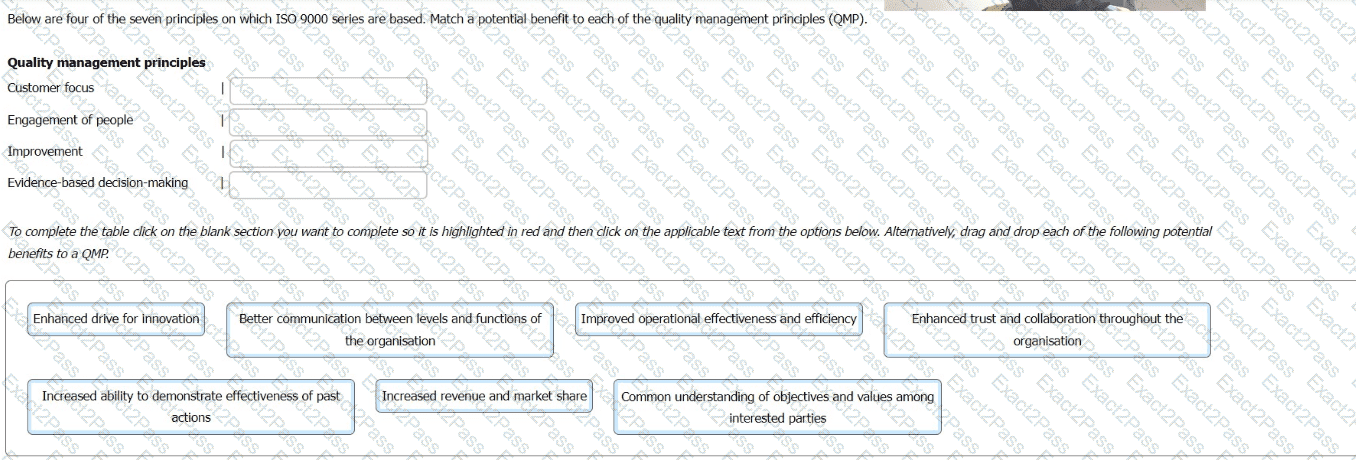
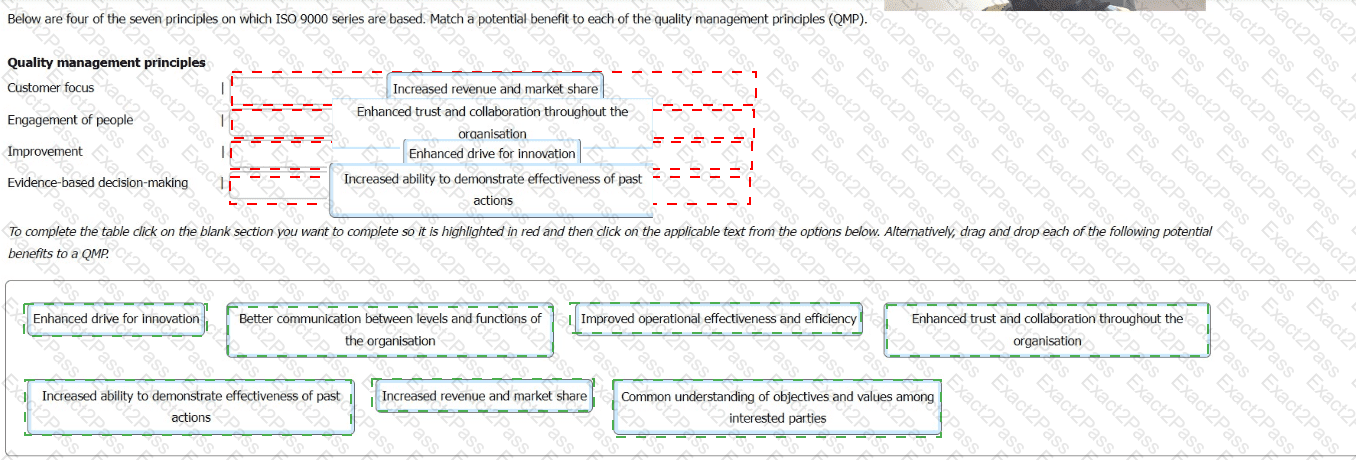
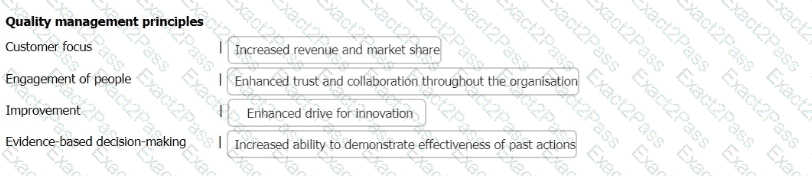
Below are four of the seven principles on which ISO 9000 series are based. Match a potential benefit to each of the quality management principles (QMP).
XYZ Corporation employs 100 people, and during a Stage 1 certification audit, certain issues are identified with the Quality Management System (QMS). Which two options describe the circumstances in which you could raise a nonconformity against Clause 6.2 of ISO 9001:2015?
Read the following role descriptions. Select two roles that are not directly involved in the audit process.


 A screenshot of a chat Description automatically generated