Exact2Pass

Last Update 16 hours ago Total Questions : 267
The QMS ISO 9001:2015 Lead Auditor Exam content is now fully updated, with all current exam questions added 16 hours ago. Deciding to include ISO-9001-Lead-Auditor practice exam questions in your study plan goes far beyond basic test preparation.
You'll find that our ISO-9001-Lead-Auditor exam questions frequently feature detailed scenarios and practical problem-solving exercises that directly mirror industry challenges. Engaging with these ISO-9001-Lead-Auditor sample sets allows you to effectively manage your time and pace yourself, giving you the ability to finish any QMS ISO 9001:2015 Lead Auditor Exam practice test comfortably within the allotted time.
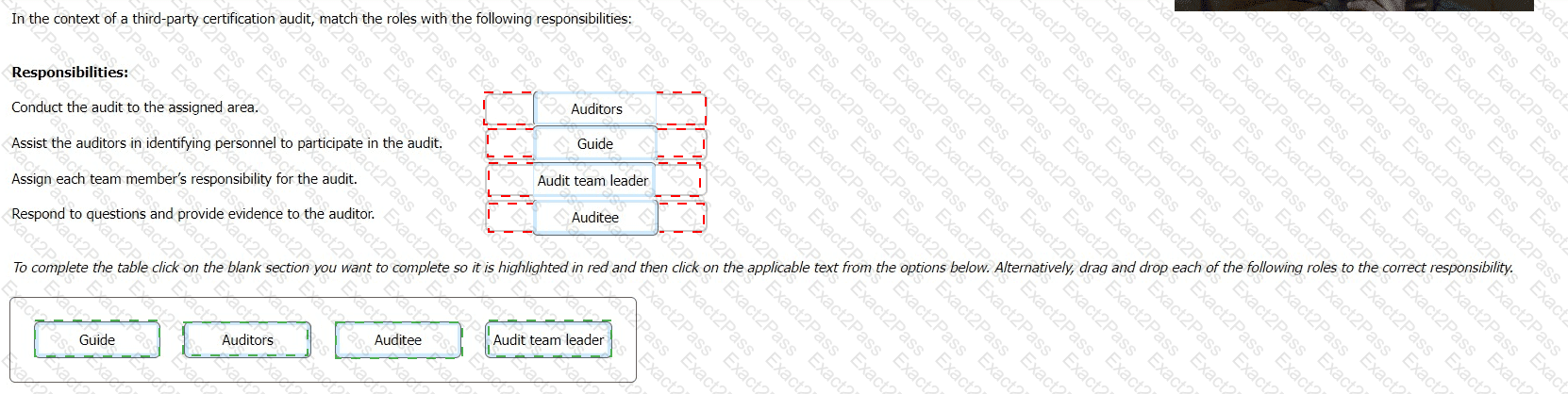
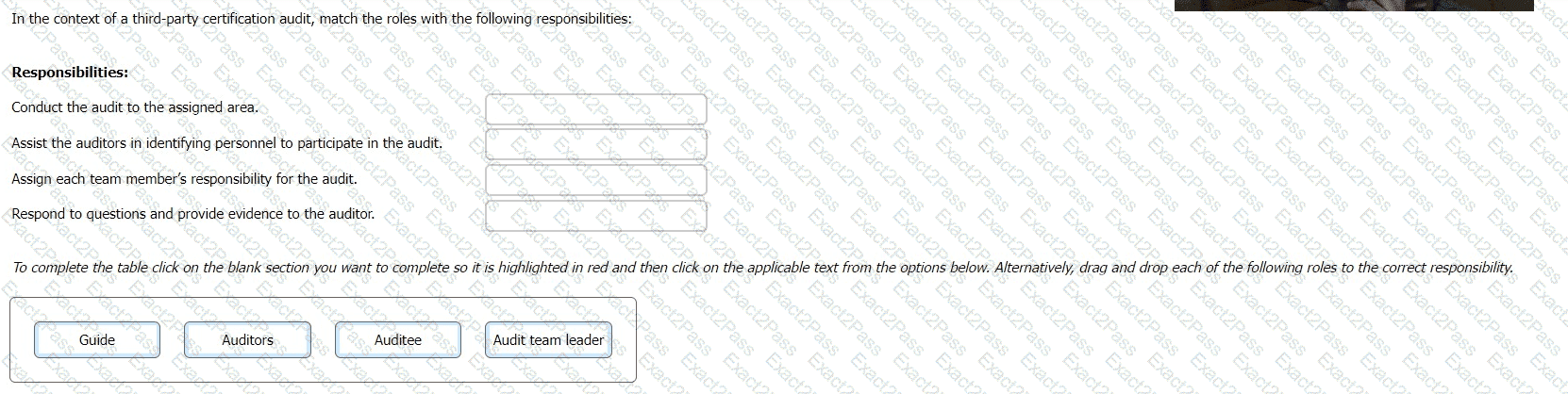
In the context of a third-party certification audit, match the roles with the following responsibilities:
(When raising a non-conformity during an audit, which two of the following items should you include in the non-conformity statement?)
ABC is a service organisation that cleans and irons bed and table linen for four large hospitals in the city centre. It claims to meet ISO 9001:2015 requirements. During an internal audit, an auditor observes that
machine No. 4 is being operated with the three variables outside the limits established in the applicable documented procedure SP-701. The auditor has decided to raise a nonconformity.
Which six elements should be included in the nonconformity report?
Which statement below indicates that an organization has developed its communication strategy by taking into account the principle of appropriateness?
Scenario 3:
Fin-Pro is a financial institution in Austria offering commercial banking, wealth management, and investment services. The company faced a significant loss of customers due to failing to improve service quality as they expanded.
To regain customer confidence, top management implemented a QMS based on ISO 9001. After a year, they contacted ACB, a local certification body, to pursue ISO 9001 certification.
The audit team was led by Emilia, an experienced lead auditor, and included three auditors. After an agreement was reached, ACB sent the audit objectives to the audit team.
The audit team began by gathering information about Fin-Pro’s understanding of ISO 9001 requirements. While reviewing documented information, they noticed missing records of training and awareness sessions. They conducted employee interviews to verify attendance.
The team also reviewed the organizational chart and job descriptions to confirm employee competence. They observed the company’s working environment (social, psychological, and physical conditions).
The audit team analyzed the evidence and prepared an audit report with findings and conclusions.
Which statement below represents the level of responsibility demonstrated by the audit team in scenario 3?
Scenario 2:
Bell is a Canadian food manufacturing company that operates globally. Their main products include nuts, dried fruits, and confections. Bell has always prioritized product quality and has maintained a good reputation for many years. However, the company ' s production error rate increased significantly, leading to more customer complaints.
To increase efficiency and customer satisfaction, Bell implemented a Quality Management System (QMS) based on ISO 9001. The top management established a QMS implementation team comprising five middle managers from various departments, including Leslie, the quality manager.
Leslie was responsible for assigning responsibilities and authorities for QMS-related roles. He also suggested including a top management representative in the QMS team, but top management declined due to other priorities.
The team defined the QMS scope as:
" The scope of the QMS includes all activities related to food processing. "
Leslie established a quality policy and presented it to the team for review before top management approval. Top management also proposed a new strategy for handling customer complaints, requiring biweekly customer surveys to monitor customer perceptions.
In scenario 2, the team determined the QMS scope by taking into account only the requirements of top management. Is this compliant with ISO 9001?
During a third-party audit of a pharmaceutical company (CD9000) having seven COVID-19 vaccination stations in various terminals at a major international airport, you, as audit team leader, interview the CD9000’s Supervisor in Terminal 2.
You: “I see that the temperature of the freezer where you keep the vaccines reads -17.2 °C. I understood that the upper limit for storing vaccines was < -18.0 °C.”
Supervisor: “Yes, I know this. But do not worry, the people who calibrated the temperature sensors said that they have an uncertainty of +/- 1 °C. So, we ensure that the reading remains between -17 °C and -19 °C.”
From the following, select two options that would form your next step.
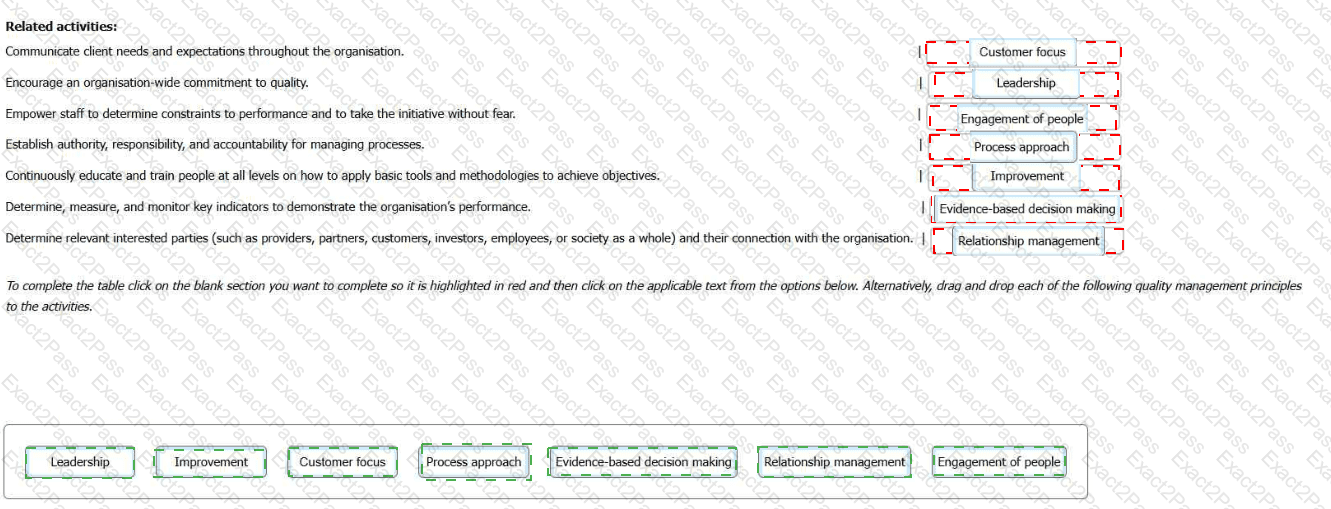
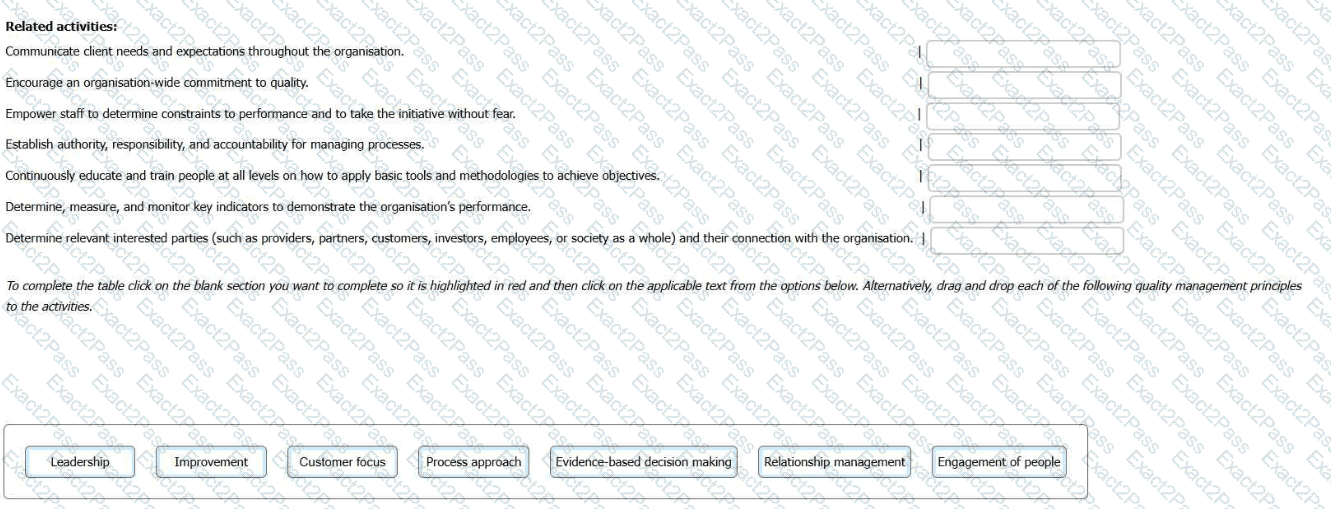
ISO 9001 is based on quality management principles. Match each of the following quality management principles to the related activity.
An audit team of three people is conducting a Stage 2 audit to ISO 9001 of an engineering organisation that manufactures sacrificial anodes for the oll and gas industry in marine environments. These are aluminium products designed to prevent corrosion of submerged
steel structures. You, as one of the auditors, find that the organisation has shipped anodes for Project DK in the Gulf of Mexico before the galvanic efficiency test results for the anodes have been fully analysed and reported as required by the customer. The Quality
Manager explains that the Managing Director authorised release of the anodes to avoid late delivery as penalties would be imposed. The customer was not informed since the tests very rarely fall below the required efficiency. You raise a nonconformity against clause 8.6 of ISO 9001.
Which of the following options for the best description of the nonconformity?
Which one of the following documents addresses audit time calculation for third-party certification audits?