Summer Sale Special Limited Time 70% Discount Offer - Ends in 0d 00h 00m 00s - Coupon code: buysanta

Exact2Pass Menu

Service Provider Professional (JNCIP-SP)

Last Update 15 hours ago Total Questions : 97

The Service Provider Professional (JNCIP-SP) content is now fully updated, with all current exam questions added 15 hours ago. Deciding to include JN0-664 practice exam questions in your study plan goes far beyond basic test preparation.

You'll find that our JN0-664 exam questions frequently feature detailed scenarios and practical problem-solving exercises that directly mirror industry challenges. Engaging with these JN0-664 sample sets allows you to effectively manage your time and pace yourself, giving you the ability to finish any Service Provider Professional (JNCIP-SP) practice test comfortably within the allotted time.

Question # 11

What is the correct order of packet flow through configurable components in the Junos OS CoS features?

A.

Multifield Classifier - > Behavior Aggregate Classifier - > Input Policer - > Forwarding Policy Options - > Fabric Scheduler - > Output Policer - > Rewrite Marker - > Scheduler/Shaper/RED

B.

Behavior Aggregate Classifier - > Multifield Classifier - > Input Policer - > Forwarding Policy Options - > Fabric Scheduler - > Output Policer - > Scheduler/Shaper/RED - > Rewrite Marker

C.

Behavior Aggregate Classifier - > Input Policer - > Multifield Classifier - > Forwarding Policy Options - > Fabric Scheduler - > Output Policer - > Scheduler/Shaper/RED - > Rewrite Marker

D.

Behavior Aggregate Classifier - > Multifield Classifier - > Input Policer - > Forwarding Policy Options - > Fabric Scheduler - > Scheduler/Shaper/RED - > Output Policer - > Rewrite Marker

Question # 12

Which two statements are correct about reflecting inet-vpn unicast prefixes in BGP route reflection? (Choose two.)

A.

Route reflectors do not change any existing BGP attributes by default when advertising routes.

B.

A BGP peer does not require any configuration changes to become a route reflector client.

C.

Clients add their originator ID when advertising routes to their route reflector

D.

Route reflectors add their cluster ID to the AS path when readvertising client routes.

Question # 13

Exhibit

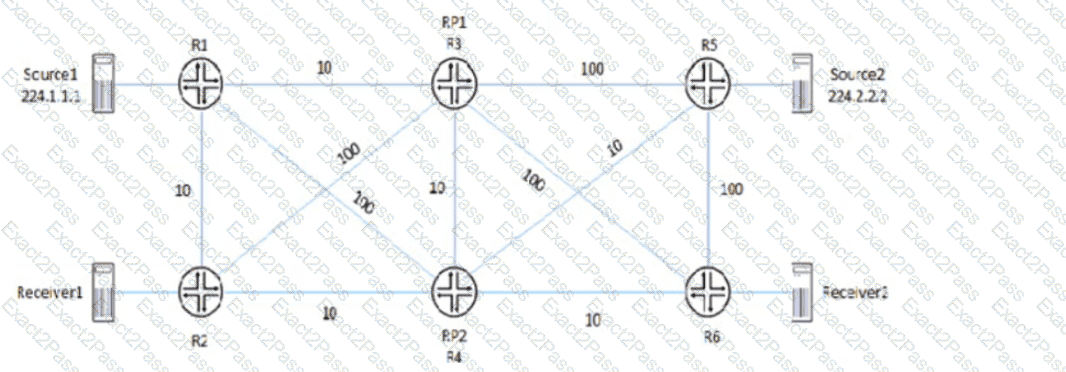
Referring to the exhibit, PIM-SM is configured on all routers, and Anycast-RP with Anycast-PIM is used for the discovery mechanism on RP1 and RP2. The interface metric values are shown for the OSPF area.

In this scenario, which two statements are correct about which RP is used? (Choose two.)

A.

Source2 will use RP2 and Receiver2 will use RP2 for group 224.2.2.2.

B.

Source2 will use RP1 and Receiver2 will use RP1 for group 224.2.2.2.

C.

Source1 will use RP1 and Receiver1 will use RP1 for group 224.1.1.1.

D.

Source1 will use RP1 and Receiver1 will use RP2 for group 224.1 1 1

Question # 14

An interface is configured with a behavior aggregate classifier and a multifield classifier How will the packet be processed when received on this interface?
A.

The packet will be discarded.

B.

The packet will be processed by the BA classifier first, then the MF classifier.

C.

The packet will be forwarded with no classification changes.

D.

The packet will be processed by the MF classifier first, then the BA classifier.

Question # 15

Click the Exhibit button.

Referring to the exhibit, which two statements are correct about BGP routes on R3 that are advertised to R1? (Choose two.)

A.

By default, the next-hop value for these routes is changed by R3 before being sent to R1.

B.

By default, all BGP attributes values must be removed before advertising the routes to R1.

C.

By default, the BGP local-preference value that is assigned on R3 is advertised to R1.

D.

By default, the next-hop value for these routes is not changed by R3 before being sent to R1.

Question # 16

Which two statements about IS-IS are correct? (Choose two.)

A.

PSNPs are used to acknowledge a received LSP.

B.

CSNPs are used to acknowledge a received LSP.

C.

CSNPs are used to request a missing LSP.

D.

PSNPs are used to request a missing LSP.

Question # 17

Exhibit

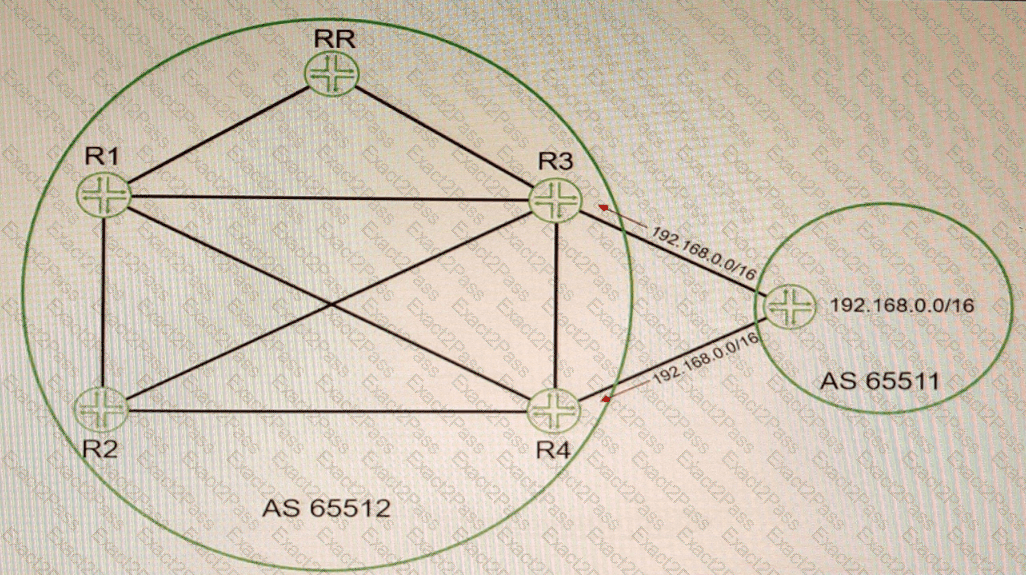
Referring to the exhibit, you are receiving the 192.168 0 0/16 route on both R3 and R4 from your EBGP neighbor You must ensure that R1 and R2 receive both BGP routes from the route reflector

In this scenario, which BGP feature should you configure to accomplish this behavior?

A.

add-path

B.

multihop

C.

multipath

D.

route-target

Question # 18

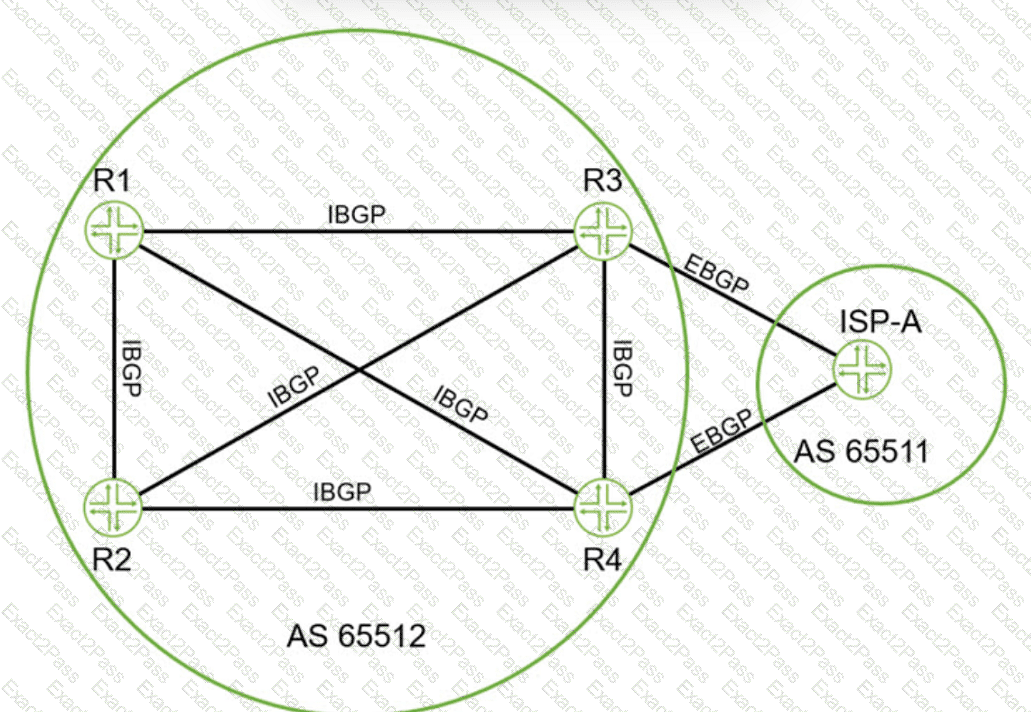
Exhibit

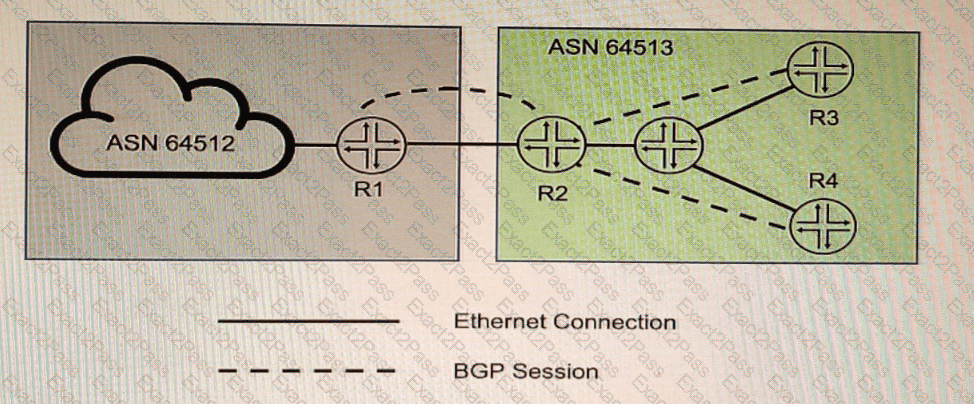
You want to implement the BGP Generalized TTL Security Mechanism (GTSM) on the network

Which three statements are correct in this scenario? (Choose three)

A.

You can implement BGP GTSM between R2, R3, and R4

B.

BGP GTSM requires a firewall filter to discard packets with incorrect TTL.

C.

You can implement BGP GTSM between R2 and R1.

D.

BGP GTSM requires a TTL of 1 to be configured between neighbors.

E.

BGP GTSM requires a TTL of 255 to be configured between neighbors.

Question # 19

Exhibit.

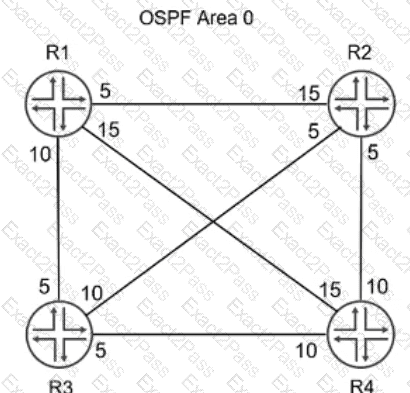
Referring to the exhibit, which path would traffic passing through R1 take to get to R4?

A.

R1 - > R3 - > R4

B.

R1 - > R2 - > R3 - > R4

C.

R1 - > R2 - > R4

D.

R1 - > R4

Question # 20

You are asked to protect your company ' s customers from amplification attacks. In this scenario, what is Juniper ' s recommended protection method?


A.

ASN prepending

B.

BGP FlowSpec

C.

destination-based Remote Triggered Black Hole

D.

unicast Reverse Path Forwarding

Go to page: