
Spring Sale Special Limited Time 70% Discount Offer - Ends in 0d 00h 00m 00s - Coupon code: buysanta

Exact2Pass Menu

Splunk Cloud Certified Admin

Last Update 50 minutes ago Total Questions : 82

The Splunk Cloud Certified Admin content is now fully updated, with all current exam questions added 50 minutes ago. Deciding to include SPLK-1005 practice exam questions in your study plan goes far beyond basic test preparation.

You'll find that our SPLK-1005 exam questions frequently feature detailed scenarios and practical problem-solving exercises that directly mirror industry challenges. Engaging with these SPLK-1005 sample sets allows you to effectively manage your time and pace yourself, giving you the ability to finish any Splunk Cloud Certified Admin practice test comfortably within the allotted time.

Question # 11

When creating a new index, which of the following is true about archiving expired events?

A.

Store expired events in private AWS-based storage.

B.

Expired events cannot be archived.

C.

Archive some expired events from an index and discard others.

D.

Store expired events on-prem using your own storage systems.

Question # 12

When is data deleted from a Splunk Cloud index?

A.

When buckets roll to frozen, without a defined archive.

B.

When data is deleted via the Splunk Cloud Admin GUI.

C.

When TA_Delete is downloaded and enabled from SplunkBase.

D.

When the daleteindex command is executed from the CLI.

Question # 13

Which of the following is a valid method to test if a forwarder can successfully send data to Splunk Cloud?

A.

Search the _audit index to confirm whether the forwarder ID was registered.

B.

Use oneshot from the CLI on the forwarders, then check to see if those logs show up in the Splunk Cloud environment.

C.

On Splunk Cloud UI, click Add Data and upload a test file, then search to see if the logs show up.

D.

Ping the inputssl.example.splunkcloud.com to see if it returns the ping.

Question # 14

Which of the following is an accurate statement about the delete command?

A.

The delete command removes events from disk.

B.

By default, only admins can run the delete command.

C.

Events are virtually deleted by marking them as deleted.

D.

Deleting events reclaims disk space.

Question # 15

Windows Input types are collected in Splunk via a script which is configurable using the GUI. What is this type of input called?

A.

Batch

B.

Scripted

C.

Modular

D.

Front-end

Question # 16

In what scenarios would transforms.conf be used?

A.

Per-Event Index Routing, Applying Event Types, SEOCMD operations

B.

Per-Event Sourcetype, Per-Event Host Name, Per-Event Index Routing

C.

Per-Event Host Name, Per-Event Index Rooting, SEDCMD operations

D.

Per-Event Sourcetype, Per-Event Index Routing, Applying Event Types

Question # 17

Consider the following configurations:
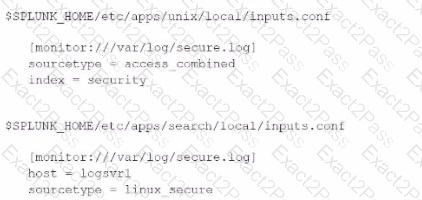
What is the value of the sourcetype property for this stanza based on Splunk ' s configuration file precedence?

A.

NULL, or unset, due to configuration conflict

B.

access_corabined

C.

linux aacurs

D.

linux_secure, access_combined

Question # 18

Which of the following app installation scenarios can be achieved without involving Splunk Support?

A.

Deploy premium apps.

B.

Install apps via the Request Install button.

C.

Install apps via self-service.

D.

Install apps that have not gone through the vetting process.

Question # 19

Which of the following are default Splunk Cloud user roles?

A.

must_delete, power, sc_admin

B.

power, user, admin

C.

apps, power, sc_admin

D.

can delete, users, admin

Question # 20

Which of the following are features of a managed Splunk Cloud environment?

A.

Availability of premium apps, no IP address whitelisting or blacklisting, deployed in US East AWS region.

B.

20GB daily maximum data ingestion, no SSO integration, no availability of premium apps.

C.

Availability of premium apps, SSO integration, IP address whitelisting and blacklisting.

D.

Availability of premium apps, SSO integration, maximum concurrent search limit of 20.

Go to page:
