Spring Sale Special Limited Time 70% Discount Offer - Ends in 0d 00h 00m 00s - Coupon code: buysanta

Exact2Pass Menu

Understanding Cisco Cybersecurity Operations Fundamentals (CBROPS)

Last Update 5 hours ago Total Questions : 476

The Understanding Cisco Cybersecurity Operations Fundamentals (CBROPS) content is now fully updated, with all current exam questions added 5 hours ago. Deciding to include 200-201 practice exam questions in your study plan goes far beyond basic test preparation.

You'll find that our 200-201 exam questions frequently feature detailed scenarios and practical problem-solving exercises that directly mirror industry challenges. Engaging with these 200-201 sample sets allows you to effectively manage your time and pace yourself, giving you the ability to finish any Understanding Cisco Cybersecurity Operations Fundamentals (CBROPS) practice test comfortably within the allotted time.

Question # 41

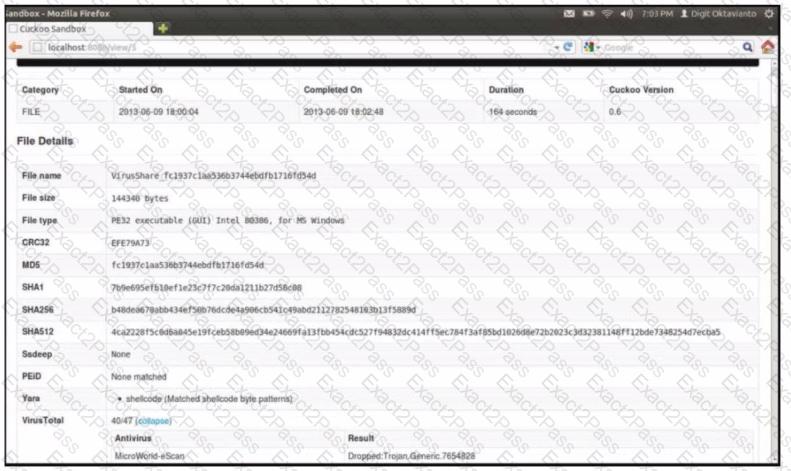
Refer to the exhibit.

What does this Cuckoo sandbox report indicate?

A.

The file is spyware.

B.

The file will open unsecure ports when executed.

C.

The file will open a command interpreter when executed.

D.

The file is ransomware.

Question # 42

Refer to the exhibit.

Which type of evidence is this file?

A.

corroborating evidence

B.

circumstantial evidence

C.

best evidence

D.

direct evidence

Question # 43

Which type of attack involves sending input commands to a web server to access data?

A.

SQL injection

B.

Denial of service

C.

Cross-site scripting

D.

DNS poisoning

Question # 44

Which tool gives the ability to see session data in real time?

A.

tcpdstat

B.

trafdump

C.

tcptrace

D.

trafshow

Question # 45

During a quarterly vulnerability scan, a security analyst discovered unused uncommon ports open and in a listening state. Further investigation showed that the unknown application was communicating with an external IP address on an encrypted channel. A deeper analysis revealed a command and control communication on an infected server. At which step of the Cyber Kill Chain was the attack detected?

A.

Delivery

B.

Weaponization

C.

Actions on Objectives

D.

Exploitation

Question # 46

What is an incident response plan?

A.

an organizational approach to events that could lead to asset loss or disruption of operations

B.

an organizational approach to security management to ensure a service lifecycle and continuous improvements

C.

an organizational approach to disaster recovery and timely restoration of operational services

D.

an organizational approach to system backup and data archiving aligned to regulations

Question # 47

During which phase of the forensic process are tools and techniques used to extract information from the collected data?

A.

investigation

B.

examination

C.

reporting

D.

collection

Question # 48

What describes the impact of false-positive alerts compared to false-negative alerts?

A.

A false negative is alerting for an XSS attack. An engineer investigates the alert and discovers that an XSS attack happened A false positive is when an XSS attack happens and no alert is raised

B.

A false negative is a legitimate attack triggering a brute-force alert. An engineer investigates the alert and finds out someone intended to break into the system A false positive is when no alert and no attack is occurring

C.

A false positive is an event alerting for a brute-force attack An engineer investigates the alert and discovers that a legitimate user entered the wrong credential several times A false negative is when a threat actor tries to brute-force attack a system and no alert is raised.

D.

A false positive is an event alerting for an SQL injection attack An engineer investigates the alert and discovers that an attack attempt was blocked by IP S A false negative is when the attack gets detected but succeeds and results in a breach.

Question # 49

What describes the concept of data consistently and readily being accessible for legitimate users?

A.

integrity

B.

availability

C.

accessibility

D.

confidentiality

Question # 50

What is a key difference between a tampered and an untampered disk image during a forensic investigation?


A.

An untampered image is encrypted, and a tampered one is not encrypted.

B.

A tampered image has a different hash value, and an untampered image has an unchanged hash value.

C.

A tampered image is accessible only by administrators, and an untampered one is accessible by all users.

D.

An untampered image is compressed, and a tampered one is left uncompressed.

Go to page: