Spring Sale Special Limited Time 70% Discount Offer - Ends in 0d 00h 00m 00s - Coupon code: buysanta

Exact2Pass Menu

Understanding Cisco Cybersecurity Operations Fundamentals (CBROPS)

Last Update 5 hours ago Total Questions : 476

The Understanding Cisco Cybersecurity Operations Fundamentals (CBROPS) content is now fully updated, with all current exam questions added 5 hours ago. Deciding to include 200-201 practice exam questions in your study plan goes far beyond basic test preparation.

You'll find that our 200-201 exam questions frequently feature detailed scenarios and practical problem-solving exercises that directly mirror industry challenges. Engaging with these 200-201 sample sets allows you to effectively manage your time and pace yourself, giving you the ability to finish any Understanding Cisco Cybersecurity Operations Fundamentals (CBROPS) practice test comfortably within the allotted time.

Question # 21

Which of these describes volatile evidence?

A.

registers and cache

B.

logs

C.

usernames

D.

disk and removable drives

Question # 22

An employee reports that someone has logged into their system and made unapproved changes, files are out of order, and several documents have been placed in the recycle bin. The security specialist reviewed the system logs, found nothing suspicious, and was not able to determine what occurred. The software is up to date; there are no alerts from antivirus and no failed login attempts. What is causing the lack of data visibility needed to detect the attack?
A.

The threat actor used a dictionary-based password attack to obtain credentials.

B.

The threat actor gained access to the system by known credentials.

C.

The threat actor used the teardrop technique to confuse and crash login services.

D.

The threat actor used an unknown vulnerability of the operating system that went undetected.

Question # 23

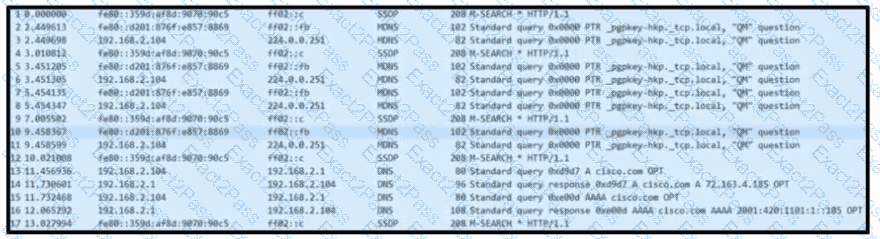
Refer to the exhibit. Based on the .pcap file, which DNS server is used to resolve cisco.com?

A.

224.0.0.251

B.

192.168.2.1

C.

72.163.4.185

D.

192.168.2.104

Question # 24

An offline audit log contains the source IP address of a session suspected to have exploited a vulnerability resulting in system compromise.

Which kind of evidence is this IP address?

A.

best evidence

B.

corroborative evidence

C.

indirect evidence

D.

forensic evidence

Question # 25

What ate two categories of DDoS attacks? (Choose two.)

A.

split brain

B.

scanning

C.

phishing

D.

reflected

E.

direct

Question # 26

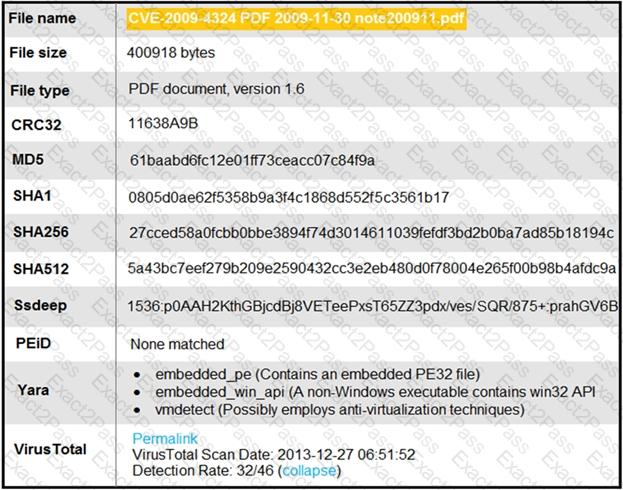
Refer to the exhibit.

An engineer is analyzing this Cuckoo Sandbox report for a PDF file that has been downloaded from an email. What is the state of this file?

A.

The file has an embedded executable and was matched by PEiD threat signatures for further analysis.

B.

The file has an embedded non-Windows executable but no suspicious features are identified.

C.

The file has an embedded Windows 32 executable and the Yara field lists suspicious features for further analysis.

D.

The file was matched by PEiD threat signatures but no suspicious features are identified since the signature list is up to date.

Question # 27

A security specialist is investigating an incident regarding a recent major breach in the organization. The accounting data from a 24-month period is affected due to a trojan detected in a department ' s critical server. A security analyst investigates the incident and discovers that an incident response team member who detected a trojan during regular AV scans had made an image of the server for evidence purposes. The security analyst made animage again to compare the hashes of the two images, and they appeared to differ and do not match. Which type of evidence is the security analyst dealing with?

A.

checksum violated image

B.

integrity violated image

C.

untampered image

D.

tampered image

Question # 28

Which action matches the weaponization step of the Cyber Kill Chain model?

A.

Scan a host to find open ports and vulnerabilities

B.

Construct the appropriate malware and deliver it to the victim.

C.

Test and construct the appropriate malware to launch the attack

D.

Research data on a specific vulnerability

Question # 29

What is the difference between attack surface and vulnerability?

A.

An attack surface is a way of taking advantage of a system or resource, and a vulnerability is a specific technique utilized by the vulnerability.

B.

A vulnerability describes how software or a system is exposed to potential attacks, and an attack surface is an actual weakness that exposes the potential risk.

C.

A vulnerability is a way of taking advantage of a system or resource, and an attack surface is a specific technique utilized by the vulnerability.

D.

An attack surface describes how software or a system is exposed to potential attacks, and a vulnerability is an actual weakness that exposes the potential risk.

Question # 30

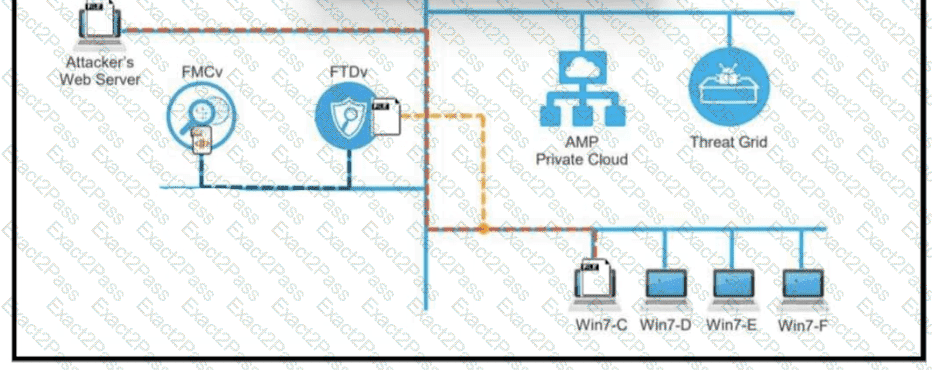
Refer to the exhibit.

A workstation downloads a malicious docx file from the Internet and a copy is sent to FTDv. The FTDv sends the file hash to FMC and the tile event is recorded what would have occurred with stronger data visibility.


A.

The traffic would have been monitored at any segment in the network.

B.

Malicious traffic would have been blocked on multiple devices

C.

An extra level of security would have been in place

D.

Detailed information about the data in real time would have been provided

Go to page: