Spring Sale Special Limited Time 70% Discount Offer - Ends in 0d 00h 00m 00s - Coupon code: buysanta

Exact2Pass Menu

Understanding Cisco Cybersecurity Operations Fundamentals (CBROPS)

Last Update 5 hours ago Total Questions : 476

The Understanding Cisco Cybersecurity Operations Fundamentals (CBROPS) content is now fully updated, with all current exam questions added 5 hours ago. Deciding to include 200-201 practice exam questions in your study plan goes far beyond basic test preparation.

You'll find that our 200-201 exam questions frequently feature detailed scenarios and practical problem-solving exercises that directly mirror industry challenges. Engaging with these 200-201 sample sets allows you to effectively manage your time and pace yourself, giving you the ability to finish any Understanding Cisco Cybersecurity Operations Fundamentals (CBROPS) practice test comfortably within the allotted time.

Question # 31

According to the NIST SP 800-86. which two types of data are considered volatile? (Choose two.)

A.

swap files

B.

temporary files

C.

login sessions

D.

dump files

E.

free space

Question # 32

How is attacking a vulnerability categorized?

A.

action on objectives

B.

delivery

C.

exploitation

D.

installation

Question # 33

What is corroborating evidence?

A.

Evidence that can be provided to cyber police for further restrictive actions over threat actors

B.

Evidence that can be presented in court in the original form, such as an exact copy of a hard drive

C.

Evidence that tends to support a theory or an assumption deduced by some initial evidence

D.

Evidence that relies on an extrapolation to a conclusion of fact, such as fingerprints

Question # 34

Which statement describes threat hunting?

A.

It is an activity by an entity to deliberately bring down critical internal servers.

B.

It is a prevention activity to detect signs of intrusion, compromise, data theft, abnormalities, or malicious activity.

C.

It includes any activity that might go after competitors and adversaries to infiltrate their systems.

D.

It is a vulnerability assessment conducted by cyber professionals.

Question # 35

What is the benefit of processing statistical data for security systems?
A.

detects suspicious behavior based on traffic baselining trends

B.

uses less CPU and RAM resources than metadata-based monitoring

C.

provides fewer false negative events than full packet capture

D.

provides full visibility based on capture of packet traffic data

Question # 36

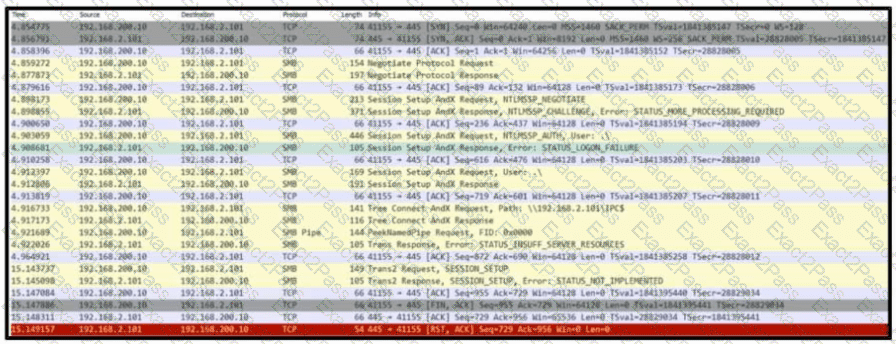
Refer to the exhibit. Based on the .pcap file, which protocol ' s vulnerability has been exploited to establish a session?

A.

SMB

B.

TCP

C.

Negotiate

D.

IP

Question # 37

An engineer discovered a breach, identified the threat’s entry point, and removed access. The engineer was able to identify the host, the IP address of the threat actor, and the application the threat actor targeted. What is the next step the engineer should take according to the NIST SP 800-61 Incident handling guide?
A.

Recover from the threat.

B.

Analyze the threat.

C.

Identify lessons learned from the threat.

D.

Reduce the probability of similar threats.

Question # 38

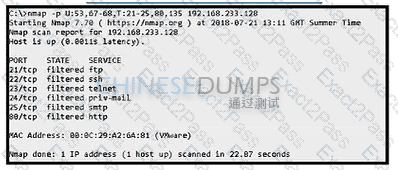
Refer to the exhibit. An attacker scanned the server using Nmap. What did the attacker obtain from this scan?

A.

Identified a firewall device preventing the pert state from being returned.

B.

Identified open SMB ports on the server

C.

Gathered information on processes running on the server

D.

Gathered a list of Active Directory users

Question # 39

Which two elements of the incident response process are stated in NIST SP 800-61 r2? (Choose two.)

A.

detection and analysis

B.

post-incident activity

C.

vulnerability scoring

D.

vulnerability management

E.

risk assessment

Question # 40

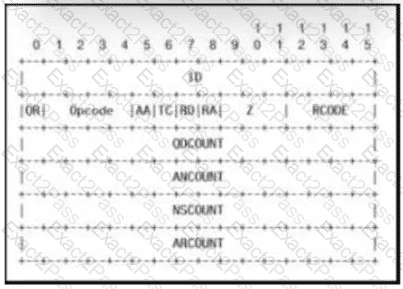
Refer to the exhibit.

Which field contains DNS header information if the payload is a query or a response?


A.

Z

B.

ID

C.

TC

D.

QR

Go to page: