Summer Sale Special Limited Time 70% Discount Offer - Ends in 0d 00h 00m 00s - Coupon code: buysanta

Exact2Pass Menu

Implementing and Administering Cisco Solutions (200-301 CCNA) v1.1

Navigating Modern Infrastructure: Why Hands-On Network Logic Trumps Static Memory Dumps

We have coached hundreds of junior systems technicians, desktop support specialists, and aspiring cloud infrastructure engineers through this foundational Cisco milestone. Let's look closely at the modern data center training landscape. The professionals who stumble on this updated v1.1 routing and switching evaluation are almost always those who relied on low-tier test pools—those flat, context-stripped answer repositories floating around public IT forums. Those static, unverified materials simply cannot prepare you for real-world interface configurations or the intricate packet-level troubleshooting tested on the real exam. At Exact2Pass, our approach targets the underlying structural logic, software-defined fabrics, and algorithmic execution patterns of the active Cisco IOS ecosystem instead. Our 200-301 CCNA exam prep delivers comprehensive programmatic breakdowns for every routing table preference and secure wireless access query. You will master actual core switching parameters instead of leaning on short-sighted memorization shortcuts. We map out Rapid PVST+ root bridge elections, VLSM IP allocation boundaries, single-area OSPFv2 neighbor adjacencies, and programmatic API authorization mechanisms step by step. Our learning material is built from the ground up by active network engineering architects who optimize enterprise corporate infrastructure daily. Because of that, we completely avoid mindless, repetitive question-and-answer lists. Instead, our workspace functions as an active training simulation that forces you to evaluate subnet hierarchies, traffic prioritization metrics, and software automation scripts like a seasoned system lead. You will learn the exact reason why a specific VLAN access rule or access control list configuration succeeds or breaks context under production constraints. That is how you build real confidence before logging into the official Pearson VUE and OnVUE testing environment. Our adaptive training software develops genuine technical expertise that transfers perfectly to production engineering sprints, helping you pass on your very first try.

Question # 21

The service password-encryption command is entered on a router. What is the effect of this configuration?

A.

restricts unauthorized users from viewing clear-text passwords in the running configuration

B.

encrypts the password exchange when a VPN tunnel is established

C.

prevents network administrators from configuring clear-text passwords

D.

protects the VLAN database from unauthorized PC connections on the switch

Question # 22

The SW1 interface g0/1 is in the down/down state. Which two configurations are valid reasons for the interface conditions?(choose two)

A.

There is a duplex mismatch

B.

There is a speed mismatch

C.

There is a protocol mismatch

D.

The interface is shut down

E.

The interface is error-disabled

Question # 23

What are two characteristics of a public cloud implementation? (Choose two.)

A.

It is owned and maintained by one party, but it is shared among multiple organizations.

B.

It enables an organization to fully customize how It deploys network resources.

C.

It provides services that are accessed over the Internet.

D.

It Is a data center on the public Internet that maintains cloud services for only one company.

E.

It supports network resources from a centralized third-party provider and privately-owned virtual resources

Question # 24

What are two reasons for an engineer to configure a floating static route? (Choose two)

A.

to automatically route traffic on a secondary path when the primary path goes down

B.

to route traffic differently based on the source IP of the packet

C.

to enable fallback static routing when the dynamic routing protocol fails

D.

to support load balancing via static routing

E.

to control the return path of traffic that is sent from the router

Question # 25

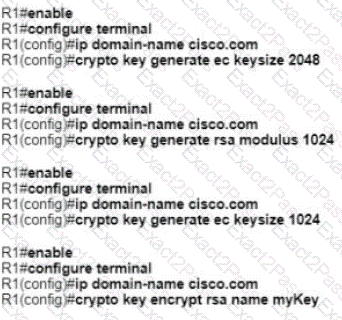
A network administrator must to configure SSH for remote access to router R1 The requirement is to use a public and private key pair to encrypt management traffic to and from the connecting client.

Which configuration, when applied, meets the requirements?
A.

Option A

B.

Option B

C.

Option C

D.

Option D

Question # 26

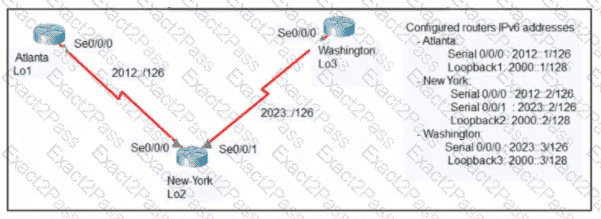
Refer to the exhibit.

An engineer configured the New York router with static routes that point to the Atlanta and Washington sites. When command must be configured on the Atlanta and Washington routers so that both sites are able to reach the loopback2 interface on the New York router?

A.

ipv6 route ::/0 Serial 0/0/1

B.

ipv6 route 0/0 Serial 0/0/0

C.

ipv6 route ::/0 Serial 0/0/0

D.

ip route 0.0.0.0.0.0.0.0 Serial 0/0/0

E.

ipv6 route ::/0 2000::2

Question # 27

An administrator must secure the WLC from receiving spoofed association requests. Which steps must be taken to configure the WLC to restrict the requests and force the user to wait 10 ms to retry an association request?

A.

Enable Security Association Teardown Protection and set the SA Query timeout to 10

B.

Enable MAC filtering and set the SA Query timeout to 10

C.

Enable 802.1x Layer 2 security and set me comeback timer to 10

D.

Enable the Protected Management Frame service and set the comeback timer to 10

Question # 28

R1 has learned route 10.10.10.0/24 via numerous routing protocols. Which route is installed?

A.

route with the lowest cost

B.

route with the next hop that has the highest IP

C.

route with the shortest prefix length

D.

route with the lowest administrative distance

Question # 29

Refer to the exhibit.

Which route type does the routing protocol Code D represent in the output?

A.

internal BGP route

B.

/24 route of a locally configured IP

C.

statically assigned route

D.

route learned through EIGRP

Question # 30

Why is TCP desired over UDP for application that require extensive error checking, such as HTTPS?

A.

UDP operates without acknowledgments, and TCP sends an acknowledgment for every packet received.

B.

UDP reliably guarantees delivery of all packets, and TCP drops packets under heavy load.

C.

UDP uses flow control mechanisms for the delivery of packets, and TCP uses congestion control for efficient packet delivery.

D.

UDP uses sequencing data tor packets to arrive in order, and TCP offers the capability to receive packets in random order.

Question # 31

What is the function of a server?

A.

It transmits packets between hosts in the same broadcast domain.

B.

It provides shared applications to end users.

C.

It routes traffic between Layer 3 devices.

D.

It Creates security zones between trusted and untrusted networks

Question # 32

When deploying syslog, which severity level logs informational message?

A.

0

B.

2

C.

4

D.

6

Question # 33

Which command must be entered when a device is configured as an NTP server?

A.

ntp authenticate

B.

ntp server

C.

ntp peer

D.

ntp master

Question # 34

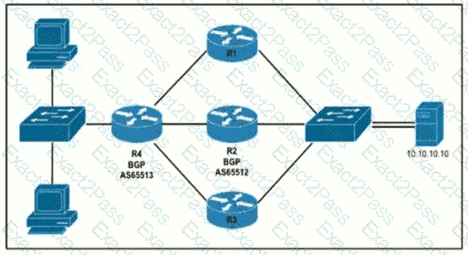
Refer to the exhibit.

Router R4 is dynamically learning the path to the server. If R4 is connected to R1 via OSPF Area 20, to R2 via R2 BGP, and to R3 via EIGRP 777, which path is installed in the routing table of R4?

A.

the path through R1, because the OSPF administrative distance is 110

B.

the path through R2. because the IBGP administrative distance is 200

C.

the path through R2 because the EBGP administrative distance is 20

D.

the path through R3. because the EIGRP administrative distance is lower than OSPF and BGP

Question # 35

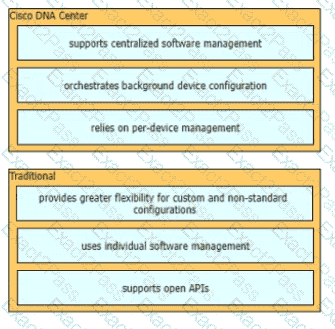
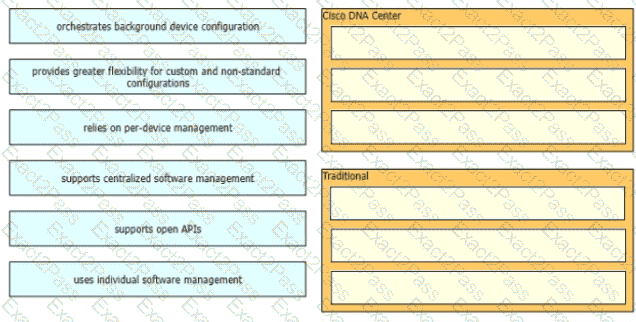
Drag and drop the characteristics of device-management technologies from the left onto the corresponding deployment types on the right.
Question # 36

What is a specification for SSIDS?

A.

They are a Cisco proprietary security feature.

B.

They must include one number and one letter.

C.

They define the VLAN on a switch.

D.

They are case sensitive.

Question # 37

What is a reason to implement IPv4 private addressing?
A.

Reduce the risk of a network security breach

B.

Comply with PCI regulations

C.

Comply with local law

D.

Reduce the size of the forwarding table on network routers

Question # 38

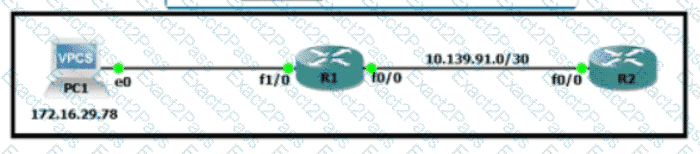
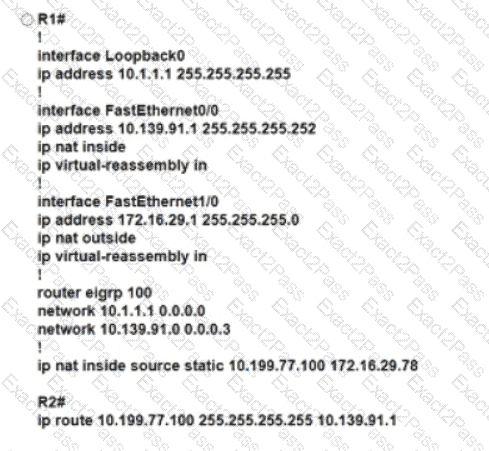
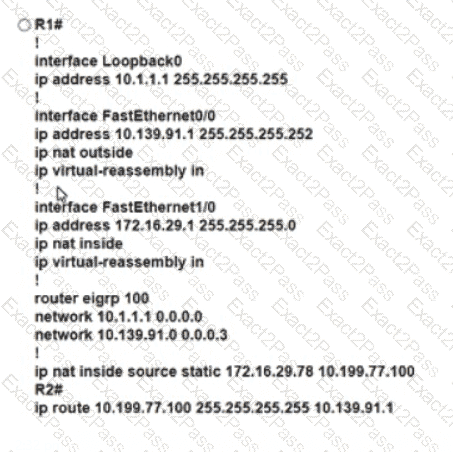
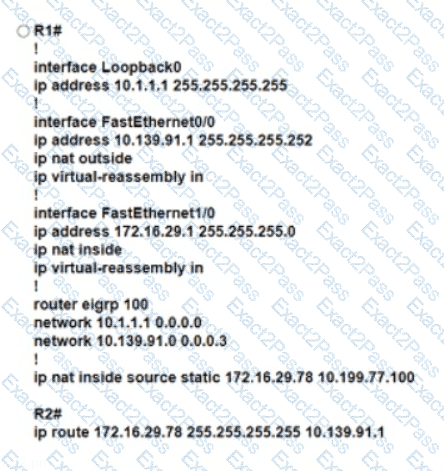
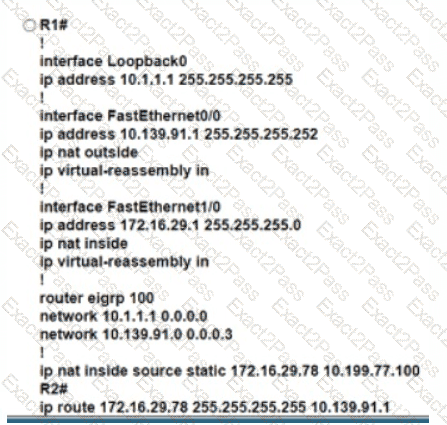
Refer to the exhibit. An engineer must transtate the PC1 IIP address to 10.199.77.100 and permit PC1 to ping the loopback 0 on router R2. What command set must be used?

A)
B)
C)
D)
A.

Option A

B.

Option B

C.

Option C

D.

Option D

Question # 39

Which two tasks must be performed to configure NTP to a trusted server in client mode on a single network device? (Choose two)

A.

Enable NTP authentication.

B.

Verify the time zone.

C.

Disable NTP broadcasts

D.

Specify the IP address of the NTP server

E.

Set the NTP server private key

Question # 40

When OSPF learns multiple paths to a network, how does it select a route?

A.

It multiple the active K value by 256 to calculate the route with the lowest metric.

B.

For each existing interface, it adds the metric from the source router to the destination to calculate the route with the lowest bandwidth.

C.

It divides a reference bandwidth of 100 Mbps by the actual bandwidth of the existing interface to calculate the router with the lowest cost.

D.

It counts the number of hops between the source router and the destination to determine the router with the lowest metric

Go to page: