Spring Sale Special Limited Time 70% Discount Offer - Ends in 0d 00h 00m 00s - Coupon code: buysanta

Exact2Pass Menu

Application Centric Infrastructure Support Representative

Last Update 1 hour ago Total Questions : 50

The Application Centric Infrastructure Support Representative content is now fully updated, with all current exam questions added 1 hour ago. Deciding to include 500-601 practice exam questions in your study plan goes far beyond basic test preparation.

You'll find that our 500-601 exam questions frequently feature detailed scenarios and practical problem-solving exercises that directly mirror industry challenges. Engaging with these 500-601 sample sets allows you to effectively manage your time and pace yourself, giving you the ability to finish any Application Centric Infrastructure Support Representative practice test comfortably within the allotted time.

Question # 4

Refer to the exhibit

Which option is a potential reason why you would see this output while provisioning a DVS?

A.

The specified data center does not exist on the vCenter m question.

B.

The Cisco APIC(s) cannot reach the vCenter host/vm.

C.

The Service Content process has crashed.

D.

Cisco Discovery Protocol is disabled on the vswitch policy tied to the corresponding AAEP.

Question # 5

Which three statements about fitter and contract are true? (Choose three.)

A.

A contract can be consumed and provided by as many EPGs as are needed by the network design.

B.

A fitter can be used by multiple contracts.

C.

A fitter contains groups of IP subnet

D.

A contract can be consumed by a single EPG

E.

A contract can be provided by a single EPG

F.

A filter contains EtherType, IP protocol, TCP flags, and Layer 4 ports.

Question # 6

Which option describes the correct sequence to discover an ESX server in the fabric without a blade switch or multiple Layer 2 hops?

A.

The leaf sends LLDP/CDP to the ESX, the ESX sends parsed UDP/CDP information to the vCenter, the AP1C receives LLDP/CDP information from the vCenter, and the APIC downloads the policy for VMs behind the ESX to the leaf node.

B.

The APIC downloads the policy for VMs behind ESX to the leaf node, the leaf sends LLDP/CCP to the ESX, the ESX sends parsed LLDP/CDP information to the vCenter, and the APIC receives LLDP/CDP information from the vCenter.

C.

The ESX sends parsed LLDP/CDP information to the vCenter, the leaf sends LLDP/CCP to the ESX, the APIC downloads the policy for VMs behind the ESX to the leaf node, and the APIC receives LLDP/CDP information from the vCenter.

D.

The ARC receives LLDP/CDP information from the vCenter, the APIC downloads policy for VMs behind ESX to the leaf node, the leaf sends LLDP/CCP to the ESX, and the ESX sends parsed LLDP/CDP information to the vCenter.

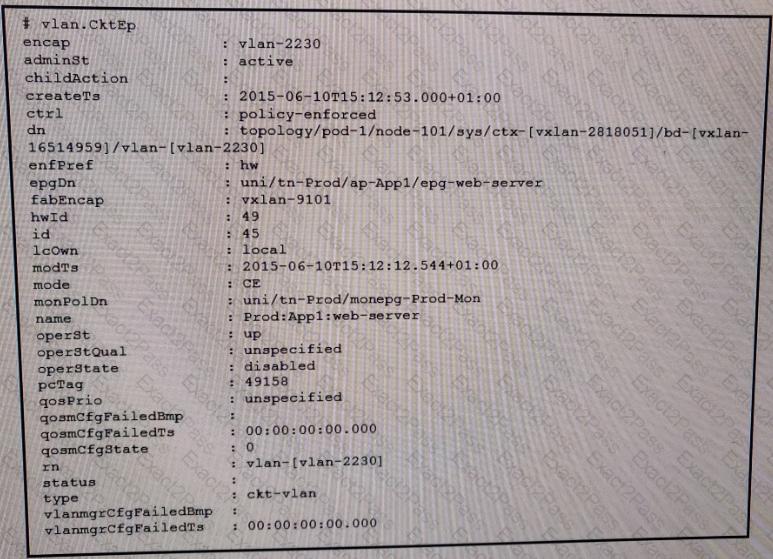
Question # 7

Refer to the exhibit

Which two statements about this managed object are true? (Choose two)

A.

This object is part of the concrete model.

B.

There are endpoints with encapsulation vlan-2230 in the EPG name "web-server" on node 101.

C.

This object is part of the resolved model.

D.

This object is part of the logical model

E.

This object represents an FPG named "web server" in tenant Prod.

Question # 8

A user must upgrade their Cisco ACI Fabric In which order should they upgrade?

A.

It will always be the switches first and the APICs second.

B.

It will always be the APICs first and the switches second.

C.

It will always depend on the specifics of the software release.

D.

It does not matter which you upgrade first (ARC/Switch) or second (APIC/Switch)

Question # 9

Which option describes how to clear a fault from the Cisco ARC after it has been generated?

A.

Faults are raised and cleared automatically by the system.

B.

Faults can be "acknowledged" only after the fault is in the "soaking" state.

C.

Faults can be "acknowledged," which means it is immediately cleared from the system.

D.

Faults are cleared only after the log is full, so the oldest faults are deleted.

Question # 10

Which packets are counted after the atomic counters are configured?

A.

packets that are switched in the hypervisors

B.

packets that are locally switched

C.

packets that are switched via AVS

D.

packets that traverse the fabric

Go to page: