Exact2Pass

Last Update 3 hours ago Total Questions : 468
The Fundamentals of Business Economics content is now fully updated, with all current exam questions added 3 hours ago. Deciding to include BA1 practice exam questions in your study plan goes far beyond basic test preparation.
You'll find that our BA1 exam questions frequently feature detailed scenarios and practical problem-solving exercises that directly mirror industry challenges. Engaging with these BA1 sample sets allows you to effectively manage your time and pace yourself, giving you the ability to finish any Fundamentals of Business Economics practice test comfortably within the allotted time.
In recent years, consumer groups have become more vocal in calling for the boycott of producers whose suppliers do not comply with international regulations on workplace safety and child labour A fashion company that outsources its production to low labour cost countries should include this phenomenon in which part of their PESTEL framework?
All of the following are barriers to entry into an industry except which one?
rson ' s correlation coefficient between the number of shirts sold per day (x) and the number of jackets sold per day (y), across its eight stores (n=8).

what is the Pearson ' s correlation coefficient? Give your answer to two decimal places.
An investor has bought a financial asset that pays a variable interest rate at the end of a three-year period At the same time, the invest forward rate agreement (FRA) on an agreed forward rate of 3% at the asset ' s maturity. What is the advantage of the FRA?
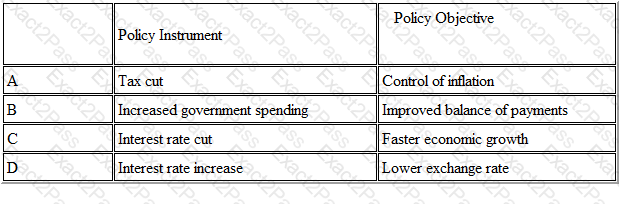
Which of the following pairings of policy instruments and policy objectives is correct?
A bank charges a 4% quarterly interest rate on a personal loan of $10,000
What is the effective annual amount of interest that the borrower pays on this loan? Give your answer to the nearest whole dollar.
Which of the following is likely to cause the demand curve of margarine to shift to the left?
If a firm wishes to maximize market share without incurring a loss, it should set its price where
Which of the following statements most accurately describes the role of an agent as defined in principal-agent theory?
A market for a normal good is in equilibrium. What will happen in this market if there was an increase in consumer incomes?

