Exact2Pass

Last Update 9 hours ago Total Questions : 392
The Fundamentals of management accounting content is now fully updated, with all current exam questions added 9 hours ago. Deciding to include BA2 practice exam questions in your study plan goes far beyond basic test preparation.
You'll find that our BA2 exam questions frequently feature detailed scenarios and practical problem-solving exercises that directly mirror industry challenges. Engaging with these BA2 sample sets allows you to effectively manage your time and pace yourself, giving you the ability to finish any Fundamentals of management accounting practice test comfortably within the allotted time.
Refer to the exhibit.
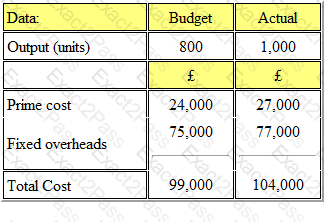
A company issued its production budget based on an anticipated output of 800 units. Actual output was 1,000 units. The details of the costs are shown below:
The total budget variance was:
A flat letting company analyses its costs by individual property. Which of the following costs would be considered an indirect cost of the property?
A company achieves a profit/volume ratio of 25%. Sales for the month of July were £127,280 and fixed costs were £24,872.
What was the profit for the month?
Which THREE of the following costs would normally be classified as semi-variable?
A manufacturing company uses an absorption based costing system. At the start of the period they planned to make 30,000 units at a selling price of £900 per unit
Fixed overheads were expected to be £900,000. The variable cost per unit is £300.
At the end of the period actual overheads were £858,000, and 33,000 units were produced, of which 32,000 were sold.
Which of the following statements are TRUE? Select ALL that apply.
The standard labour content of one unit of ' BFC ' is $35 (7 hours paid at $5 per hour).
During period 2, 600 hours were worked at a cost of $3,300 to produce 90 units of ' BFC ' .
What was the direct labour total variance for Period 2?
Refer to the exhibit.
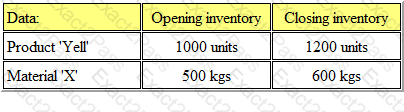
Each unit of product ' Yell ' uses 3 kgs of material ' X ' .
The budgeted details for July are as follows:
It is anticipated that sales of product ' Yell ' in July will be 5,000 units.
The amount of material ' X ' that needs to be purchased in July is:
Which THREE of the following statements could explain why an adverse material price variance has arisen?
In the context of short term decision making, what is a notional cost?
A product has a break-even point of 40,000 units and a margin of safety of 20%. The contribution per unit is £3.
What is the budgeted profit?

