Exact2Pass

Last Update 9 hours ago Total Questions : 392
The Fundamentals of management accounting content is now fully updated, with all current exam questions added 9 hours ago. Deciding to include BA2 practice exam questions in your study plan goes far beyond basic test preparation.
You'll find that our BA2 exam questions frequently feature detailed scenarios and practical problem-solving exercises that directly mirror industry challenges. Engaging with these BA2 sample sets allows you to effectively manage your time and pace yourself, giving you the ability to finish any Fundamentals of management accounting practice test comfortably within the allotted time.
Which of the following statements about batch costing is true?
Based upon extensive historical evidence, a company’s daily sales volume is known to be normally distributed with a mean of 1,728 units and a standard deviation of 273 units.
What is the probability that, on any one day, the sales volume will be at least 1,300 units?
Which of the following would NOT be an appropriate performance measure for a profit centre manager?
The records of a manufacturing company show the following relationship between total cost and output.

The budgeted output for Period 3 is 27,000 units. Assume that previous cost behaviour patterns will continue.
What is the total budgeted cost for Period 3?
Give your answer in the nearest whole number.
A company has spent $5,000 on a report into the viability of using a subcontractor. The report highlighted the following:
A machine purchased six years ago for $30,000 would become surplus to requirements. It has a written-down value of $10,000 but would be resold for $12,000.
A machine operator would be made redundant and would receive a redundancy payment of $40,000.
The administration of the subcontractor arrangement would cost the company $25,000 each year.
Which THREE of the following are relevant for the decision? (Choose three.)
Refer to the exhibit.

The following costs apply to batch 325, which consists of 10000 units of identical products:
The company charges selling and administration costs at a rate of 20% of production costs and wishes to achieve a profit margin of 20% of sales.
What is the required selling price per unit of product?
Give your answer to 2 decimal places.
Which of the following are not advantages of Absorption costing? (Select ALL that apply.)
The selling price of product ' P ' is £20 per unit. Variable costs are £6 per unit and total fixed costs are £140,000 each year.
To earn a profit of £70,000 each year, the annual sales will need to be, to the nearest 1,000 units,
Refer to the exhibit.
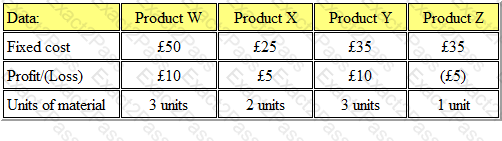
SS Ltd. manufactures four products which require the same type of material. The following fixed cost and profit/(loss) per unit is available:
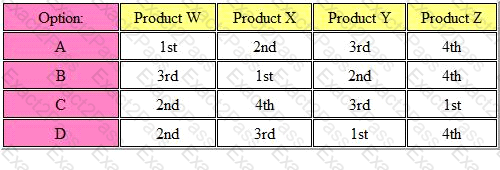
In a period in which materials are in short supply, which of the following options is the rank order of production?
Refer to the exhibit.
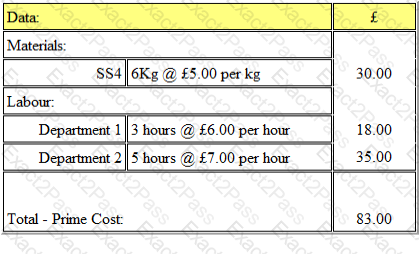
The prime cost of product ' Z ' is as follows:
Overheads are absorbed at £4.00 per labor hour in Department 1 and £6.00 per labor hour in Department 2.
The production cost of Product Z, to the nearest £, will be:
Give your answer to 2 decimal places.

