Exact2Pass

Last Update 20 hours ago Total Questions : 393
The Fundamentals of financial accounting content is now fully updated, with all current exam questions added 20 hours ago. Deciding to include BA3 practice exam questions in your study plan goes far beyond basic test preparation.
You'll find that our BA3 exam questions frequently feature detailed scenarios and practical problem-solving exercises that directly mirror industry challenges. Engaging with these BA3 sample sets allows you to effectively manage your time and pace yourself, giving you the ability to finish any Fundamentals of financial accounting practice test comfortably within the allotted time.
Which one of the following would not be classified as an efficiency ratio?
The balances of the trial balance of CDE for the year ended 31 May 20X4 is as follows

What must the balance on the share capital account be at 31 May 20X4 if the trial balance is to balance? Give your answer in $’000

Financial statements should present fairly the financial position, financial performance and cash flows of an entity. In virtually all circumstances, a fair presentation is achieved by..........
Which of the following?
Which one of the following would not be considered a purpose of segregation of duty?
Which of the following statements concerning the statements of cashflows are INCORRECT?
Which of the following transactions would be classified as a revenue transaction?
Comany D recently purchased an intangible asset from CompanyJFY, which was priced at £150,500, which Company D paid, along a goodwill amount that totalled 25% of the asking price.
Company D has estimated that the purchased entity will have a useful life of 35 years. Company D has decided to amortise the cost of the new asset using the straight line method.
What will the amortisation figure per annum be for Company D ' s new entity?
Refer to the Exhibit.
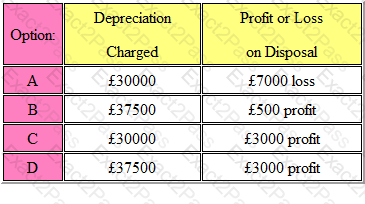
Your organization bought a machine for £50,000 at the beginning of year 1, which had an expected useful life of four years and an expected residual value of £10,000; the machine was depreciated on the straight-line basis.
At the beginning of year 4, the machine was sold for £13,000
The total amount of depreciation charged to the income statement over the life of the machine, and the amount of profit or loss on disposal was:
The answer is:
JW ' s debits total £10,502 for this period. JW ' s credits total £8,940.
What amount does JW ' s accountant need to include in the company ' s suspense account to make the transactions balance?
Which of the following is the best definition of the objective of accounting?

