Spring Sale Special Limited Time 70% Discount Offer - Ends in 0d 00h 00m 00s - Coupon code: buysanta

Exact2Pass Menu

Fundamentals of Ethics, Corporate Governance and Business Law

Last Update 5 hours ago Total Questions : 661

The Fundamentals of Ethics, Corporate Governance and Business Law content is now fully updated, with all current exam questions added 5 hours ago. Deciding to include BA4 practice exam questions in your study plan goes far beyond basic test preparation.

You'll find that our BA4 exam questions frequently feature detailed scenarios and practical problem-solving exercises that directly mirror industry challenges. Engaging with these BA4 sample sets allows you to effectively manage your time and pace yourself, giving you the ability to finish any Fundamentals of Ethics, Corporate Governance and Business Law practice test comfortably within the allotted time.

Question # 46

Which of the following statements is INCORRECT?

A.

The ratio decidendi is the legal principle underpinning the decision of the court.

B.

When a court departs from a previous decision on the basis of different material facts the court is said to have “distinguished” the case.

C.

If an appellate court reaches a different decision to the court which first heard the case, the decision is said to have been “reversed”.

D.

Obiter dicta of the Supreme Court is binding on all lower courts.  

Question # 47

Wye has borrowed £10,000 from Exe and the loan has now become repayable in full.  Exe has received a cheque from Wye for £9,000 stated to be “in full and final settlement of the loan.” What is the position if Exe cashes the cheque?

(i) Exe will have accepted £9,000 in full and final settlement and will not be able to claim the other £1,000 from Wye.

(ii) Exe is legally entitled to cash the cheque and pursue Wye for the balance of £1,000.

(iii) Exe will have accepted £9,000, but at law payment of less than the amount due cannot satisfy the full debt. 

A.

(i) only

B.

(ii) only

C.

(iii) only

D.

(ii) and (iii) only

Question # 48

Which of the following statements is correct following the enactment of the Companies Act 2006?

(i) A public company must hold an annual general meeting within six months of the end of its accounting reference date.

(ii) A private company is no longer required to hold an annual general meeting.

(iii) A private company must give 21 days ' notice of a general meeting. 

A.

(i) and (ii) only

B.

(ii) and (iii) only

C.

(i) and (iii) only

D.

(i), (ii) and (iii)

Question # 49

Which of the following statements is correct?

A.

The question as to whether a worker is an employee or an independent contractor is one of law.

B.

The question as to whether a worker is an employee or an independent contractor is one of fact.

C.

The question as to whether a worker is an employee or an independent contractor is one of fact and law.

D.

Whether a worker is an employee or an independent contractor depends entirely on the application of the control test.

Question # 50

Which of the following is correct?

A.

In England the government cannot make law without the authority of Parliament.

B.

In England the government can pass a law overruling any Act of Parliament.

C.

In England the government is not bound by the law.

D.

In England the government may delegate authority to a local authority to make law.

Question # 51

You work for an oil company and your company is negotiating a contract with the government of another country. During the course of the negotiations, your managing director has run up a very substantial expenses bill for entertaining personnel from the country ' s government. This scenario suggests which TWO of the following ethical issues?

A.

Harassment

B.

Data protection

C.

Gifts and hospitality

D.

Bribery and corruption

Question # 52

Which of the following statements is TRUE in relation to ethical dilemmas?

A.

They can be difficult to spot, since they are not always obvious

B.

Inaction or silence is often the best way of dealing with them

C.

Professional accountants can be disciplined for encountering them

D.

They can relate to someone ' s personal life, or professional life, but not both at the same time

Question # 53

Immediately before being placed in creditors voluntary liquidation, Tom, the sole director of Bee Ltd, arranged for the company to make an early repayment of an unsecured loan made to Bee Ltd by his wife Anne. Which of the following is correct?

A.

The company has acted in breach of fiduciary duty and can be made liable up to the amount of the loan.

B.

The company has given a " preference " to Anne, and the court may make any order it thinks fit to restore the position to what it was before Anne was repaid.  

C.

The company has entered into a " transaction at an undervalue " with Anne, and the court may fine or imprison Tom.

D.

The transaction amounts to " wrongful trading " and Tom may be held personally liable up to the amount of the loan.    

Question # 54

Natthapong ' s toilet won ' t flush, so he hires a plumber to come over and fix it.

He tells the plumber what the problem is, and the plumber agrees to fix it.

However, once the builder supposedly finishes the job, Natthapong finds that it still won ' t flush.

Is he able to terminate the contract?

A.

Yes - The plumber did not fix the toilet and so the offer cannot be accepted.

B.

Yes - He is able to terminate the contract at any time, even if the plumber did fix the toilet.

C.

No - Once he ' s offered the plumber the job he is unable to terminate the contract.

D.

No - Even if the plumber hasn ' t fixed the toilet he has still given up his time and effort and should therefore be paid.

Question # 55

Which of the following is INCORRECT in relation to corporate governance in the UK?

A.

Corporate governance is primarily concerned with the ability to control the activities of board of directors of listed public limited companies.

B.

The majority of shares in listed public companies are usually held by the board so that independent shareholders have insufficient power to exercise control over the board.

C.

Listed public companies in the UK are required to disclose in their annual reports the extent to which they have complied with the requirements of corporate governance.

D.

The UK Corporate Governance Code contains codes of best practice which do not have the force of law.  

Question # 56

P is an accountant working in a business Which of the following circumstances might create a self-interest threat for P in her professional role?

A.

A client is threatening P ' s dismissal over a disagreement about the review of accounting policies

B.

P is concerned over her employment security

C.

P is required to review data after previously being involved in its preparation

D.

The company is being threatened by litigation

Question # 57

B is employed by Zed plc and has suffered an occupational injury.


Which of the following is correct?


Zed plc may be liable to B for:

i. breach of an implied term in B ' s contract of employment

ii. breach of the duty to take care in the tort of negligence

iii. breach of statutory duty

A.

(i) only

B.

(ii) only

C.

(iii) only

D.

(i), (ii) and (iii)

Question # 58

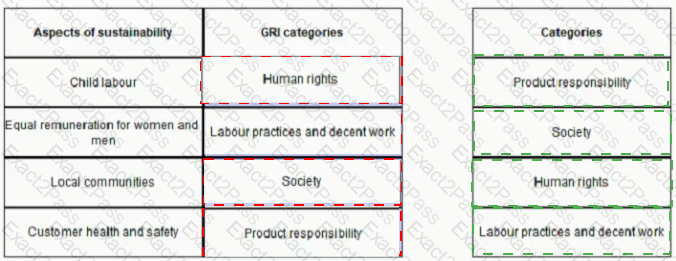
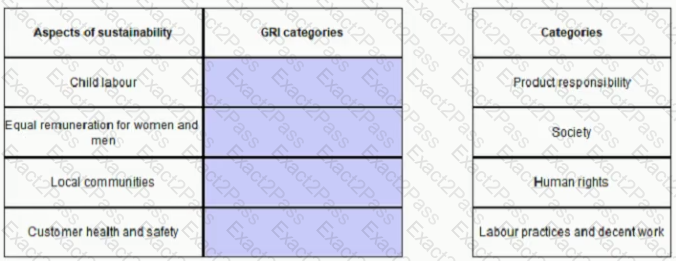
The Global Reporting Initiative (GRI) has produced Sustamability Reporting Guidelines, setting out categories and aspects which should be addressed through sustainable reporting.

Place the GRI categories next to the appropriate aspect of sustamability below.
Question # 59

High profile corporate scandals in the past decade have had an effect on which of the following?

A.

Public trust in business

B.

Legislation in the US and elsewhere

C.

Public trust in accountants

D.

All of the above

Question # 60

Which of the following is CORRECT?

(i) A company registered today may restrict its ability to contract by including a provision to that effect in its articles of association.

(ii) A company which was registered before the Companies Act 2006 came into force may pass a special resolution to remove its objects clause from its memorandum of association.

(iii) If the directors ignore any restriction on the company’s ability to contract they may be sued for breach of duty by the company.


A.

(i) only

B.

(ii) only

C.

(i) and (iii) only

D.

(i), (ii) and (iii)

Go to page: