Exact2Pass

Last Update 10 hours ago Total Questions : 184
The Conducting Forensic Analysis and Incident Response Using Cisco CyberOps Technologies (CBRFIR v1.2) content is now fully updated, with all current exam questions added 10 hours ago. Deciding to include 300-215 practice exam questions in your study plan goes far beyond basic test preparation.
You'll find that our 300-215 exam questions frequently feature detailed scenarios and practical problem-solving exercises that directly mirror industry challenges. Engaging with these 300-215 sample sets allows you to effectively manage your time and pace yourself, giving you the ability to finish any Conducting Forensic Analysis and Incident Response Using Cisco CyberOps Technologies (CBRFIR v1.2) practice test comfortably within the allotted time.
An engineer is investigating a ticket from the accounting department in which a user discovered an unexpected application on their workstation. Several alerts are seen from the intrusion detection system of unknown outgoing internet traffic from this workstation. The engineer also notices a degraded processing capability, which complicates the analysis process. Which two actions should the engineer take? (Choose two.)
What is an issue with digital forensics in cloud environments, from a security point of view?
Which type of record enables forensics analysts to identify fileless malware on Windows machines?
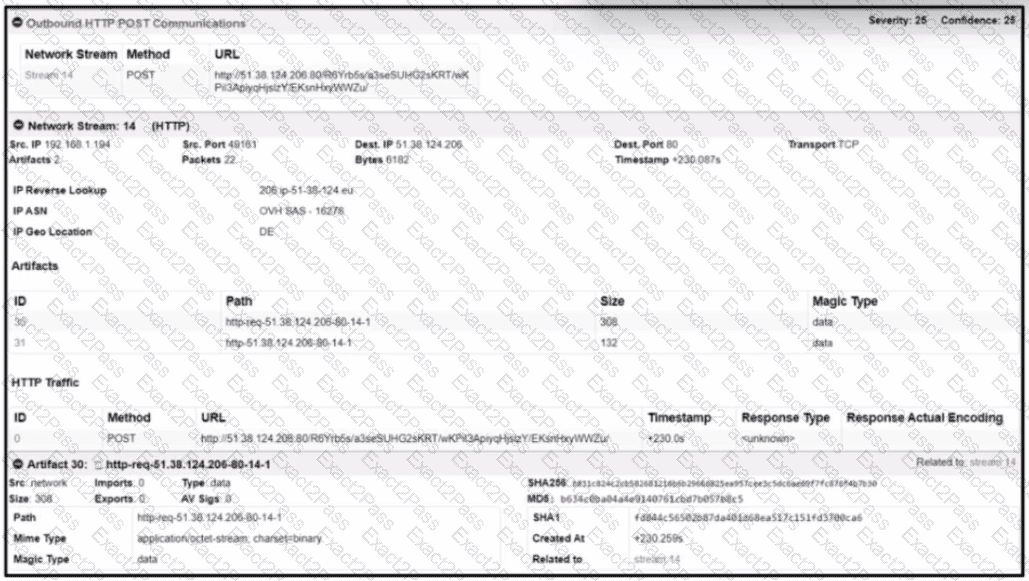
Which tool conducts memory analysis?
Refer to the exhibit.

What does the exhibit indicate?
Refer to the exhibit.
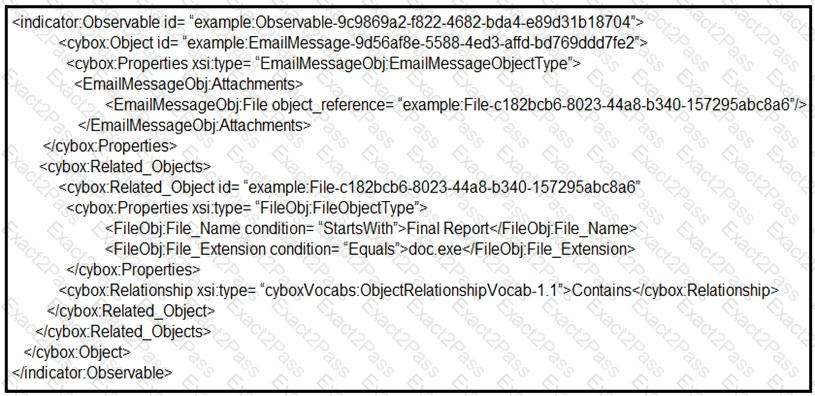
Which determination should be made by a security analyst?
A scanner detected a malware-infected file on an endpoint that is attempting to beacon to an external site. An analyst has reviewed the IPS and SIEM logs but is unable to identify the file’s behavior. Which logs should be reviewed next to evaluate this file further?
An investigator is analyzing an attack in which malicious files were loaded on the network and were undetected. Several of the images received during the attack include repetitive patterns. Which anti-forensic technique was used?

