
Spring Sale Special Limited Time 70% Discount Offer - Ends in 0d 00h 00m 00s - Coupon code: buysanta

Exact2Pass Menu

Fortinet NSE 7 - Enterprise Firewall 7.0

Last Update 4 hours ago Total Questions : 163

The Fortinet NSE 7 - Enterprise Firewall 7.0 content is now fully updated, with all current exam questions added 4 hours ago. Deciding to include NSE7_EFW-7.0 practice exam questions in your study plan goes far beyond basic test preparation.

You'll find that our NSE7_EFW-7.0 exam questions frequently feature detailed scenarios and practical problem-solving exercises that directly mirror industry challenges. Engaging with these NSE7_EFW-7.0 sample sets allows you to effectively manage your time and pace yourself, giving you the ability to finish any Fortinet NSE 7 - Enterprise Firewall 7.0 practice test comfortably within the allotted time.

Question # 21

What is the diagnose test application ipsmonitor 99 command used for?

A.

To enable IPS bypass mode

B.

To provide information regarding IPS sessions

C.

To disable the IPS engine

D.

To restart all IPS engines and monitors

Question # 22

An administrator is running the following sniffer in a FortiGate:

diagnose sniffer packet any “host 10.0.2.10” 2

What information is included in the output of the sniffer? (Choose two.)

A.

Ethernet headers.

B.

IP payload.

C.

IP headers.

D.

Port names.

Question # 23

In which two states is a given session categorized as ephemeral? (Choose two.)

A.

A TCP session waiting for FIN ACK

B.

A UDP session with packets sent and received

C.

A UDP session with only one packet received

D.

A TCP session waiting for the SYN ACK

Question # 24

Which two statements about bulk configuration changes made using FortiManager CLI scripts are correct? (Choose two.)

A.

When run on the Device Database, you must use the installation wizard to apply the changes to the managed FortiGate device.

B.

When run on the Remote FortiGate directly, administrators do not have the option to review the changes prior to installation.

C.

When run on the All FortiGate in ADOM, changes are automatically installed without the creation of a new revision history.

D.

When run on the Policy Package, ADOM database, changes are applied directly to the managed FortiGate device.

Question # 25

View the global IPS configuration, and then answer the question below.
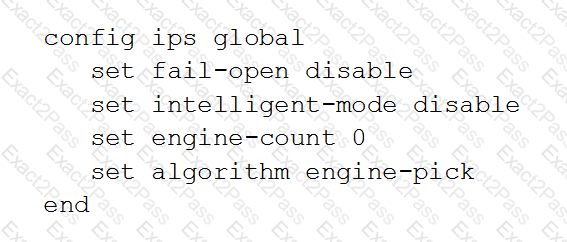
Which of the following statements is true regarding this configuration?

A.

IPS will scan every byte in every session.

B.

FortiGate will spawn IPS engine instances based on the system load.

C.

New packets will be passed through without inspection if the IPS socket buffer runs out of memory.

D.

IPS will use the faster matching algorithm which is only available for units with more than 4 GB memory.

Question # 26

The logs in a FSSO collector agent (CA) are showing the following error:

failed to connect to registry: PIKA1026 (192.168.12.232)

What can be the reason for this error?

A.

The CA cannot resolve the name of the workstation.

B.

The FortiGate cannot resolve the name of the workstation.

C.

The remote registry service is not running in the workstation 192.168.12.232.

D.

The CA cannot reach the FortiGate with the IP address 192.168.12.232.

Question # 27

Refer to the exhibit, which contains partial output from an IKE real-time debug.
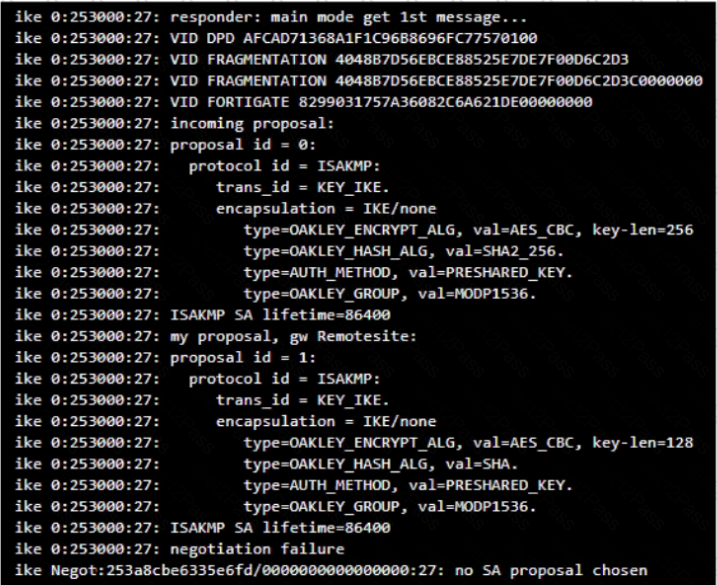
Why did the tunnel not come up?

A.

The local gateway has configured less secure encryption and hashing algorithms compared to the remote gateway.

B.

The Diffie-Hellman group does not match on the local and remote gateways.

C.

The proposal ID does not match between local and remote gateways.

D.

The encapsulation method for phase 2 is set to none on local and remote gateways.

Question # 28

Which configuration can be used to reduce the number of BGP sessions in an IBGP network?

A.

Neighbor range

B.

Route reflector

C.

Next-hop-self

D.

Neighbor group

Question # 29

What are two functions of automation stitches? (Choose two.)

A.

Automation stitches can be configured on any FortiGate device in a Security Fabric environment.

B.

An automation stitch configured to execute actions sequentially can take parameters from previous actions as input for the current action.

C.

Automation stitches can be created to run diagnostic commands and attach the results to an email message when CPU or memory usage exceeds specified thresholds.

D.

An automation stitch configured to execute actions in parallel can be set to insert a specific delay between actions.

Question # 30

Refer to the exhibit, which contains a CLI script configuration on FortiManager.
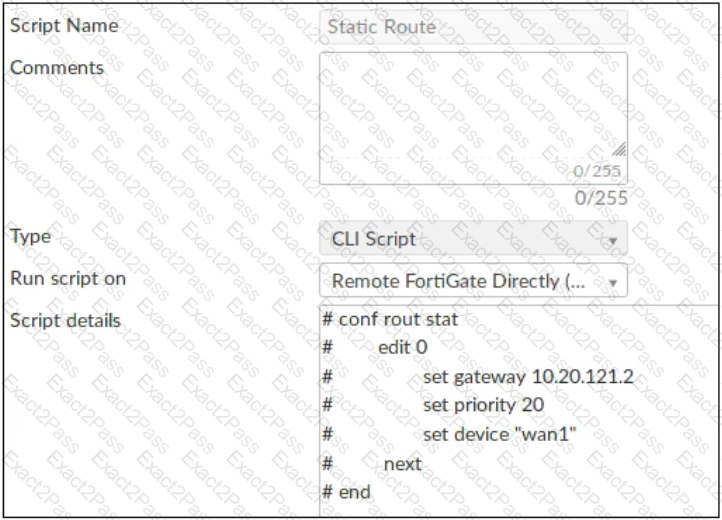
An administrator configured the CLI script on FortiManager, but the script failed to apply any changes to the managed device after being executed.

What are two reasons why the script did not make any changes to the managed device? (Choose two.)


A.

Static routes can be added using only TCL scripts.

B.

The commands that start with the # sign did not run.

C.

CLI scripts must start with #!.

D.

Incomplete commands can cause CLI scripts to fail.

Go to page: