Exact2Pass

Last Update 14 hours ago Total Questions : 379
The Designing Cisco Enterprise Networks content is now fully updated, with all current exam questions added 14 hours ago. Deciding to include 300-420 practice exam questions in your study plan goes far beyond basic test preparation.
You'll find that our 300-420 exam questions frequently feature detailed scenarios and practical problem-solving exercises that directly mirror industry challenges. Engaging with these 300-420 sample sets allows you to effectively manage your time and pace yourself, giving you the ability to finish any Designing Cisco Enterprise Networks practice test comfortably within the allotted time.
Refer to the exhibit. A company is expanding and decides to use a DMVPN solution to connect the branches. The network uses the EIGRP routing protocol. All remote branch routers must be configured with the normal EIGRP area. Auto-summary is not allowed on the routers in the network. Which solution must the company implement on R1 to achieve this goal?
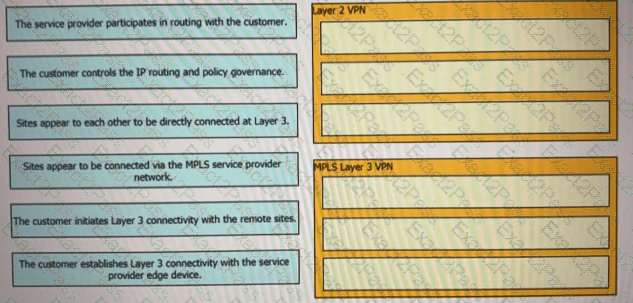
Drag and drop the descriptions from the left onto the corresponding VPN types on the rights.
When vEdge router redundancy is designed, which FHRP is supported?
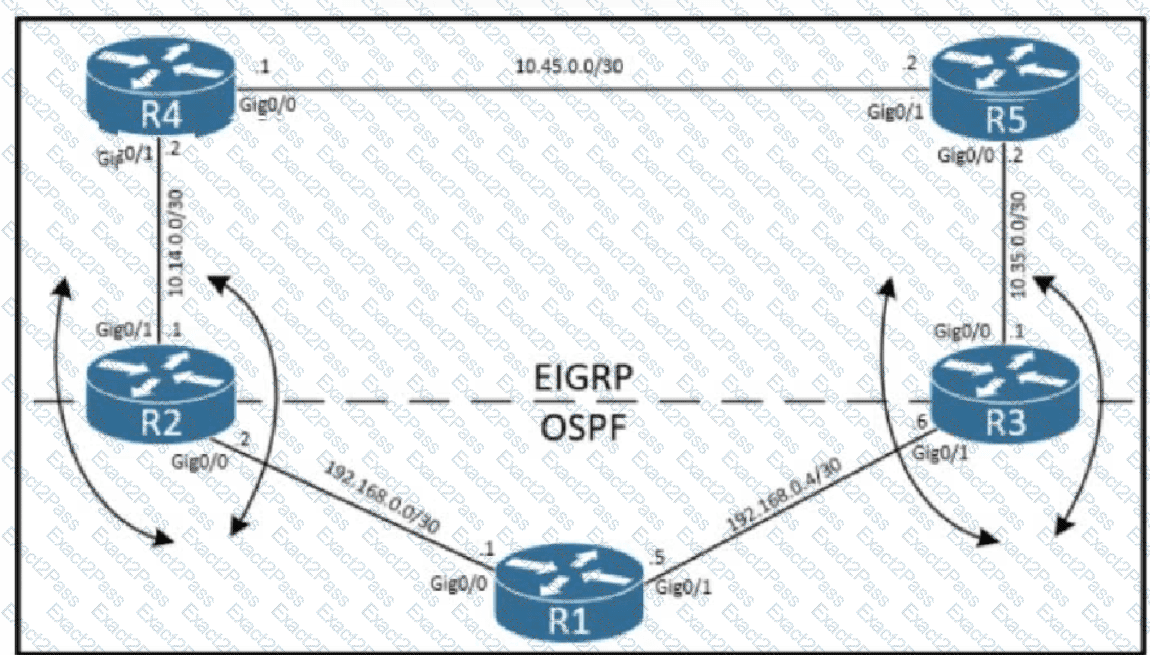
Refer to the exhibit. As part of a design review of redistribution, a client requested that R2 be preferred over R3 for traffic passing toward the EIGRP domain. Which method meets this design requirement?
Which control-plane technology allows the same subnet to exist across multiple network locations?
An engineer is designing a BGP network for a large customer. To permit efficient scaling, the BGP domain is split into clusters. Which peering solution should be used between the route reflectors in different clusters for the BGP routes to be propagated appropriately?
What is the purpose of a control plane node in a Cisco SD-Access network fabric?
Which two steps can be taken to improve convergence in an OSPF network? (Choose two.)
Mobile service provider “A” is going to launch 5G support with the ISP “B” IP network backbone as the underlay transport. Conversational traffic type will be marked with expedited forwarding class, streaming services will be marked with assured forwarding 2 class, and web browsing will be marked with assured forwarding 3 class. Which QoS model meets these requirements if the solution is to be implemented end to end on the ISP_B backbone network?
Refer to the exhibit. A mid-size company that produces media content has four offices across the country connected via MPLS Layer 3 service, which is provided by a local ISP. The network uses static routing. In anticipation of future growth, the engineering team must review and recommend design improvements in accordance with RFC 5340 requirements. The solution must optimize the routing table and reduce the number of routing updates exchanged between routers. The updated routing design must also be reliable and avoid routing loops. Which implementation meets the requirements?


